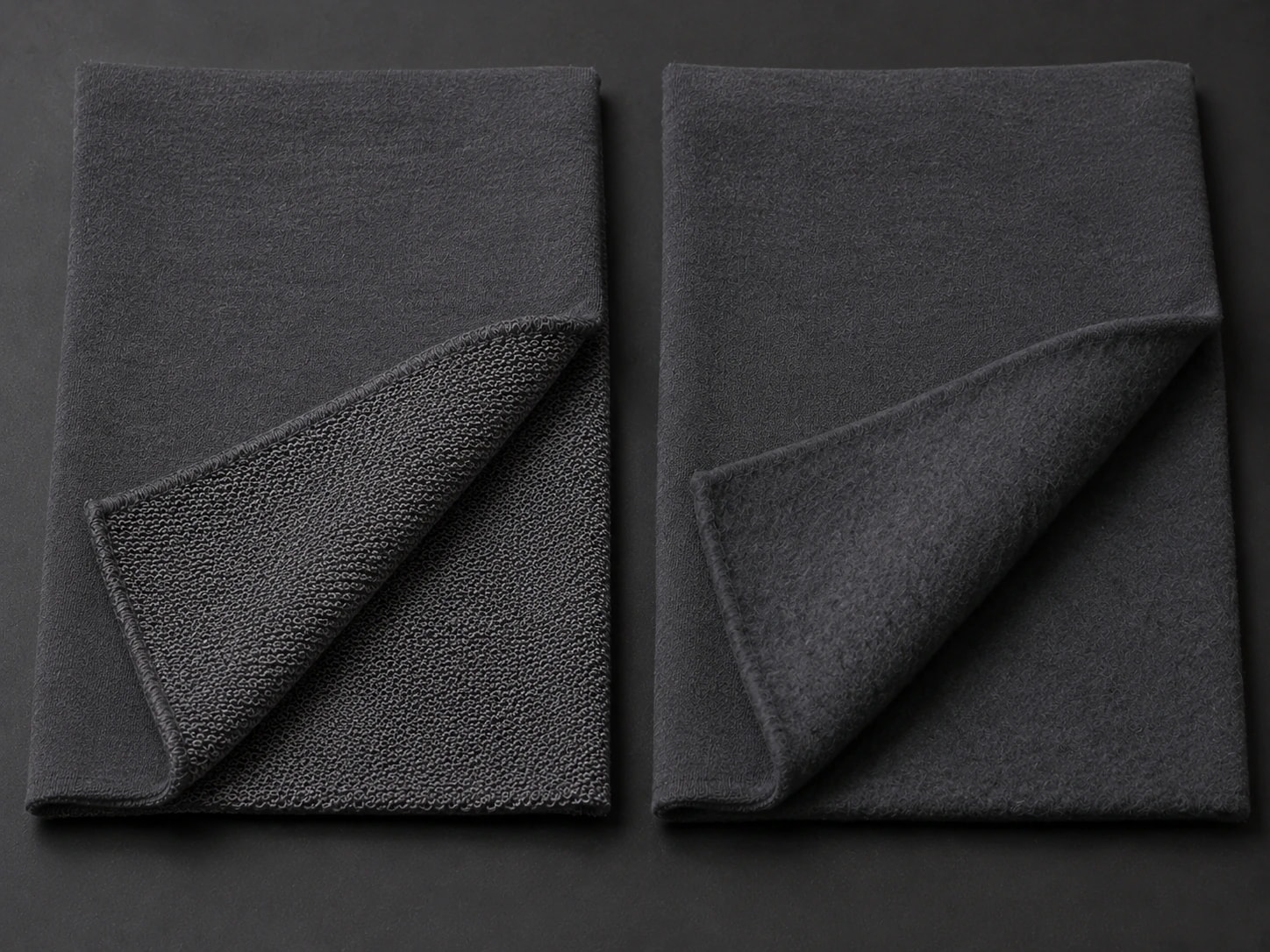
French Terry and Brushed Fleece can produce hoodies with a similar face but a very different reverse, wearing experience and production route. French Terry retains visible loopback yarns; Brushed Fleece raises those yarns into a soft, insulating nap.
Neither is universally better. A brand should choose according to sales climate, season, silhouette, finished GSM, fiber composition, decoration, wash effect and target price—not from the word “fleece” alone.
Answer in 30 seconds
- Choose French Terry for clearer structure, breathability, fine printing and broader seasonal use.
- Choose Brushed Fleece for a warmer, softer, loftier autumn-winter hoodie.
- At the same finished GSM and composition, Brushed Fleece is usually warmer—not heavier.
- Approve the complete washed garment; a small swatch cannot confirm fit, shrinkage, pilling or decoration.
What Is the Main Difference Between French Terry and Fleece?
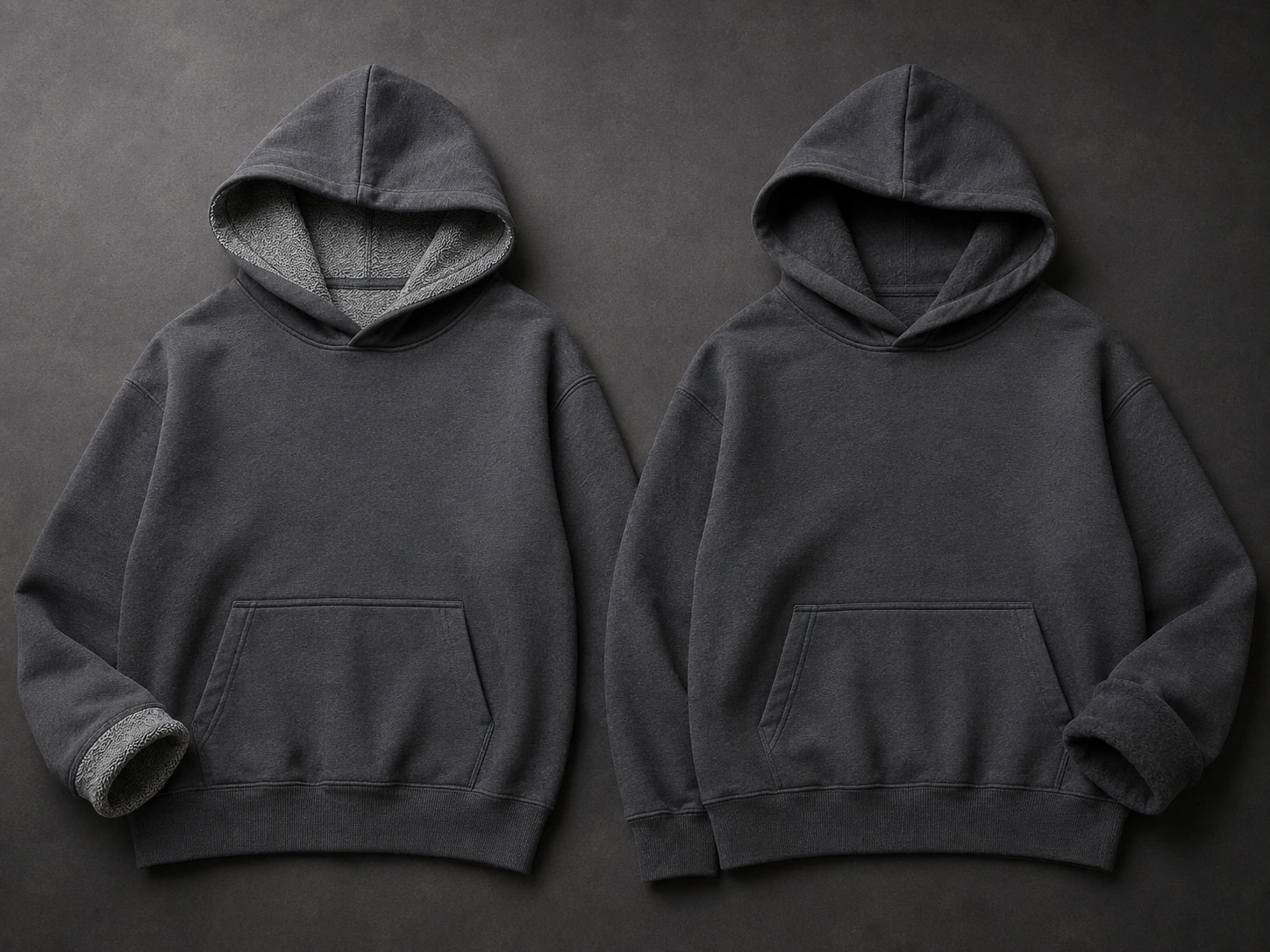
The fastest identification point is the reverse side. French Terry keeps a visible loop or curved inlay structure. Brushed Fleece has been mechanically brushed so the reverse yarns open into a continuous, fluffy surface. The face of both fabrics is normally much smoother, so face-only photos are not a reliable identification method.
| Performance | French Terry | Brushed Fleece |
|---|---|---|
| Visual thickness | Relatively compact | Visually and physically loftier |
| Weight at the same GSM | The same mass per square metre | The same mass per square metre |
| Wearing feel | Drier and lighter against the body | More enveloping and may feel heavier |
| Inside hand | Soft with a dry loopback character | Soft, warm and plush |
| Drape | Cleaner, more natural downward fall | More loft and less fluid drape |
| Breathability | Usually better | Usually lower |
| Warmth | Moderate | Clearly higher at comparable GSM and composition |
| Best seasons | Spring, autumn, four-season and mild climates | Autumn, winter and colder climates |
“Fleece” is a broad family that can also mean Polar Fleece, Sherpa Fleece, Microfleece, Coral Fleece, Bonded Fleece or Technical Fleece. Specify Brushed Fleece sweatshirt fabric, composition, finished GSM, face and reverse construction, color and finish.
How Are French Terry Loops and Brushed Fleece Nap Made?
French Terry loops are knitted into the fabric
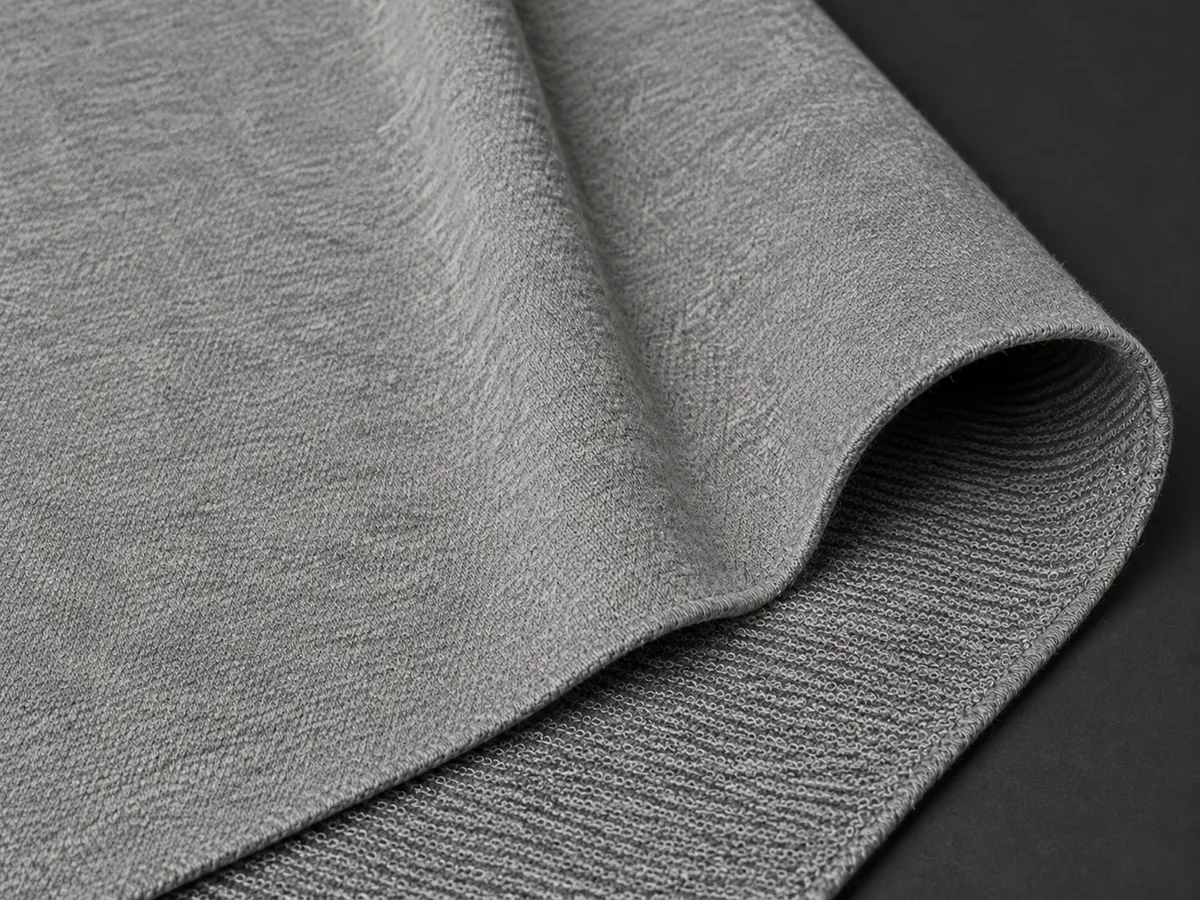
The reverse is not glued on. A circular knitting machine forms a relatively smooth face while an inlay or loop yarn creates longer floats or arcs on the reverse. Two-thread and three-thread sweatshirt structures are common; a three-thread construction can provide greater weight and stability for heavyweight French Terry. After dyeing, setting and pre-shrinking, the reverse remains identifiable.
Brushed Fleece adds a mechanical raising stage
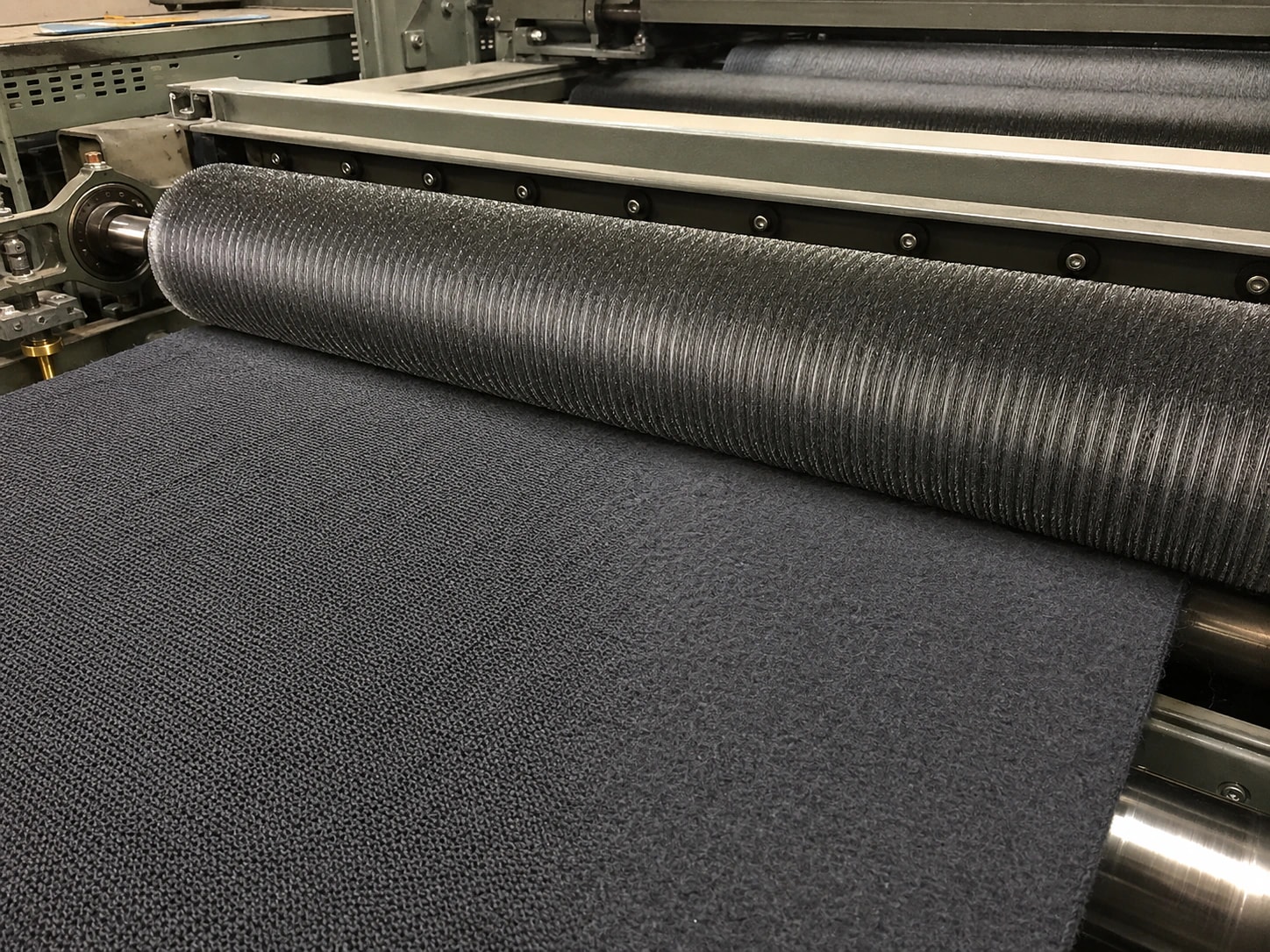
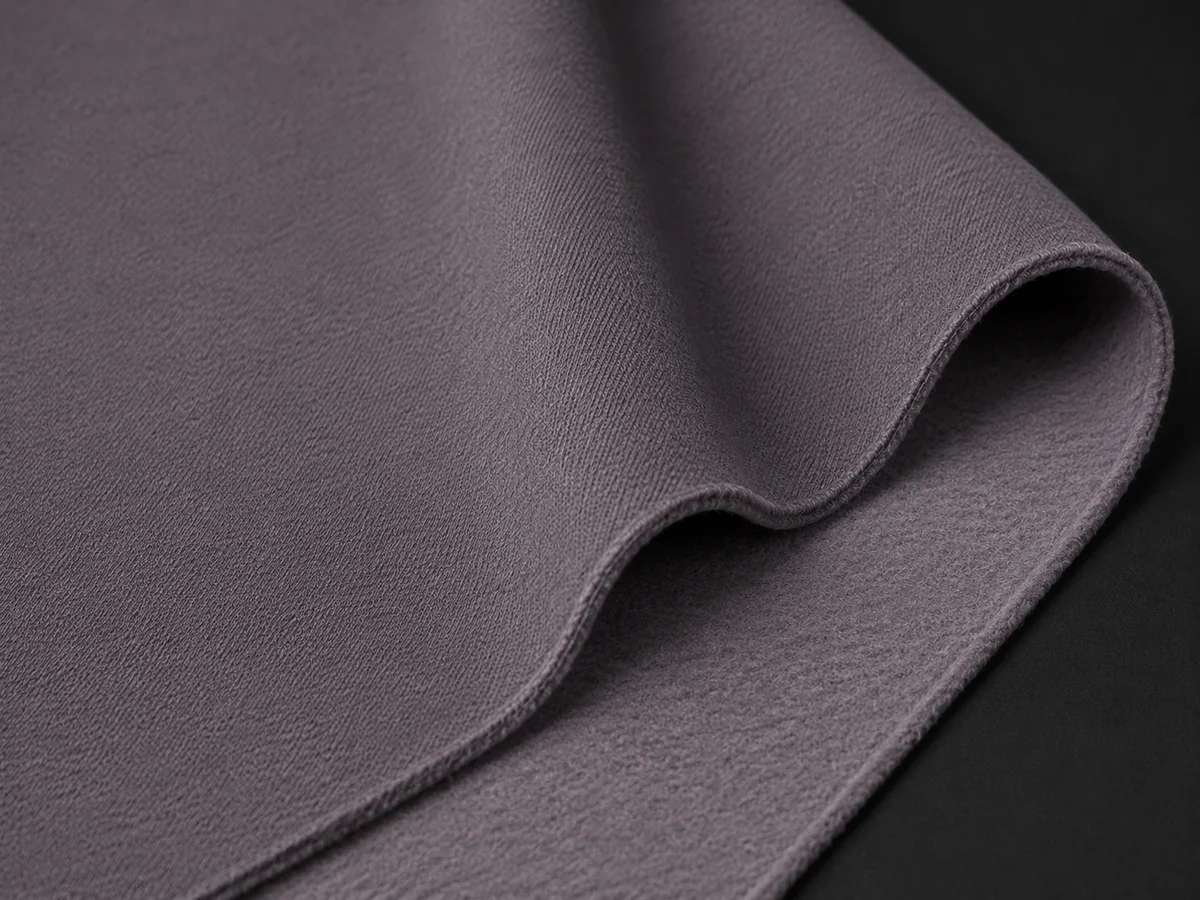
Brushed Fleece normally begins as a loopback or inlay sweatshirt fabric. Fine wire-covered rollers repeatedly comb the reverse and pull fibers from those yarns. Brushing passes, wire-card specification, back yarn and shearing determine pile length, density, softness, warmth, shedding and pilling. Light brushing may leave traces of the loops; heavy brushing creates a thicker, more continuous nap.
Is French Terry or Fleece Warmer?
Brushed Fleece is generally warmer when finished GSM and composition are comparable. Brushing does not add area weight by itself, but the lofted reverse traps more still air and slows heat loss. French Terry usually feels drier, releases heat faster and works across a broader climate range.
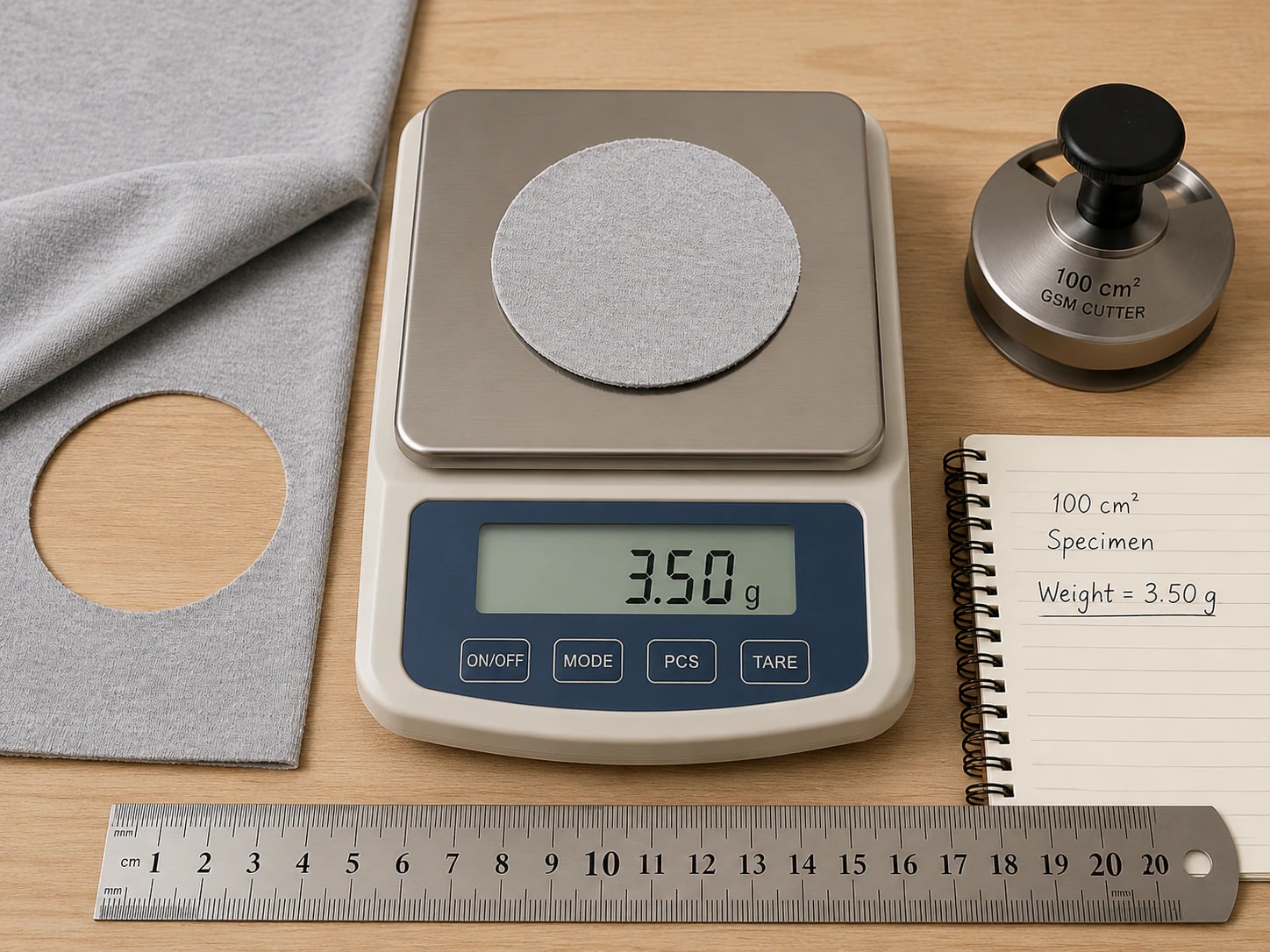
GSM alone cannot predict warmth. Fiber, knitting density, thickness, brushing level, fit, rib closure and garment finishing also change the result. A 300 GSM Brushed Fleece hoodie and a 300 GSM French Terry hoodie can weigh similarly per square metre while feeling substantially different on the body.
What GSM Is Best for French Terry and Fleece Hoodies?
KAOUYOU's broad working ranges are approximately 240–500 GSM for French Terry and 260–450 GSM for Brushed Fleece. Mainstream programs more often fall around 280–420 GSM and 280–380 GSM respectively. Compare only finished fabric after dyeing, setting and brushing; greige or pre-brush numbers from different suppliers are not directly comparable.
| Product direction | French Terry starting range | Brushed Fleece starting range |
|---|---|---|
| Warm-weather market | 240–300 GSM | Not usually the first choice; 260–280 GSM light brushing if needed |
| Four-season hoodie | 280–340 GSM | 280–320 GSM |
| Autumn-winter hoodie | 320–400 GSM | 300–380 GSM |
| Heavyweight streetwear | 380–450 GSM | 350–420 GSM |
| Ultra-heavy structured style | 450–500+ GSM | About 420–480 GSM |
How Does Fabric Composition Change the Hoodie?
| Composition direction | Main benefit | Main production consideration |
|---|---|---|
| 100% cotton | Natural hand, absorbency and breathability | Higher shrinkage and distortion risk; generally higher cost |
| CVC cotton-rich blend | Cotton hand with better wash and dimensional stability | Balanced direction for commercial and e-commerce programs |
| TC polyester-rich blend | Abrasion resistance, stability and lower cost | Less natural hand and usually lower breathability |
| Cotton blend with spandex | Improved stretch and recovery | Higher cost and tighter dyeing and dimensional-control requirements |
A brand should approve composition and construction together. “100% cotton” identifies fiber content; it does not prove yarn quality, knitting density, shrinkage, surface cleanliness or final hand. Review physical options through the fabric and trim development process.
Which Fabric Is Better for Regular, Boxy or Oversized Hoodies?
French Terry works across Regular, Relaxed, Boxy and Oversized fits and often creates a drier, cleaner outline. Brushed Fleece is particularly effective for Relaxed and Oversized autumn-winter hoodies. A thick, lofty fleece in a close Regular fit can feel hot and create underarm bulk.
A major change in thickness or stretch requires pattern review. Check chest and sleeve width, armhole ease, shoulder and sleeve-length balance, body length, hem proportion, hood capacity and opening, plus rib length, thickness and stretch ratio. Lofty fleece usually needs more internal space.
How Do Cutting and Sewing Requirements Differ?
Fleece production also needs more frequent lint removal. Needle, presser-foot pressure, differential feed, thread tension, cutting layers and seam construction should be set after testing the actual production fabric. The thicker the fabric, the more important real-bulk tests become at the hood, pocket, armhole, cuff and hem.
What Quality Problems Should a Brand Test?
French Terry risks include shrinkage, spirality, snagging and pulled loops. Brushed Fleece risks include shedding, pilling, uneven nap, interior matting and shrinkage. Before bulk, test pre-shrink performance, spirality, pilling, shedding and washed appearance, then approve the finished GSM and brushing level.
Garment dye, enzyme wash and vintage wash can soften both structures while increasing shrinkage, color variation and spirality. French Terry loops may loosen or become more visible. Fleece may become loftier, but excessive washing can increase shedding, pilling or matting. Strong processing can also reduce fabric strength and silhouette definition.
Which Is Better for Printing or Embroidery?
Both fabrics can normally support screen printing, DTG, DTF, puff print and embroidery. French Terry often has the more stable face for fine or large-area printing. If the face of a fleece fabric has more hair, print clarity and adhesion can decrease. Large DTF applications and high-density embroidery can make an already heavy hoodie rigid and uncomfortable.
Run the selected print, embroidery or wash technique on production-intent fabric, then wash and review it. A decoration test on a different stock fabric does not approve the final combination.
Is Brushed Fleece More Expensive? What About MOQ?
At the same GSM, composition, color and order quantity, Brushed Fleece is usually slightly more expensive because brushing, raising or shearing adds operations. As a factory planning reference, fabric processing may increase by roughly 5–15%, while the complete hoodie may increase by roughly 2–8%. Brushing passes, nap specification, waste and quantity determine the actual difference; these ranges are not a quotation.
French Terry stock selection is usually broader in black, white, grey and basic colors. Brushed Fleece stock is more seasonal, and unusual GSM or nap requirements may have fewer options. Custom dyeing commonly starts around 300–500 kg per color, depending on the mill. Stock fabric is more practical for small runs, testing and tight lead times; custom development suits larger orders with strict GSM, color, composition and hand requirements.
Which Fabric Should Your Brand Choose?
| Brand requirement | Practical starting direction |
|---|---|
| Warm sales region | French Terry, 240–300 GSM |
| Europe or North America autumn-winter | Brushed Fleece, 300–380 GSM |
| Premium heavyweight streetwear | French Terry, 380–500 GSM |
| Sport, commute or four-season wear | French Terry or light CVC Brushed Fleece, 280–320 GSM |
| Large-area print | Smooth-face French Terry |
| Large embroidery | High-density French Terry or stable mid-heavy Brushed Fleece |
| High dimensional-stability requirement | CVC French Terry or CVC Brushed Fleece |
| Cost-controlled first order | Stock CVC fabric in a basic color |
What Should Be Approved Before Sampling and Bulk Production?
- Approve the finished GSM, composition, physical hand swatch and color standard
- Develop and review the Fit Sample in the intended fabric direction
- Confirm the brushing level, reverse-side appearance and matching rib
- Test the selected print, embroidery, dye or wash technique
- Make the production-intent PP Sample with confirmed materials
- Test shrinkage, spirality, pilling, shedding, colorfastness and washed appearance
- Re-measure and review the washed garment, then approve it in writing
- Seal the approved reference and release bulk production
Common mistakes include approving only a small swatch, treating GSM as a complete quality grade, failing to define whether the number is pre-brush or finished, reusing a pattern after changing fabric, ignoring the rib, and approving color, pile or hand from photographs alone.
What Should a Brand Ask in a French Terry or Fleece RFQ?
- Is this French Terry, Brushed Fleece or another type of fleece?
- Is the quoted GSM measured after dyeing, setting and brushing?
- Which composition, yarn and sweatshirt construction are proposed?
- Which option best fits our market, season, silhouette and target price?
- Will the pattern, hood and rib be adjusted for the selected thickness and stretch?
- Is a suitable stock fabric available, or will custom dyeing be required?
- Which shrinkage, spirality, pilling, shedding and colorfastness tests will apply?
- Can our print, embroidery or wash be tested on the actual fabric?
- What changes in cost, MOQ and lead time should we expect?
These questions give a factory enough context to compare real material directions instead of quoting from one ambiguous word. If you are developing a hoodie collection, share your target market, fit, reference garment, fabric hand, color, decoration and estimated quantity in the KAOUYOU RFQ.
Frequently Asked Questions
What is the difference between French Terry and brushed fleece?
French Terry keeps visible loops or inlay floats on the reverse. Brushed Fleece starts with a similar sweatshirt construction, but the reverse is mechanically raised so those yarns become a continuous, fluffy nap. Their faces may look similar, so the reverse side is the fastest way to tell them apart.
Is French Terry warmer than fleece?
Usually no. At the same finished GSM and composition, Brushed Fleece is generally warmer because its raised nap traps more still air. French Terry is usually more breathable and suited to a wider seasonal range.
Which is better for hoodies: French Terry or fleece?
French Terry is often better for a clean, structured, printable or four-season hoodie. Brushed Fleece is often better when warmth, softness and an autumn-winter wearing experience are the priority. The correct choice depends on market, fit, composition, GSM, finish and target price.
What GSM is best for a French Terry hoodie?
A practical mainstream range is approximately 280–420 GSM. Around 280–340 GSM suits many four-season hoodies, 320–400 GSM supports autumn-winter products, and 380–500 GSM is used for intentionally heavyweight streetwear. These are finished-fabric starting points, not universal grades.
Does fleece always mean brushed sweatshirt fabric?
No. Fleece can also refer to polar fleece, sherpa fleece, microfleece, coral fleece, bonded fleece and technical fleece. A tech pack or quotation should state Brushed Fleece and include composition, finished GSM and the required surface and reverse-side construction.
Which hoodie fabric is better for printing?
A smooth, stable French Terry face is usually the safer direction for detailed or large-area printing. Brushed Fleece can also be printed, but face hair may reduce clarity or adhesion. Always test the selected decoration on production-intent fabric and wash it before approval.
Is Brushed Fleece more expensive than French Terry?
At the same composition, GSM, color and quantity, Brushed Fleece is usually slightly more expensive because brushing, raising or shearing adds processing. A factory planning reference is roughly 5–15% more for fabric processing and 2–8% more for the complete hoodie, but this is not a fixed quotation.
What should a brand approve before bulk hoodie production?
Approve the finished GSM, composition, hand, color, fit sample, brushing level, rib, shrinkage, spirality, pilling, shedding, colorfastness, decoration and final washed PP sample. The approved material and garment should be recorded in writing before bulk release.