AQL inspection uses a defined random sample to make an acceptance decision about a production lot. It does not mean that an AQL of 2.5 permits 2.5% major defects in every shipment, and it does not prove that every uninspected garment is defect-free.
Clothing brands should agree the standard, lot, inspection level, defect definitions, limits, product specification and reporting method before inspection. KAOUYOU uses AQL-based bulk inspection as part of its clothing quality-control process, while a client quality manual or appointed third-party plan takes priority when one is specified for the order.
Answer in 30 seconds
- AQL is a lot-acceptance tool, not a simple allowable-defect percentage.
- Lot size and inspection level lead to a sample size; the selected AQL then leads to Ac/Re numbers.
- General Level II is common in apparel, but the client’s standard and order risk decide the final plan.
- 100% garment checking finds individual problems; random sampling checks whether the offered lot is stable enough to accept.
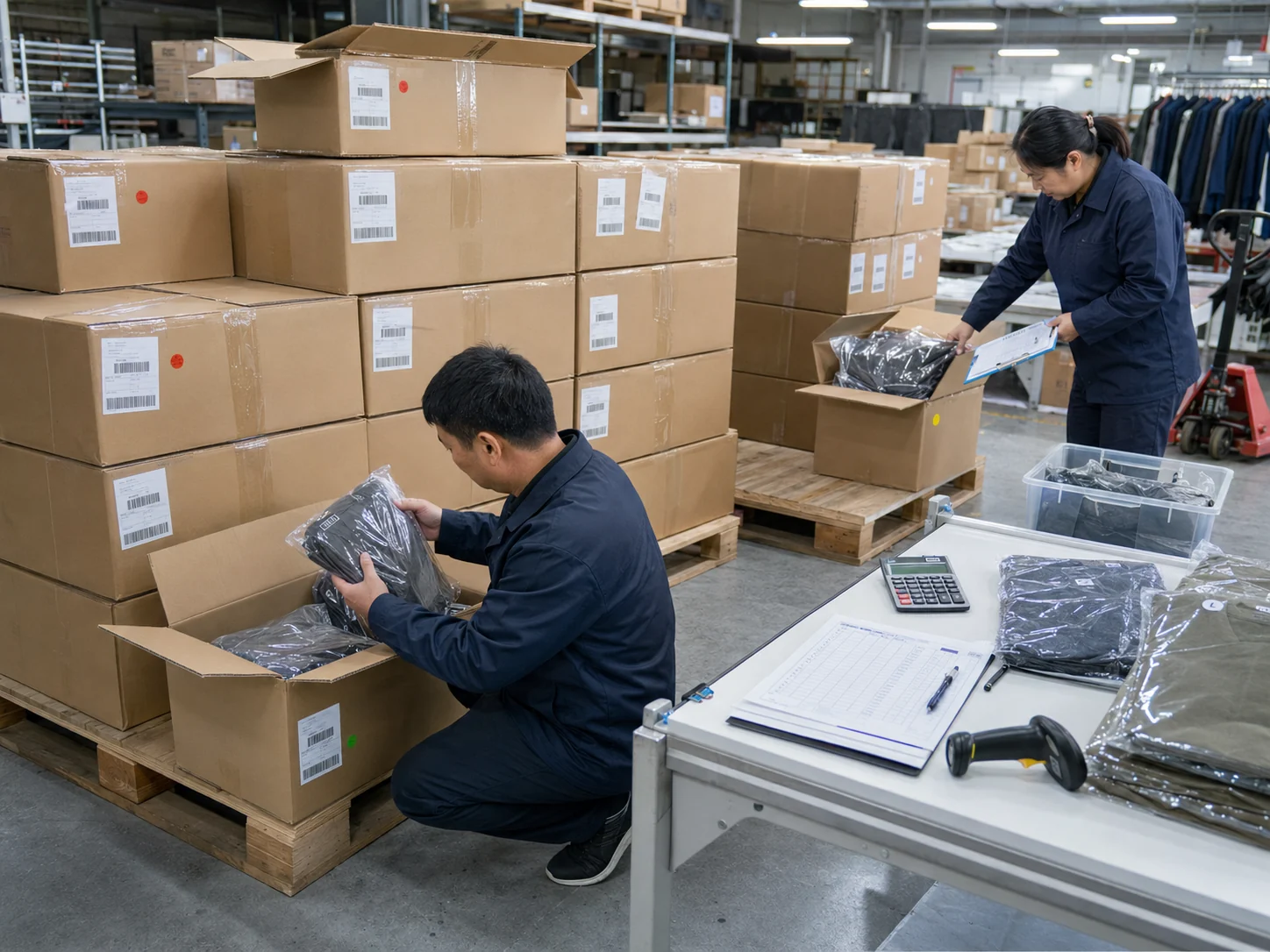
What Does AQL Mean in Clothing Inspection?
AQL means Acceptance Quality Limit. The current international standard, ISO 2859-1:2026, describes AQL-indexed sampling schemes for lot-by-lot inspection by attributes. ASQ lists ANSI/ASQ Z1.4-2003 (R2018) as its current attributes-sampling standard, with normal, tightened and reduced plans for a continuing stream of lots.
In practical apparel inspection, attributes are decisions such as conforming/nonconforming or counts assigned to agreed defect classes. Measurements may also be recorded as numerical results, but the lot-acceptance method, tolerances and counting rules still need to be named in the inspection instruction.
An AQL value is an index used with a sampling plan. It should not be converted into a statement such as “2.5% of the whole shipment may be major defects.” The actual decision uses the sample and the corresponding acceptance and rejection numbers.
Which Rules Control an Apparel AQL Inspection?
Three layers must remain separate. Mixing them is how a general example becomes an unsupported factory promise.
If a brand supplies its own quality manual, AQL limits or third-party inspection protocol, KAOUYOU adjusts the inspection scope to that documented requirement. A higher-risk style, first order, previous failure, changed lot or complex construction may also justify a different level or additional checks.
How Is an AQL Sampling Plan Built?
- Define the inspection lot and confirm that the offered goods meet the agreed completion and packing condition.
- Name the applicable standard, edition, sampling type and normal/tightened/reduced status.
- Select the inspection level stated by the client or justified by the order risk.
- Use the authorized standard table to obtain the sample-size code and sample quantity.
- Apply the agreed limit or zero-tolerance rule to each defect class and obtain its Ac/Re numbers.
- Select units randomly across the defined lot rather than choosing convenient or pre-screened pieces.
- Inspect against the approved product references, count results consistently and issue the lot decision.
| Input | What must be confirmed |
|---|---|
| Standard and edition | For example, the standard or customer quality manual named in the purchase agreement |
| Lot definition | Which finished units belong to the lot being offered for inspection |
| Inspection type | Single, double or multiple sampling, plus normal, tightened or reduced status where applicable |
| Inspection level | The level agreed for the order; General Level II is a common apparel starting point, not a universal rule |
| AQL or zero-tolerance rule | The limit assigned to each agreed defect class |
| Counting method | Whether the plan evaluates nonconforming units or nonconformities, and how repeated defects are counted |
| Product specification | Approved sample, Tech Pack, measurement tolerances, artwork, labels and packing requirements |
Do not copy a sample quantity from another order. A different lot boundary, inspection level, sampling status, standard edition or customer manual can change the required sample and decision numbers.
How Do Ac/Re Numbers Work? A Clearly Limited Example
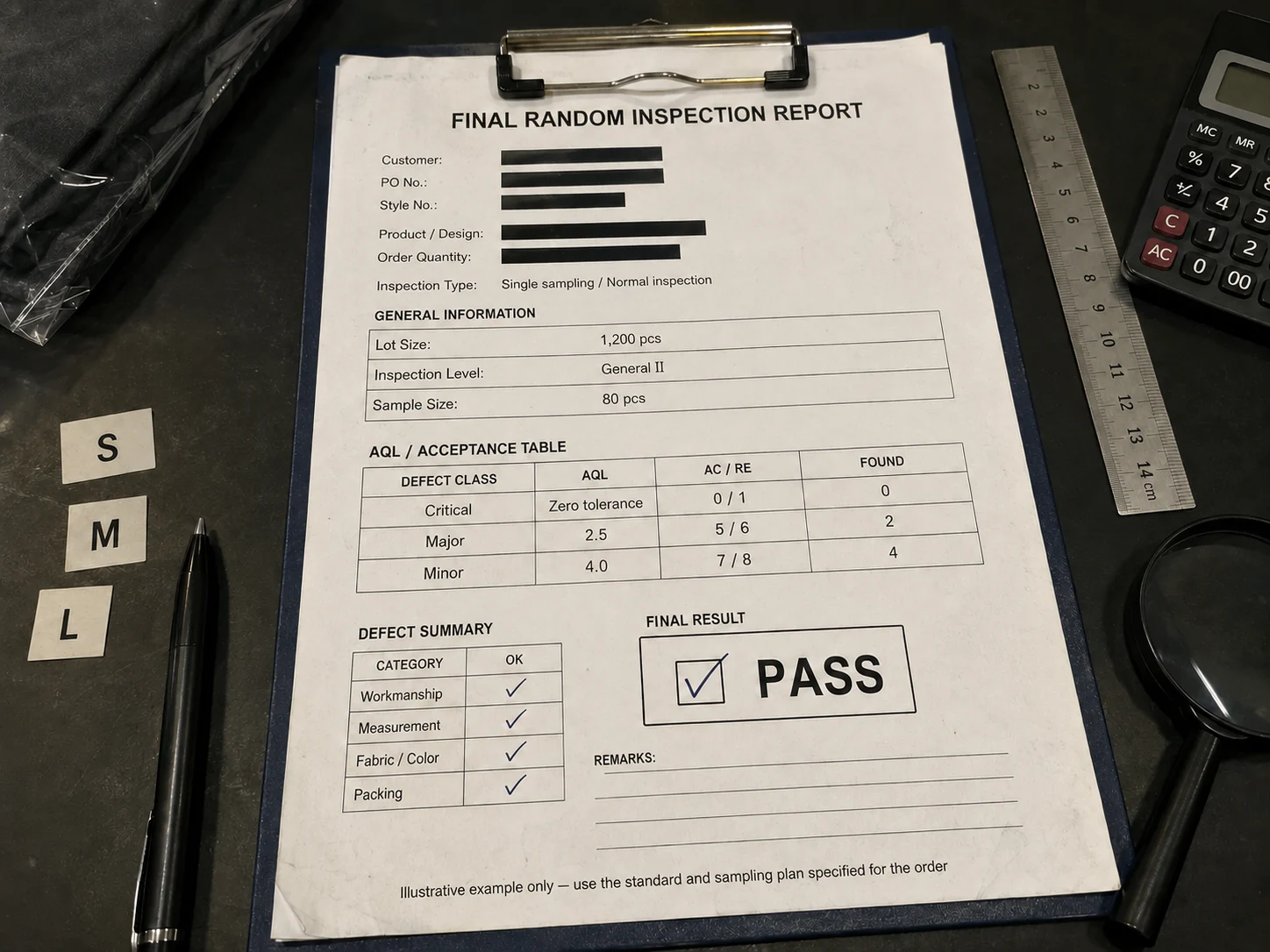
The following illustration uses a commonly referenced ANSI/ASQ Z1.4 single-sampling normal-inspection setup: a 1,200-piece lot, General Inspection Level II and an 80-piece sample. It shows zero tolerance for critical defects, AQL 2.5 for major defects and AQL 4.0 for minor defects. These inputs are an example only, not KAOUYOU’s automatic plan for every order.
| Defect class | Example requirement | Ac / Re | Found | Example outcome |
|---|---|---|---|---|
| Critical | Zero-tolerance requirement | 0 / 1 | 0 | Pass this class |
| Major | AQL 2.5 | 5 / 6 | 2 | Pass this class |
| Minor | AQL 4.0 | 7 / 8 | 4 | Pass this class |
In this illustration, two major and four minor findings remain below their respective rejection numbers, and no critical finding is present. The example therefore shows a pass for those classes. If major findings reached six, that class would reach the illustrated rejection number and the lot could not be released as a pass under this example.
The report must also define whether it counts nonconforming units or individual nonconformities. One garment can contain more than one issue, so inconsistent counting can change the decision. Always verify the exact values in the contracted standard or client table before inspection.
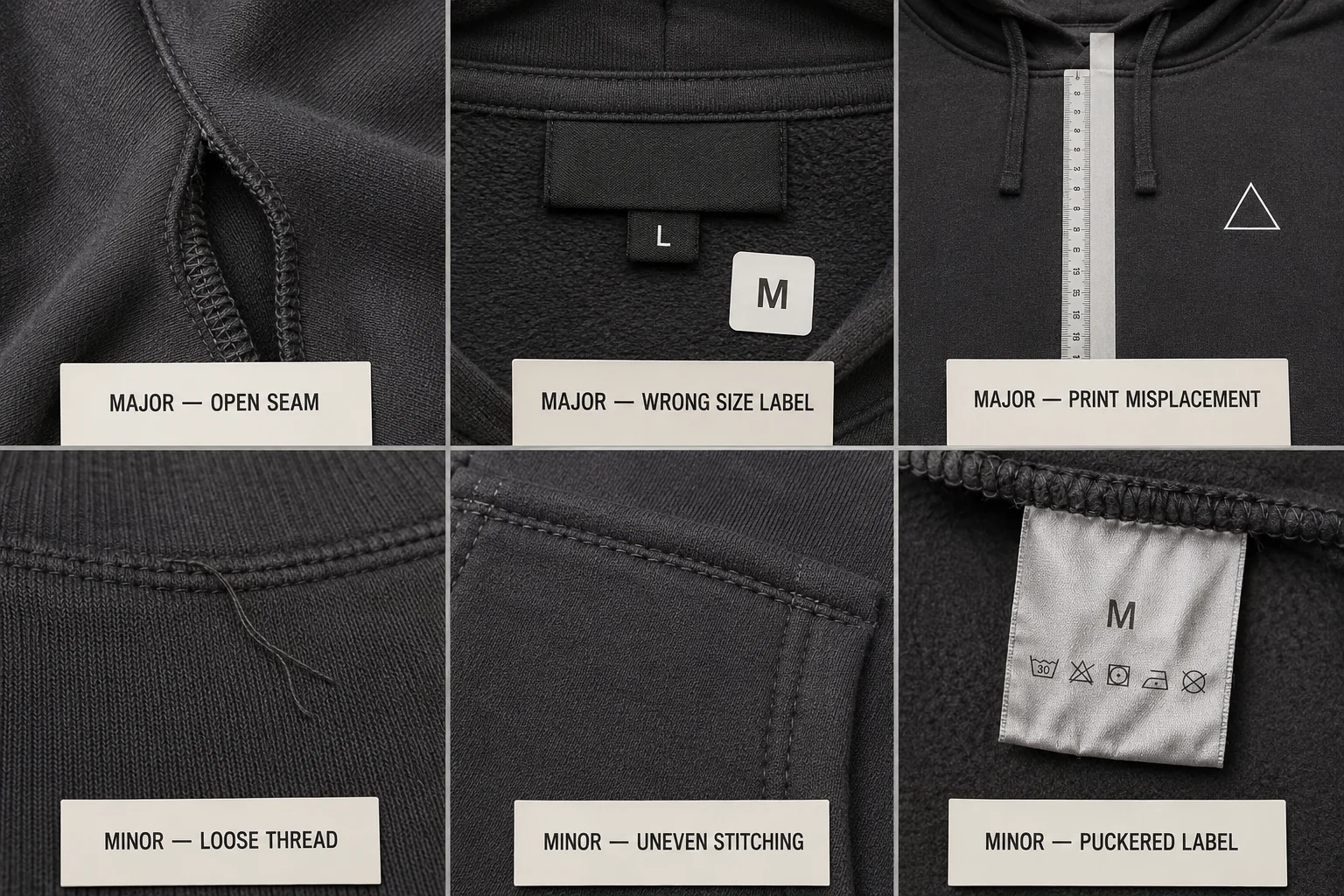
How Are Critical, Major and Minor Garment Defects Classified?
Severity depends on safety, legal requirements, product function, visibility, location, intended use and the client’s defect manual. The same physical issue can receive a different classification in a different position or product. A small mark inside a garment may be minor; the same mark in a prominent front position may be major.
| Class | Decision principle | Apparel examples |
|---|---|---|
| Critical | May create a safety, legal or severe-use risk | Sharp metal, a hazardous drawcord where regulated, missing mandatory safety information, severe contamination |
| Major | Materially affects use, function, appearance or saleability | Open seam, major measurement failure, non-working closure, wrong size label, clear print displacement, hole or prominent stain |
| Minor | Does not normally prevent use but falls below the agreed workmanship standard | Untrimmed thread, slight stitch variation, minor seam puckering or a small low-visibility appearance issue |
Critical issues require special care. A sharp object, unsafe component or missing mandatory information should not be treated as acceptable merely because a statistical sample is otherwise below a numeric limit. The brand should define product- and market-specific safety requirements before production.
Does AQL Replace 100% Final Garment Inspection?
No. The two activities answer different questions.
| Activity | Main purpose | Typical action | What it cannot prove alone |
|---|---|---|---|
| 100% final garment check | Find visible or functional problems on individual pieces | Separate, repair or remove affected garments | That the offered lot will satisfy a defined random-sampling decision |
| AQL final random inspection | Evaluate the consistency and acceptability of the defined lot from a random sample | Pass, hold or reject the offered lot under the agreed plan | That every uninspected garment is defect-free |
KAOUYOU carries out 100% final visual and workmanship checking before packing, covering appearance, sewing, stains, damage, decorations, labels and relevant closures or hardware. AQL-based random inspection is then used with client requirements to verify the bulk lot. Earlier checking can still miss issues, which is why the later random check remains useful.
How Should Garments Be Selected for AQL Inspection?
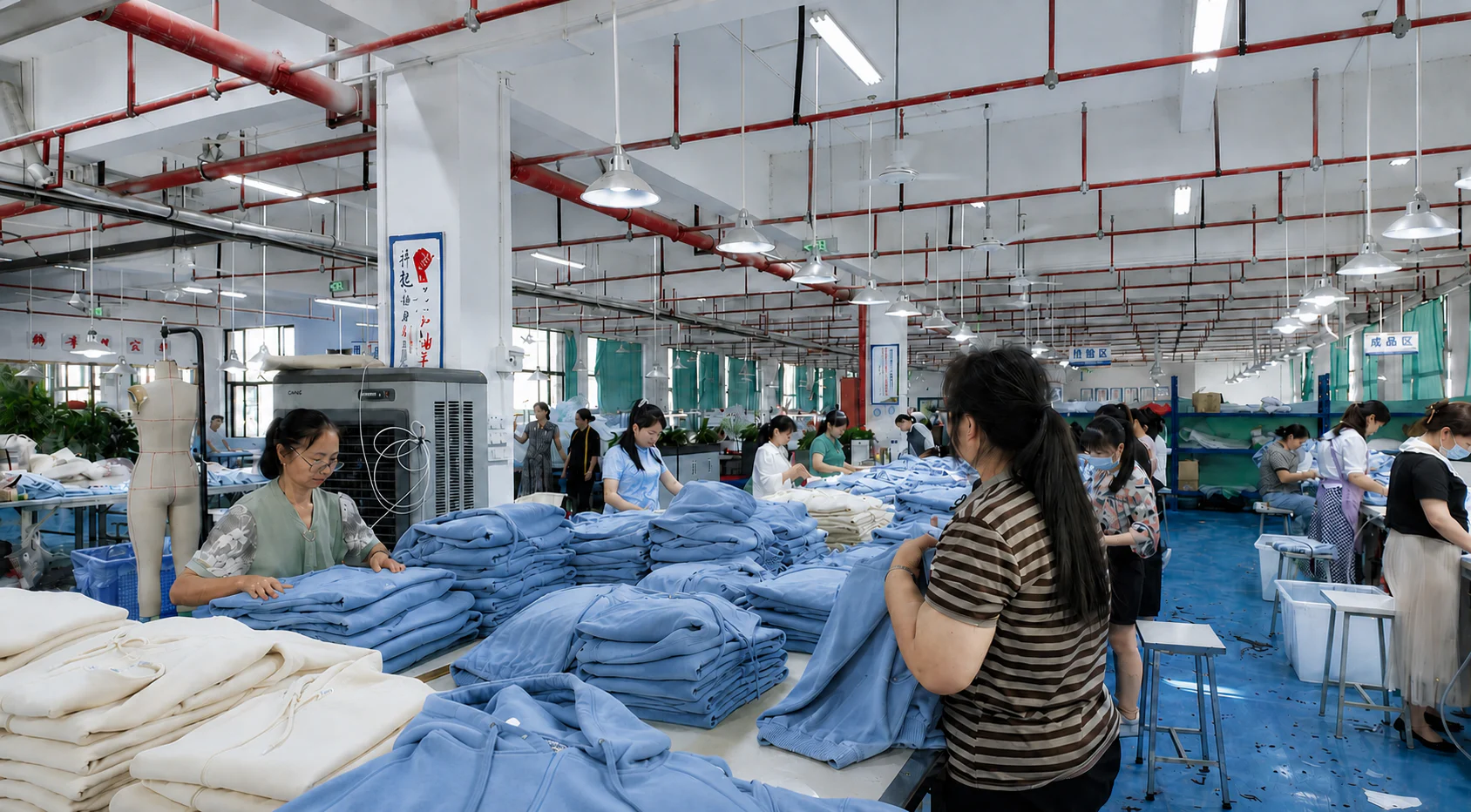
A random sample should represent the defined lot. Selection should reach different cartons, colors, sizes, bundles and production groups where they form part of the lot. Pulling only the easiest cartons or pieces prepared in advance undermines the purpose of the inspection.
Measurement sampling also needs coverage. KAOUYOU draws garments across relevant styles, colors, sizes, bundles and production batches according to the project plan. Because one sewing station commonly repeats the same operation across a bundle, repeated dimensional deviations may point to a pattern, marker, cutting, sewing, pressing, washing or shrinkage issue rather than an isolated garment.
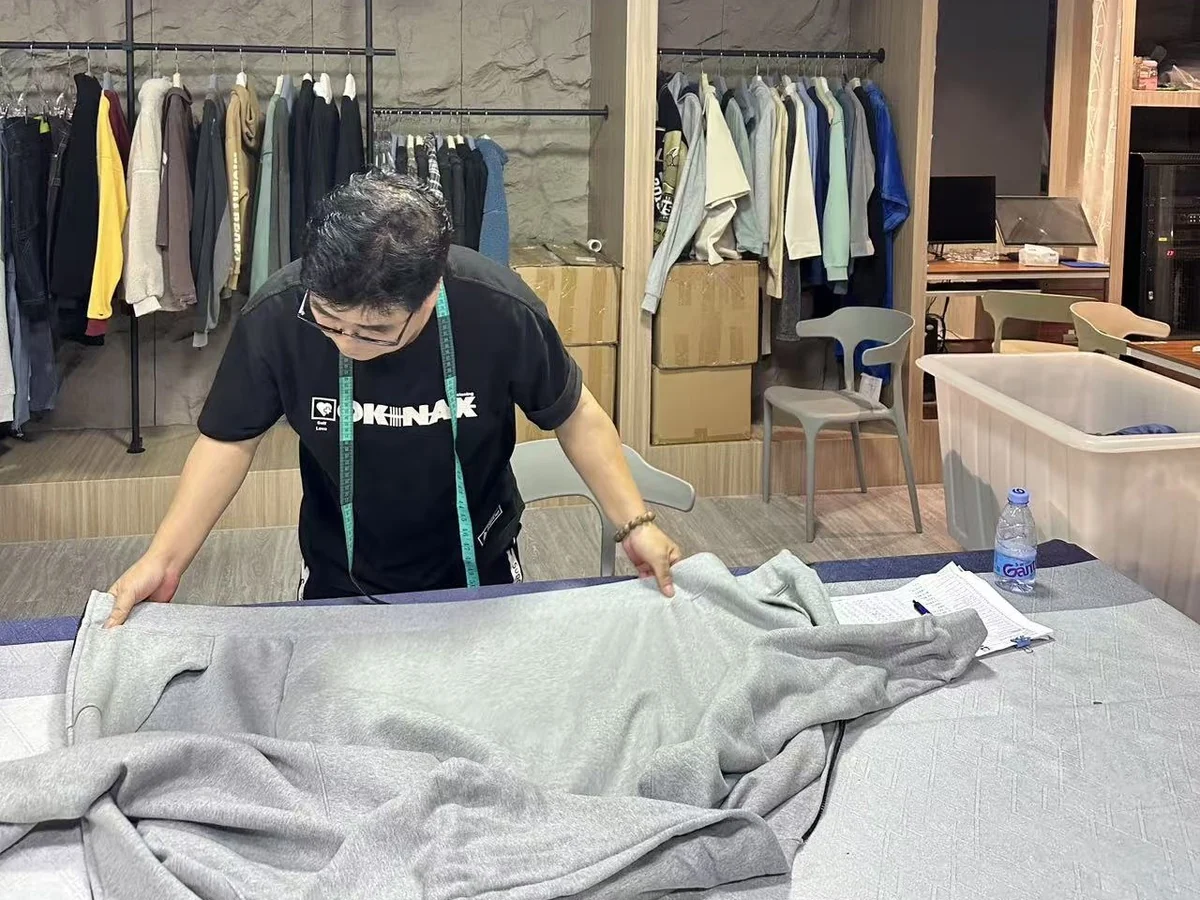
Expand the investigation beyond the sampled pieces. Check the pattern and grading, marker and cut panels, the operation performed by the same sewing station, seam take-up, pressing, wash process and the affected bundle or batch.
What Happens When an Apparel AQL Inspection Fails?
- Hold and identify the relevant lot, batch or bundles.
- Classify the findings and trace whether they originate in cutting, sewing, washing, decoration, finishing or packing.
- Expand the check where the evidence suggests a repeated or systematic problem.
- Rework correctable garments and remove products that cannot meet the approved requirement.
- Reinspect the repaired goods and the affected production range.
- Arrange a fresh random inspection or other agreed verification before packing release or shipment.
A failed sample is not solved by repairing only the selected pieces. If one bundle shares a dimensional error, one zipper batch is wrong or the same seam opens repeatedly, the investigation must cover the population that may share the cause.
What inspection evidence can KAOUYOU provide?
Depending on the order and agreed scope, available internal records can include:
- Internal inspection report
- Measurement inspection record
- Defect photographs and rework record
- Finished-garment appearance result
- Packing and carton spot-check record
- Fabric test or inspection report where applicable
A client may also supply its own report template. Records used externally are redacted where necessary to protect brand names, order numbers, pricing, quantities, supplier information and unreleased designs.
How does third-party inspection work at the factory?
Before the appointment, KAOUYOU can prepare the completed bulk goods, packing list, order information, final measurement chart, Tech Pack, approved PP Sample, approved materials and technique references, packed cartons, inspection area and measuring tools. The third-party inspector independently selects cartons and samples and makes the decision under the client’s plan. Factory staff may move cartons, open packages and explain product requirements, but do not control the inspector’s selection or result.
What Should a Clothing Brand Confirm Before Inspection?
- The named sampling standard and edition
- The inspection lot and minimum completion or packing condition
- Inspection level, sampling type and current inspection status
- Critical, major and minor definitions with product-specific examples
- AQL limits or zero-tolerance requirements for each class
- Approved PP Sample, Tech Pack and measurement tolerances
- Color, fabric, trims, artwork, labels and packing references
- Function, safety or market-specific checks
- Counting method, report format, photographs and record requirements
- Action required after a failed result and authority for shipment release
Share these requirements before quotation and production planning. A clear Tech Pack and an approved pre-production sample give the inspector concrete product references. If your brand has a quality manual or third-party inspection template, attach it to the KAOUYOU project RFQ so the sampling and reporting scope can be reviewed before the order reaches final inspection.
Authoritative standards referenced
- ISO 2859-1:2026 — current international standard for AQL-indexed lot-by-lot inspection by attributes.
- ANSI/ASQ Z1.4-2003 (R2018) — ASQ’s current listed attributes-sampling standard.
- ASQ overview of attributes and variables sampling — definitions and the role of acceptance-sampling plans.
Frequently Asked Questions
What does AQL mean in garment inspection?
AQL means Acceptance Quality Limit. It indexes an acceptance-sampling plan used to decide whether an inspection lot is accepted or not accepted from a random sample. It is not a promise that the shipment contains exactly that percentage of defects.
Is AQL 2.5 the same as allowing 2.5% major defects?
No. The selected standard uses the lot size, inspection level and sampling plan to produce a sample size and acceptance/rejection numbers. The inspector compares the observed count with those Ac/Re limits; the AQL number is not applied as a simple shipment percentage.
Which inspection level is normally used for clothing?
General Inspection Level II is a common starting point in apparel, but the contracted customer standard and the actual risk control the final level. A different level may be used for complex products, first orders, prior failures, changed scope or third-party inspection requirements.
Does AQL inspection replace 100% garment checking?
No. Piece-by-piece production checks find and correct individual problems. AQL sampling later tests whether the offered lot is sufficiently consistent for the agreed acceptance decision. One activity does not make the other unnecessary.
Does an AQL pass mean every garment is defect-free?
No. A sampling result is a lot-acceptance decision with statistical risk; it is not a certificate that every uninspected unit is perfect. Clear specifications, process control and in-line and final checks are still required.
Can a brand use different AQL limits for critical, major and minor defects?
Yes, when those limits and definitions are agreed before inspection. Many apparel briefs use zero tolerance for critical defects and separate AQLs for major and minor defects, but the buyer must specify the applicable rule instead of assuming one default works for every order.
What happens when an AQL inspection fails?
The affected lot or production group should be held while the cause and scope are investigated. Correctable goods may be reworked, the affected range may receive an expanded or full check, and a fresh inspection is arranged before release according to the agreed procedure.
Can KAOUYOU work with a third-party inspection company?
Yes. KAOUYOU can prepare the completed goods, packing list, final Tech Pack, approved PP Sample, quality references, inspection area and measurement tools. The appointed inspector selects cartons and samples independently and makes the decision under the client’s inspection plan.