A cargo pocket is not defined by a flap alone. Its body, pleat or gusset, opening, placement, closure, reinforcement and intended load work together. If a Tech Pack shows only an approximate rectangle, the factory must guess the proportion, volume and construction.
This guide explains how clothing brands should specify pockets when developing custom cargo pants and utility trousers—from the first reference image to an approved PP Sample and bulk inspection standard.
Answer in 30 seconds
- Choose pocket structure from its intended use and capacity, not appearance alone.
- Placement and scale must be redeveloped for Regular, Relaxed, Baggy and Wide-leg fits.
- Measure the pocket body, expansion, flap, opening and placement from named reference points.
- Approve the open, loaded, worn and washed pocket—not only a front-view photograph.
How Many Pockets Do Cargo Pants Normally Have?
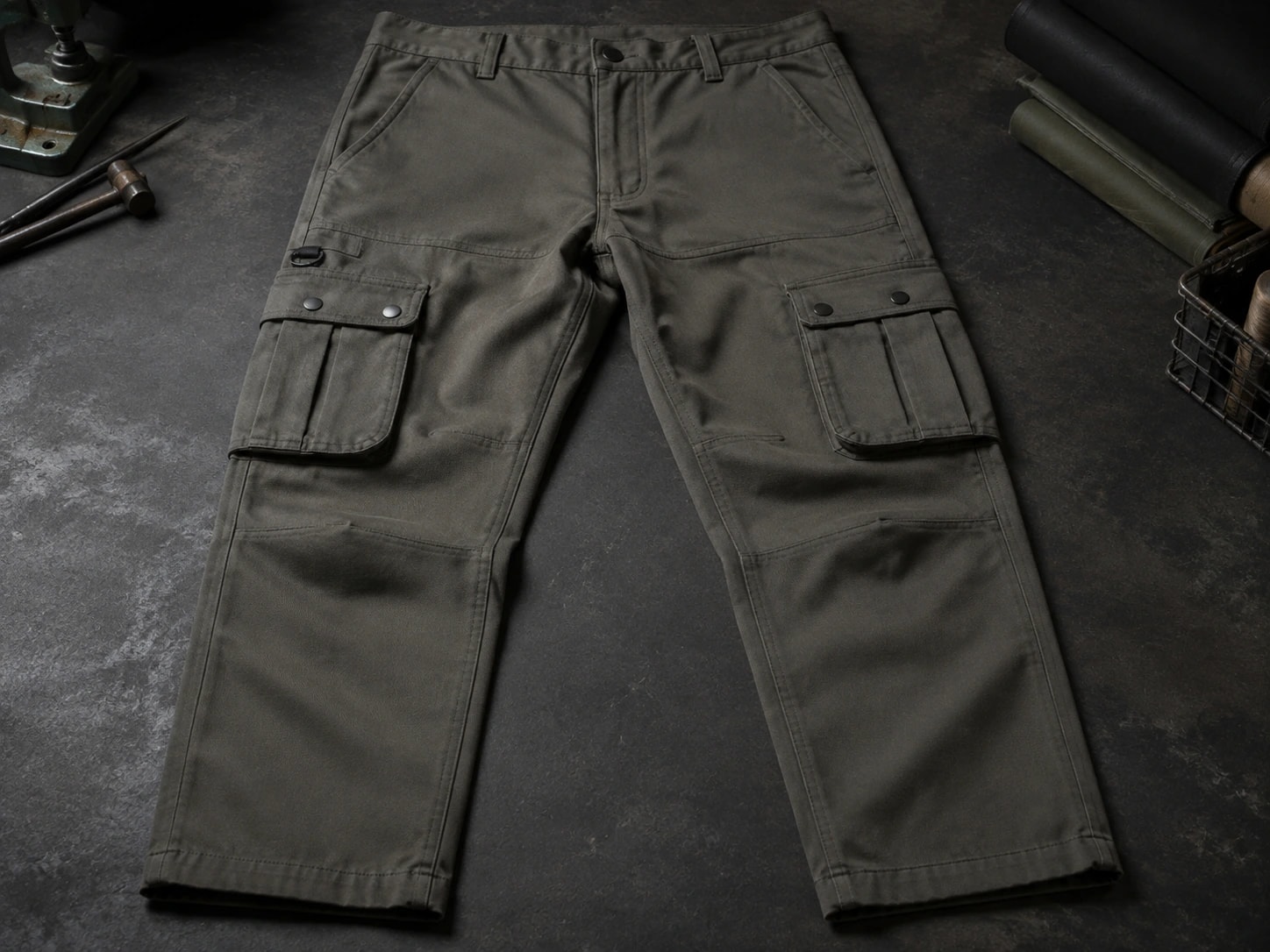
There is no fixed cargo-pants formula. A basic product often has five or six pockets; a more functional design may have eight or more. More is not automatically better: every added pocket increases weight, cost and visual complexity, and can make the leg look crowded.
| Pocket group | Common quantity | Main purpose |
|---|---|---|
| Front hand pockets | 2 | Daily access and basic trouser function |
| Back pockets | 1–2 | Storage, balance and back-view proportion |
| Thigh cargo pockets | 1–2 | Utility identity, capacity and side silhouette |
| Tool, phone or coin pockets | 0–2 | Specific storage or visual layering |
KAOUYOU commonly develops two front hand pockets, one or two back pockets and left-right flat or box-pleat cargo pockets. Other frequent arrangements use one back pocket, two flap-covered volume pockets, or an asymmetric combination with a cargo pocket on one side and a zipper or tool pocket on the other.
What Are the Main Types of Cargo Pockets?
The practical difference is how the pocket expands after an object is inserted. Flat patch pockets stay close to the leg. Pleats add expansion within the front panel. Bellows add expansion at the sides. A three-sided gusset lets the sides and bottom move away from the garment.
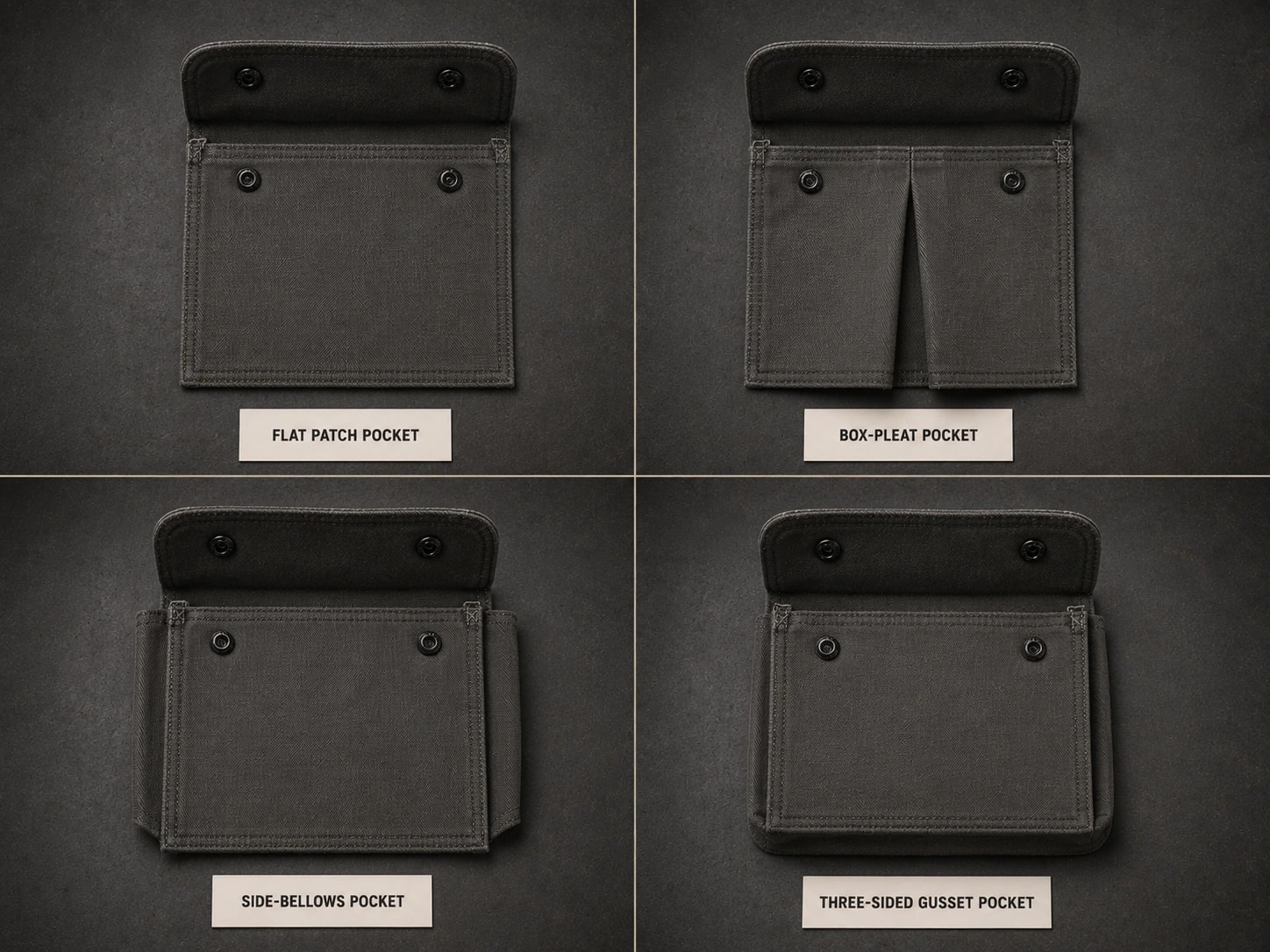
| Construction | Capacity | Visual effect | Relative complexity |
|---|---|---|---|
| Flat patch pocket | Low | Clean and flat | Lowest |
| Single-pleat pocket | Low to medium | One controlled expansion point | Low to medium |
| Box-pleat pocket | Medium | Strong front-facing volume | Medium |
| Side-bellows pocket | Medium to high | Expands mainly at the sides | Higher |
| Three-sided gusset pocket | High | Sides and bottom project from the leg | Highest |
Which cargo pocket is best for real storage?
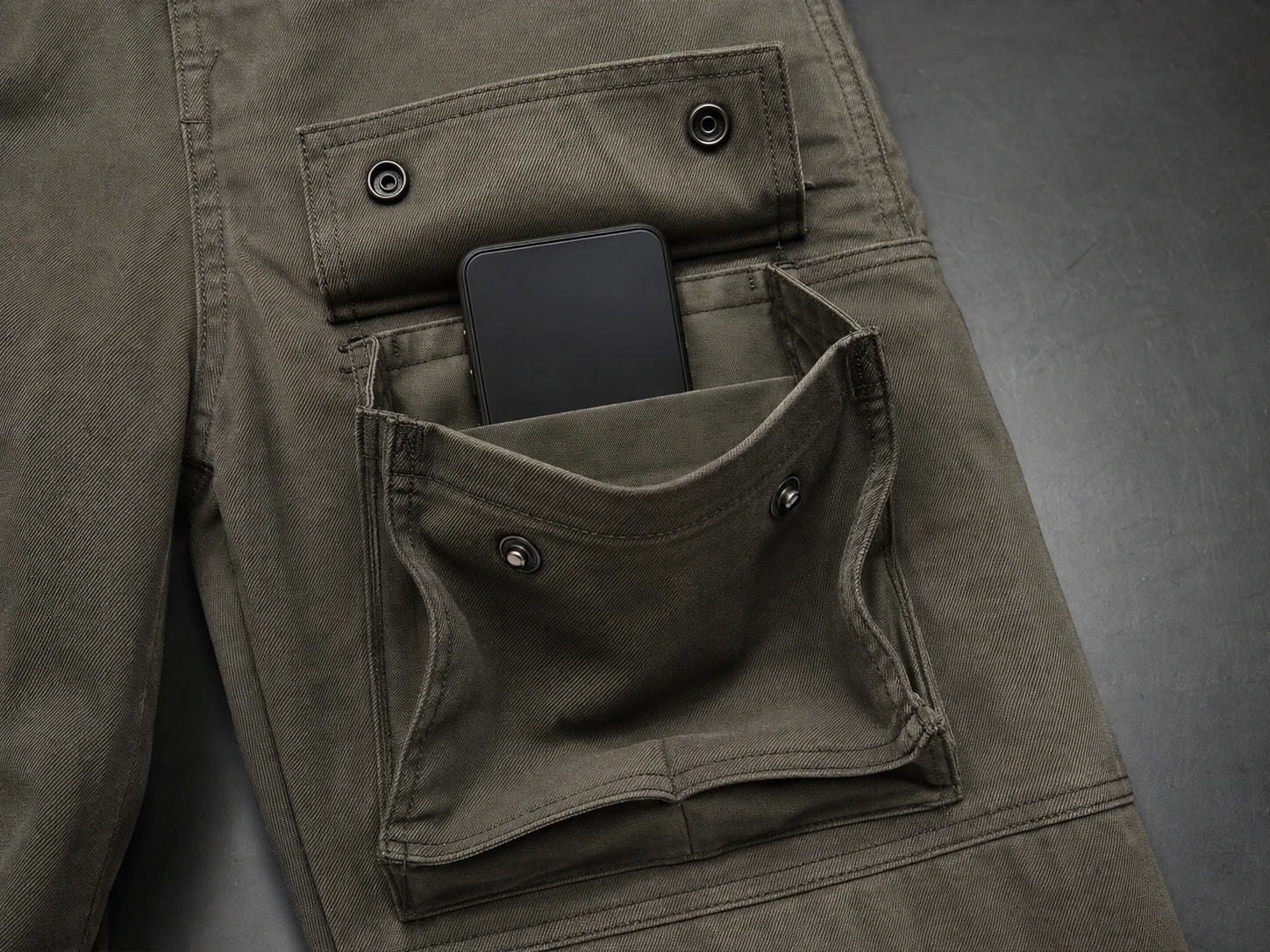
For meaningful capacity, start with a box pleat, side bellows or three-sided gusset. A flat patch pocket is more appropriate for a phone, cards, small objects, lightweight cargos or a clean design that should not project from the leg. Tell the factory whether the target item is a phone, wallet, tool or only a visual reference: opening width, depth and reinforcement depend on that decision.
What Should a Cargo Pocket Tech Pack Specify?
The factory needs finished measurements and construction notes, not only artwork dimensions. The minimum fields below remove the most common ambiguities during pattern making, quotation and sample review.
| Specification group | Required information |
|---|---|
| Pocket body | Finished width, height and opening length |
| Expansion | Pleat allowance or gusset depth, direction and opening limit |
| Flap | Width, height, shape, layers, interlining and overlap |
| Placement | Distance from waist, side seam and knee line |
| Closure | Type, size, material, color, supplier and exact position |
| Construction | Seam allowance, topstitch width, stitch count and bartacks |
| Internal build | Self fabric, pocketing, lining, divider or reinforcement |
| Symmetry | Mirrored left and right, or separate drawings for asymmetry |
| Intended use | Target item, required capacity and access direction |
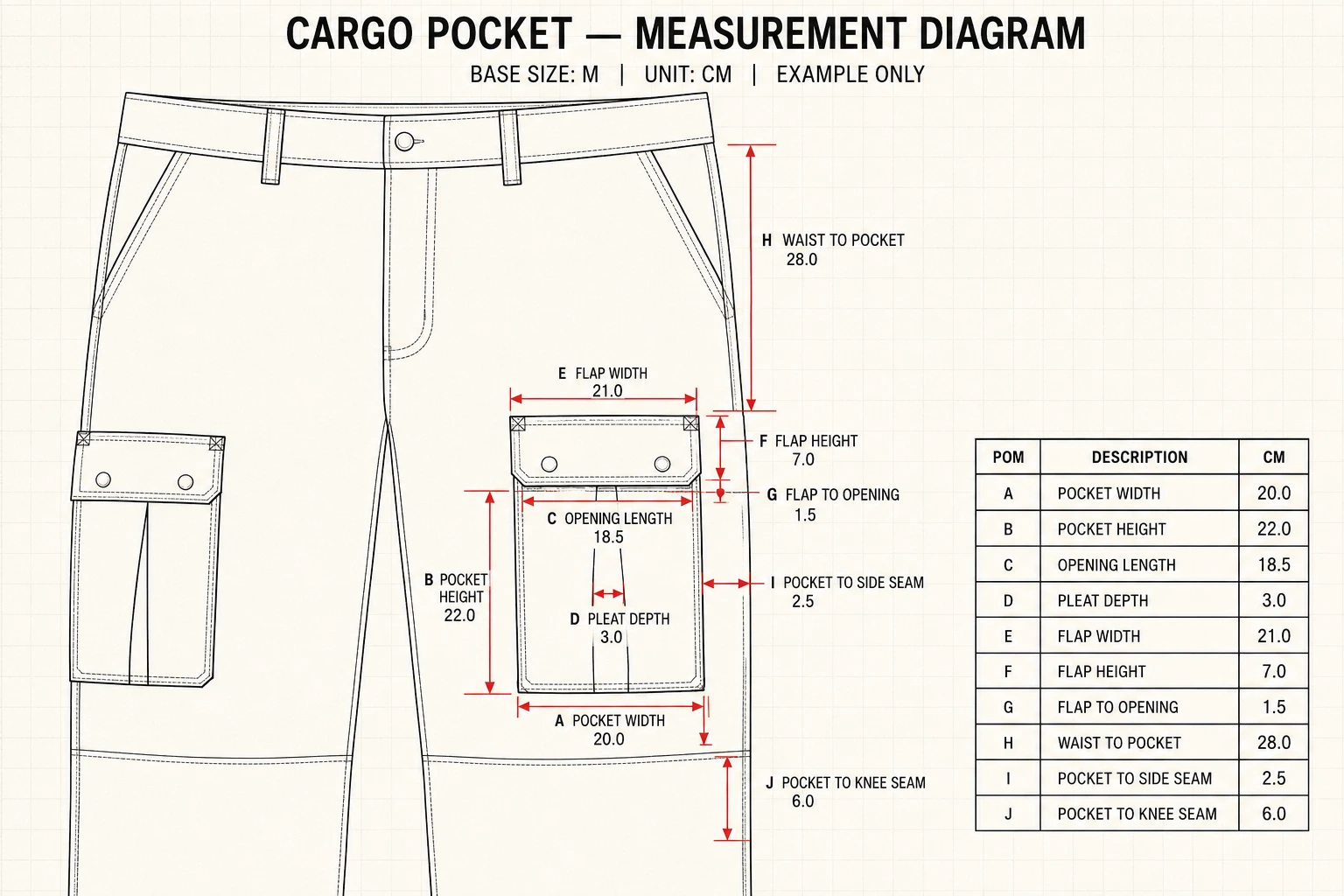
If left and right pockets are identical, a drawing may specify mirrored construction. If they differ, provide separate left-leg and right-leg views; “asymmetric pockets” is not enough. The measurement table and drawing must also agree with each other and state the unit and sample size.
Where Should a Cargo Pocket Sit on the Leg?
Position is determined by trouser ease, body and leg length, knee line, side-seam shape, access while standing, and comfort when sitting or bending. A pocket that is too low can strike the knee during walking; one too far back is difficult to reach; one too close to the front can distort the visual balance.
Regular, Relaxed, Baggy and Wide-leg patterns should not reuse one location automatically. As the leg widens, the pocket normally needs a new scale and visual center. Otherwise it may look too small, too forward or too far behind the side seam. Confirm placement on the complete Fit Sample, not on an isolated paper pattern alone.
Specify the named reference point and direction for every position measurement—for example, top waist edge to flap top, pocket side edge to side seam, and pocket bottom to knee seam. “28 cm below waist” is incomplete if the waist reference is undefined.
How Should Pleats, Gussets and Pocket Flaps Be Specified?
Pleats and gussets
State pleat width, total allowance, expansion depth, direction, whether the top is secured, topstitching, where expansion stops, and whether the pleat should remain closed or open naturally after washing. Left and right pockets often need mirrored pleat direction; without that instruction, a factory may make both pleats face the same way.
Pocket flaps
Define single or double layer, interlining, finished width and height, square, rounded or angled corners, topstitch width and stitch density, reverse-side material, opening overlap and the distance from flap to pocket mouth. Medium-weight workwear commonly uses a double-layer flap. Lightweight fabric may need support; extremely heavy fabric may need fewer layers or a lighter underside so corners turn cleanly and the flap does not become rigid.
Which Closure and Reinforcement Should a Brand Choose?
| Closure | Best-known benefit | Confirm before bulk |
|---|---|---|
| Snap | Fast, secure and strongly associated with workwear | Wash, corrosion, color and operation |
| Button | Traditional appearance and replaceable | Buttonhole size, sew strength and slower access |
| Hook-and-loop | Fast access for uniform or functional products | Lint pickup, noise and wash life |
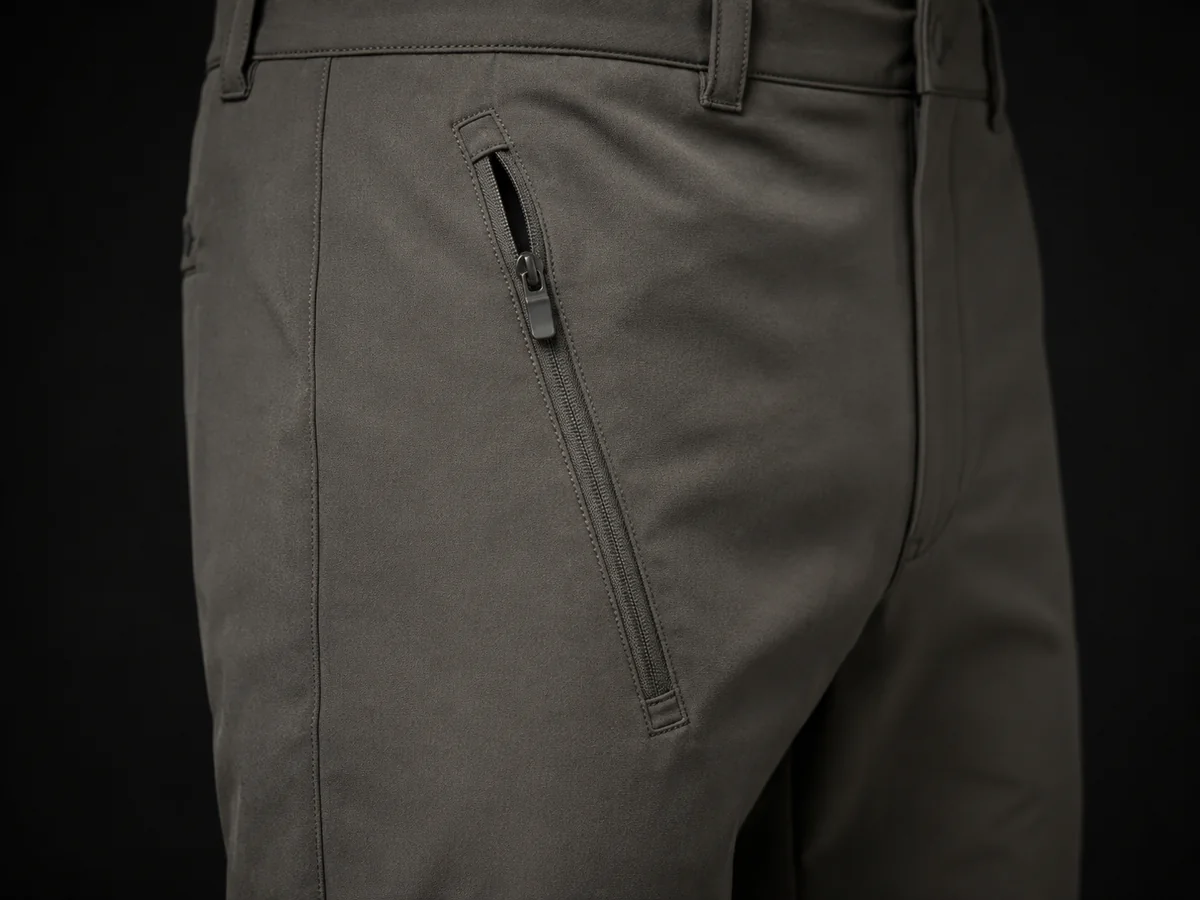
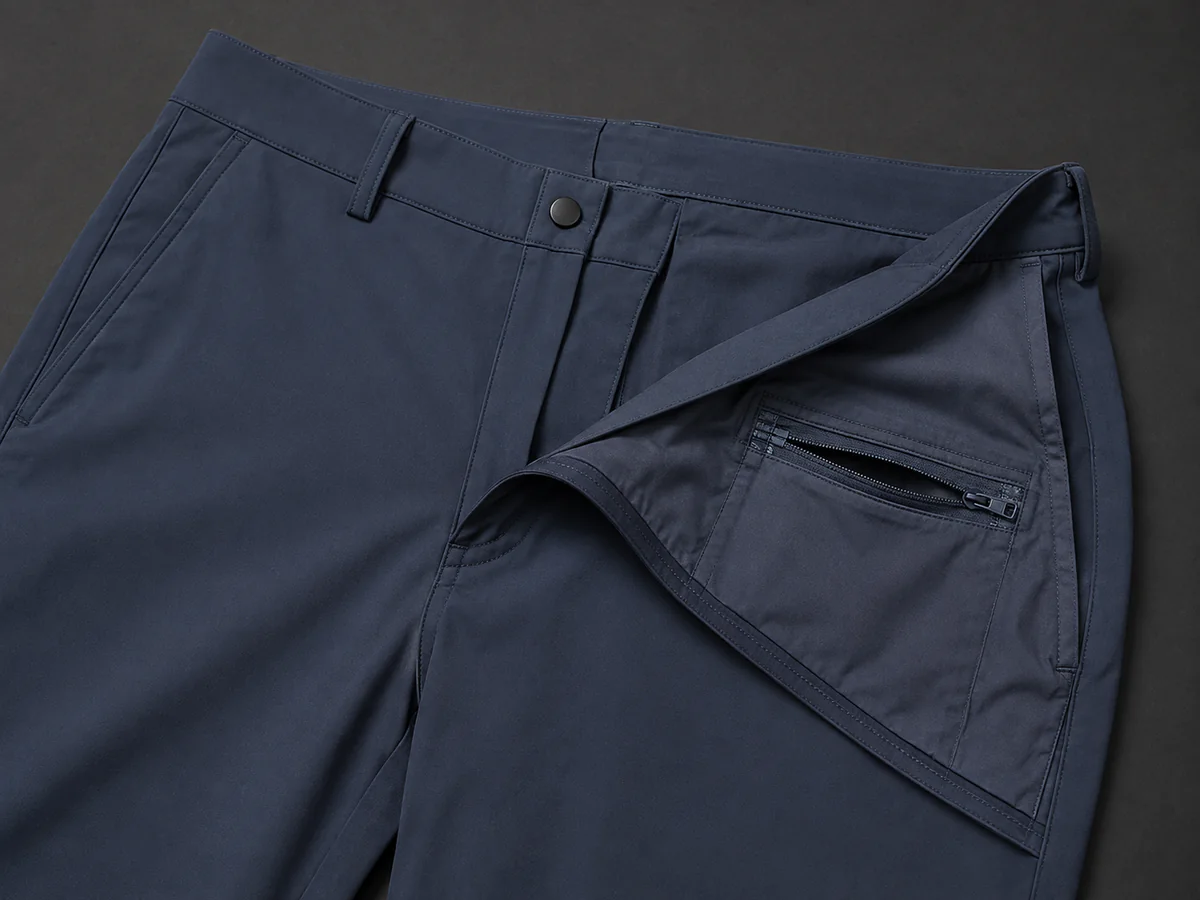
| Zipper | Secure for phones and hidden compartments | Tape, slider, end reinforcement and wash compatibility |
| Magnetic closure | Clean exterior and quick access | Higher cost, application limits and wash testing |
| No closure | Simple access or decorative use | Contents may not remain secure |
Snaps, magnets and metal zippers must be tested for wash compatibility, color change, corrosion and repeated operation. Secure supply also matters: a custom finish or magnetic system can affect both sampling and bulk timing.
Typical reinforcement points include pocket-opening ends, flap attachment, pleat termination, gusset corners, back-pocket openings, tool-pocket and hammer-loop attachments, zipper ends and belt-loop ends. Reinforcement does not always need to be visually prominent; a cleaner product may use internal support, backtacking or concealed bartacks.
How Do Fabric and Sewing Change Cargo Pocket Construction?
| Fabric direction | Useful characteristic | Main pocket risk |
|---|---|---|
| Cotton twill | Classic workwear hand and clear topstitching | Shrinkage, wrinkling and layered bulk |
| Canvas | Firm structure and strong utility character | Thick corners, rigid flaps and heavy legs |
| Denim | Durable appearance and strong wash character | Shade, abrasion, seam bulk and wash marks |
| Cotton or nylon ripstop | Lighter technical appearance and tear resistance | Heat, needle marks and coating or finish compatibility |
| Lightweight nylon | Low weight and packable function | Seam stability, puckering and need for reinforcement |
When body fabric is repeated in the pocket body, gusset and double-layer flap, thickness accumulates quickly. Common failures include bulky corners, an opening that turns outward, a rigid flap, uneven topstitching, skipped stitches, broken needles, a locally heavy leg and visible wash impressions.
A factory may clip or notch corners, grade seam allowances, separate intersecting seams, press components before attachment, adjust needle size, thread tension and presser foot, slow down at corners, use templates for symmetry, or replace a hidden layer with lighter fabric. Extremely heavy constructions should not automatically use double self-fabric for every component.
Does every cargo pocket need pocketing or interlining?
No. A normal flat or volume patch pocket can use body fabric directly. Zipper pockets, phone dividers and concealed compartments usually require pocketing. Lightweight shells may need localized support at the opening, while a flap may use light fusible, nonwoven support or no interlining depending on fabric thickness. Record pocketing composition, color, GSM, dimensions and whether it must match the body.
Which functions make sampling more difficult?
- Hidden zipper pockets and zippers concealed inside flaps
- Phone dividers, pen slots and multi-layer tool pockets
- D-rings, webbing and modular attachment systems
- Detachable pockets and pocket-within-pocket designs
- Hidden magnets and complex bellows
These features must work during access, movement and washing, not only look correct on a table. Hardware availability and repeatability should be resolved before the PP Sample.
How Do Garment Washing and Bulk Inspection Affect Cargo Pockets?
Garment dye, enzyme wash, stone wash and vintage finishing can make the flap and body shrink differently, turn the opening outward, stop a pleat from closing, abrade edges, change or corrode hardware, leave press marks and create a wash shadow underneath the pocket. A heavily washed program should be tested as a complete garment using production-intent fabric and hardware.
What should the factory inspect in bulk?
- Left-right dimensions, height and position
- Horizontal alignment or the specified angle
- Mirrored pleat direction and controlled expansion
- Flat flap shape, correct overlap and pocket opening
- Straight topstitching and secure bartacks
- Working snaps, zippers or other hardware
- Pocket bag, divider and internal construction
- Real capacity, access and loaded appearance
- Shape, hardware and surface after washing
Dimensions are only part of the inspection. The pocket must also open, hold the intended item, remain accessible and recover to the approved appearance after use and washing.
What Are the Most Common Cargo Pocket Development Mistakes?
- Copying the outer shape without defining real capacity
- Making the opening too small for a hand or phone
- Placing the pocket too low so it strikes the knee
- Placing it too far behind the side seam for natural access
- Keeping the same pocket scale after widening the leg
- Using too many self-fabric layers in a heavy construction
- Making a flap that does not fully cover the opening
- Failing to define mirrored pleat direction
- Approving hardware without the intended wash test
- Ignoring sagging and leg distortion when the pocket is loaded
What Should Be Approved Before Cargo Pants Bulk Production?
- Review the reference image or Tech Pack and define pocket use
- Confirm pocket count, type, finished measurements and placement
- Create the pocket and trouser pattern
- Make a pocket mock-up for complex structures or the complete first sample
- Check capacity, access, left-right relationship and worn proportion
- Confirm closures, hardware, bartacks and internal construction
- Run the intended garment wash using production-intent materials
- Review shape, shade, hardware and measurements after wash
- Revise the pattern and sewing method where required
- Make and approve the PP Sample in writing
- Hold the pre-production meeting and release bulk
A simple flat pocket may not need a separate mock-up. A complex gusset, heavy fabric or unusual closure often benefits from testing the pocket unit before the complete sample. During approval, review front and side views, the interior, expanded state, target-item load, and comfort while sitting, walking and bending. One closed front-view photo is insufficient.
KAOUYOU can propose the initial structure and measurements, but the brand should identify the trouser fit, pocket use, approximate quantity, capacity, preferred reference proportion, closure, fabric direction, target size, market and order quantity. The first sample may still need adjustment.
What Should a Brand Ask in a Cargo Pants RFQ?
- Which pocket structure matches our required capacity and silhouette?
- Will the pocket be functional, decorative or designed for a named item?
- How will pocket scale and position change with our trouser fit?
- Which dimensions, reference points and pleat directions are still missing?
- Should left and right pockets be mirrored or documented separately?
- Can heavy layers be reduced with lighter hidden fabric or revised seams?
- Which closure, reinforcement and pocketing material are proposed?
- Will hardware and the complete pocket be tested after the intended wash?
- Does the structure require a pocket mock-up before the full sample?
- Which pocket choices materially affect quotation and development time?
Share your cargo-pants reference, intended pocket use, fit, fabric, wash, closure, target size and estimated quantity through the KAOUYOU project RFQ. We can identify missing pocket specifications before quotation and sampling.
Frequently Asked Questions
How many pockets do cargo pants normally have?
There is no fixed number. A common configuration has two front hand pockets, one or two back pockets, one or two thigh cargo pockets and up to two smaller tool or phone pockets. Basic cargo pants often total five or six pockets; complex utility products may have eight or more.
What are the main types of cargo pockets?
Common types include flat patch, single-pleat, box-pleat, side-bellows and three-sided gusset pockets. They differ in where the fabric expands, how much they hold, how far they project from the leg and how difficult they are to manufacture.
Which cargo pocket has the most capacity?
A three-sided gusset pocket normally provides the greatest capacity because its left, right and bottom edges can expand. Box pleats and side bellows provide moderate to high capacity, while a flat patch pocket stays comparatively flat.
What measurements should a cargo pocket Tech Pack include?
Specify finished pocket width and height, opening length, pleat or gusset depth, flap dimensions, flap-to-opening distance, placement from the waist, side seam and knee line, closure position, topstitching, seam allowance and reinforcement.
Should left and right cargo pockets always be symmetrical?
No. Symmetry is classic and easier to control, while asymmetric systems can combine a large cargo pocket with a phone, zipper or tool pocket. If the two sides differ, provide separate left-leg and right-leg drawings.
Where should a cargo pocket sit on the leg?
Placement depends on trouser ease, length, knee line, side-seam shape, natural hand access and movement when sitting or bending. Regular, Relaxed, Baggy and Wide-leg patterns should not automatically share one pocket position.
Which cargo pocket construction costs the most?
Three-sided gusset, complex bellows, multiple internal dividers, hidden zippers, magnetic closures and detachable systems normally cost more. They use more pattern pieces, material, pressing, positioning, hardware, reinforcement and sewing time.
Do cargo pocket snaps and zippers need wash testing?
Yes. Snaps, magnetic closures, metal zippers and other hardware should be checked for color change, corrosion, operation and attachment after the intended garment wash. A complete garment test is more reliable than a fabric swatch alone.
Can a factory develop cargo pockets from a reference photo?
Usually yes, but the brand should still define the trouser fit, pocket use, approximate count, required capacity, preferred proportion, closure, fabric, target size, market and quantity. One photograph cannot guarantee an exact first sample.
What must a brand approve before cargo pants bulk production?
Approve pocket type, dimensions, placement, left-right relationship, flap, pleat or gusset behavior, closure, capacity, loaded appearance, movement, wash result and final PP Sample in writing before bulk release.