An exposed-seam hoodie needs more than a request for an “inside-out look.” Specify which joins carry the garment structure, which allowances or stitches should remain visible, how the edges should finish, and what the garment should look and feel like after washing. Decorative stitching can produce a similar outline while requiring a different pattern and construction.
At KAOUYOU, development starts with the reference, a marked panel layout and a seam sample showing both faces. The complete hoodie then establishes seam position, fit, bulk, comfort and washed behavior before the production details are approved.
Answer in 30 Seconds
Define the visible effect and its locations first. Record the panel lines, seam direction, allowance, stitching, thread color and any permitted raw edge. Pair materials for compatible stretch and shrinkage, then approve both a seam sample and the complete hoodie. Structural security and comfortable movement remain requirements even when the design intentionally exposes its construction.
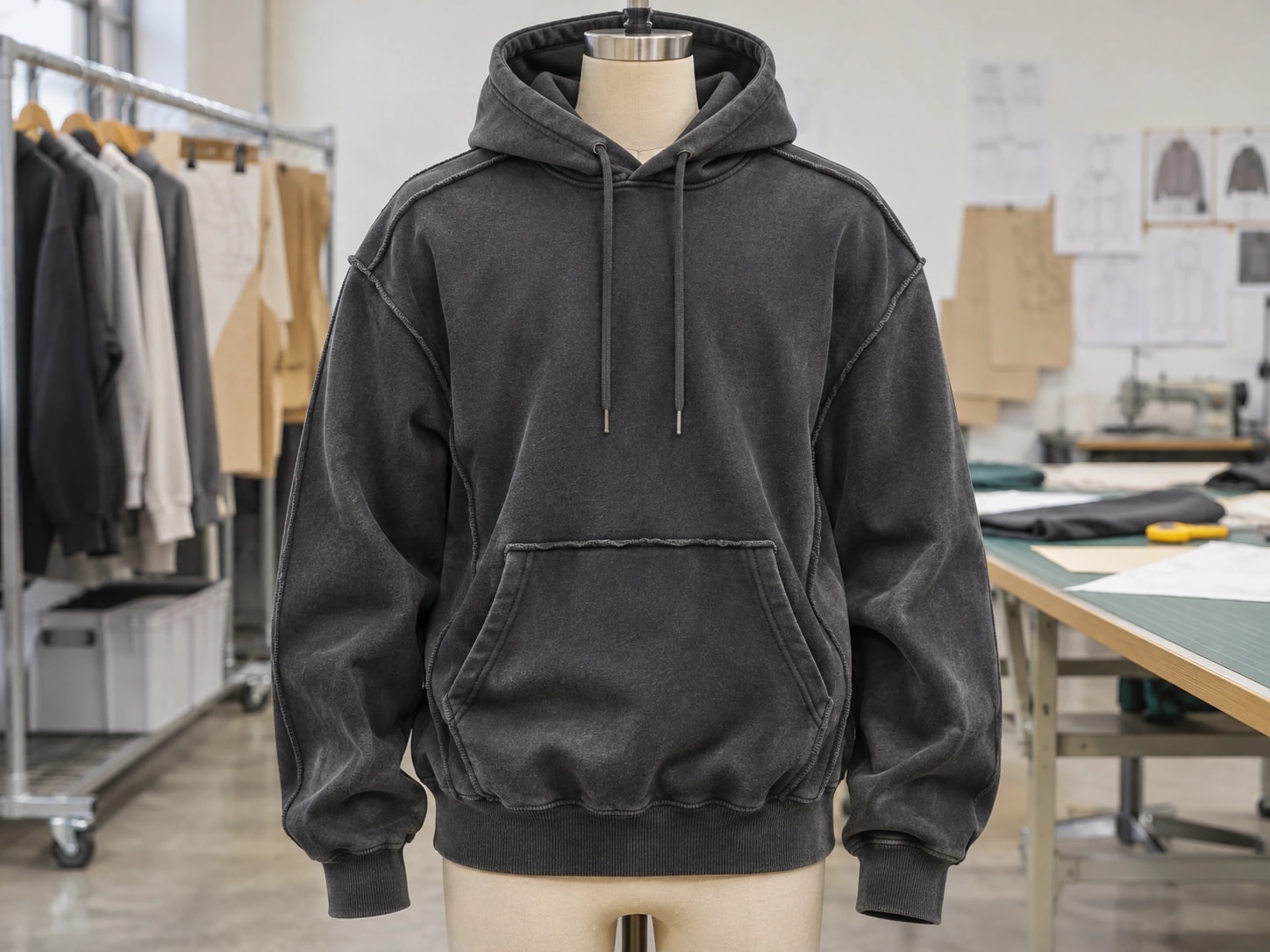
What should an exposed-seam hoodie reference actually specify?
A reference may show allowances turned outward, visible overlocking, surface stitching or a decorative line that does not join separate panels. KAOUYOU first asks which result the customer wants, then confirms allowance width, visible thread, raw-edge character, colors and the intended clean or worn finish.
| Reference direction | What needs to be distinguished | What the sample should establish |
|---|---|---|
| Outward-facing seam allowance | A real join with the allowance visible outside | Allowance direction, exposed width, edge control and seam security |
| Visible seam stitching | The stitch's structural role and appearance on both faces | Surface texture, thickness, stretch and the intended inside finish |
| Decorative topstitching | A surface line rather than necessarily a panel join | Line route, spacing, thread color and its relationship to the underlying construction |
When a customer requests overlock, flatlock or coverstitch, KAOUYOU confirms whether the name describes a structural need or a visual effect. Available development routes include exposed overlocking, flat-seaming, two- or three-needle coverstitching, paired topstitching and a conventional join with its allowance turned outward and stitched down.
Those options differ in bulk, stretch and appearance. Approve a physical sample showing both sides rather than relying on a stitch name alone. The black washed pullover hoodie offers a reference for visible construction lines; the new brief still needs its own stitch and finishing decisions.
Where should the seams be visible?
KAOUYOU has developed exposed shoulder joins, raglan lines, sleeve seams, hood joins, side panels and pocket details. Shoulder seams, raglan lines, hood center seams and sleeve-panel joins are common starting points.
Placement also affects comfort and strength. Underarms, the inside neckline, lower armholes, pocket openings, zipper fronts and other stressed joins need closer review. Depending on the design, KAOUYOU may retain an internal seam, cover the allowance, add reinforcement or secure it with additional stitching.
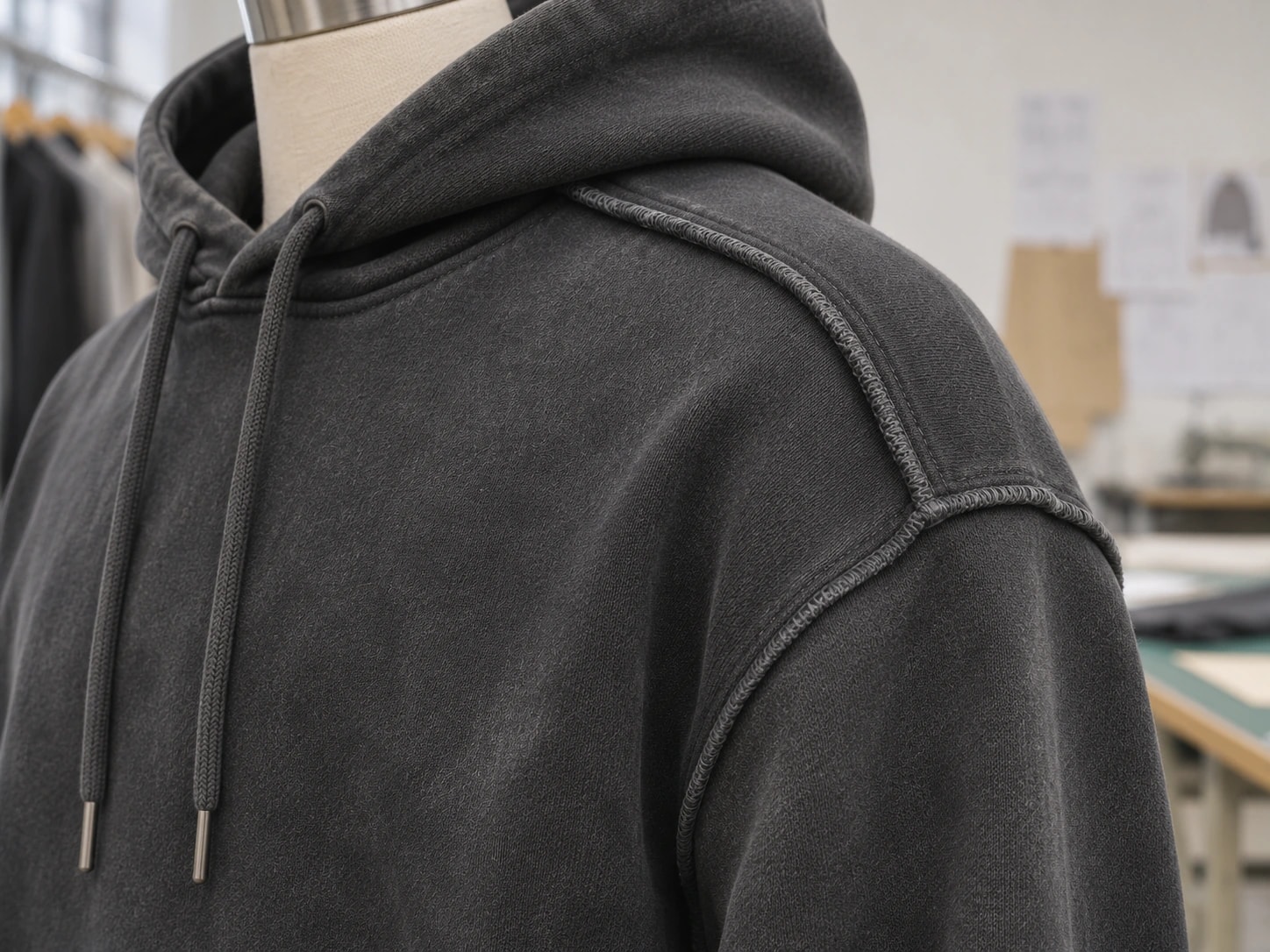
Decide where the visible line starts and stops, and how it meets the hood, pocket, sleeve and rib. Do not assume a striking exterior treatment must continue through every junction. The color-block raglan hoodie illustrates how panel boundaries and visible lines can work together, with the actual seam system confirmed through sampling.
Which fabrics work with exposed seams?
KAOUYOU often considers loopback French terry because the reverse loops can add texture to an exposed allowance or selected panel. Brushed sweatshirt fabric can also be used, but an outward-facing brushed surface requires attention to lint, pilling and friction wear. It is generally reviewed for smaller exposed areas rather than assumed suitable everywhere.
A higher cotton content can support a natural worn appearance; a suitable cotton/polyester blend may be considered where greater stability is wanted. Excessive stretch, loose construction, severe shedding or an insufficiently supportive surface can make broad exposed treatments difficult to control. No single GSM establishes suitability.
Before exposing reverse texture, KAOUYOU checks surface shedding, pilling, snagging, shrinkage and the washed hand. Rough reverse surfaces are treated cautiously where they would rub the neck, underarm or pocket opening. The fabric swatch evaluation guide covers the earlier material review.
Different panel fabrics are checked separately for shrinkage, colorfastness and stretch recovery, then together in a washed garment. A large mismatch can produce waving joins, contracted panels or twisting. If pattern compensation cannot control that behavior reliably, KAOUYOU recommends a closer material match.
What belongs in the seam and panel specification?
Provide front and back drawings with the panel lines, start and end positions, actual dimensions, symmetry requirements and fabric or color distribution. KAOUYOU translates those lines into pattern pieces with the necessary allowances and matching notches, then checks the curves and proportions on the first garment.
| Specification field | Information to record | Approval reference |
|---|---|---|
| Panel and seam map | Real joins, decorative lines, start/end points and symmetry | Marked drawing and approved pattern direction |
| Visible face and allowance | Outward or inward placement, exposed width and lay direction | Seam sample showing both faces |
| Stitching and thread | Selected stitch appearance, line width, thread character and color | Approved physical stitching sample |
| Edge finish | Contained edge or permitted raw edge, control-line location and variation | Approved finished edge, including the intended wash |
| Junctions and scale | Hood, armhole, pocket and rib intersections; size-related changes | Complete sample and measurement/construction instructions |
Allowance width depends on fabric thickness, seam location and the desired effect. Raised character also depends on the layers, stitching and whether the seam is pressed or stitched down. KAOUYOU normally establishes these variables on a local technique sample before recording the approved result in the production instructions.
Tonal thread can retain a restrained structural appearance. Contrast thread emphasizes the panel route, but also makes uneven stitches and joins more noticeable. Heavier thread needs review for needle holes, tension and fabric damage; visual strength alone is not a reason to choose it.
Grading should preserve the intended curve and seam relationship. Shoulder/neck areas, underarms, armholes, pocket corners and hood junctions cannot simply be enlarged mechanically. The clothing size grading guide supports the measurement review; panel routes and decorative-line distances also need to be checked across the intended size range.
How can curved joins and seam intersections stay comfortable?
Curves, sharp turns and corners need controlled allowances and matching points. KAOUYOU may position or temporarily secure the pieces before sewing. Stretchy panels require controlled feeding and tension so that the sewn edge is not lengthened into a wave.
Load-bearing joins still need sufficient structural allowance and reinforcement. Cutting an allowance very narrow solely to create an exposed look can compromise the join. At the neckline, hood base, underarm, pocket corners and rib connections, trimming or staggering excess allowances can reduce bulk while preserving the required seam structure.
Avoid concentrating several bulky joins at one point. Binding, topstitching or local reinforcement may be appropriate, depending on the location. Check the inside for coarse thread, hard edges and raised sections that rub during movement. The hoodie ribbing guide provides context for the adjoining cuffs and hem.
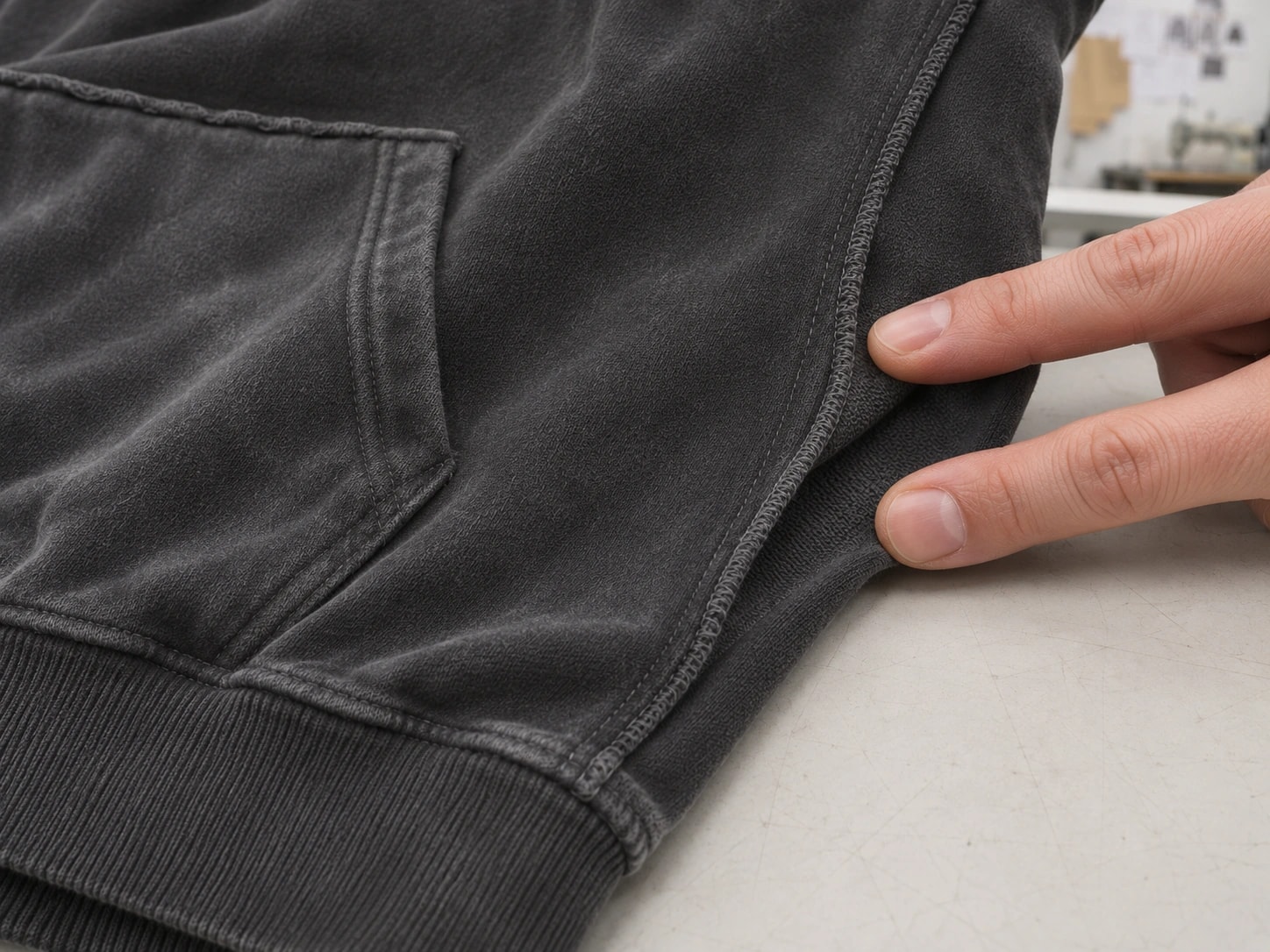
When a seam waves, KAOUYOU reviews fabric stretching during sewing, presser-foot pressure and thread tension. Skipped stitches or broken thread require checks of the needle, thread and layered thickness; loose stitching and uneven joins also call for feeding and operator review. Adjustments are checked on another seam sample before production proceeds.
How should washing, raw edges and graphics be coordinated?
Garment dyeing or a vintage wash can change thread contrast, open raw edges further, shrink panels and alter how prominently the seam stands. Some threads absorb color differently from the body. KAOUYOU checks a seam technique sample and then a complete washed garment, approving the finished appearance rather than only the untreated stitching.
If the joins and edges should develop a coordinated worn effect, sewing before washing may be appropriate. A clean, stable thread color calls for a suitable wash-resistant thread and advance testing. Neither intention removes the need to check the selected fabric and stitch combination.
For raw edges, record the permitted opening, allowance width and distance to the control stitching. KAOUYOU may add a securing line inside the exposed edge to limit further opening. Controlled wear within an approved range differs from a broken structural seam, released stitches, an unapproved opening or damage that continues to spread.
Artwork needs its own processing decision. Printing or embroidering cut panels before assembly can improve access and positioning. A raised seam may interfere with decoration equipment, and text, faces, circles, fine lines and regular geometry are especially sensitive to misalignment. A separate decoration sample cannot establish their final relationship to the garment's seams.
The quarter-zip panel hoodie provides a reference for several elements meeting in one garment: curved panels, a short zipper, a pocket and visible seam details. Specify their intersections together rather than approving each feature in isolation.
What should be approved on a seam sample and complete hoodie?
The local seam sample establishes the chosen stitching and edge finish. The complete hoodie establishes whether that treatment works with the garment's proportions, movement and finishing. Both references matter for bulk production.
| Approval stage | What KAOUYOU checks | What the reference should communicate |
|---|---|---|
| Seam technique sample | Stitch appearance, allowance width, raised character, color, raw edge and washed change | The agreed construction and finish on both faces |
| Complete hoodie | Seam position, overall proportion, movement, inside comfort and deformation | How the treatment works on the actual garment |
| Finished and washed sample | Twisting, puckering, seam security, color and edge range | The intended condition after the agreed processing |
| Production reference set | Approved garment, technique sample, pattern, measurements, materials, thread colors and instructions | One consistent standard with the customer's written approval |
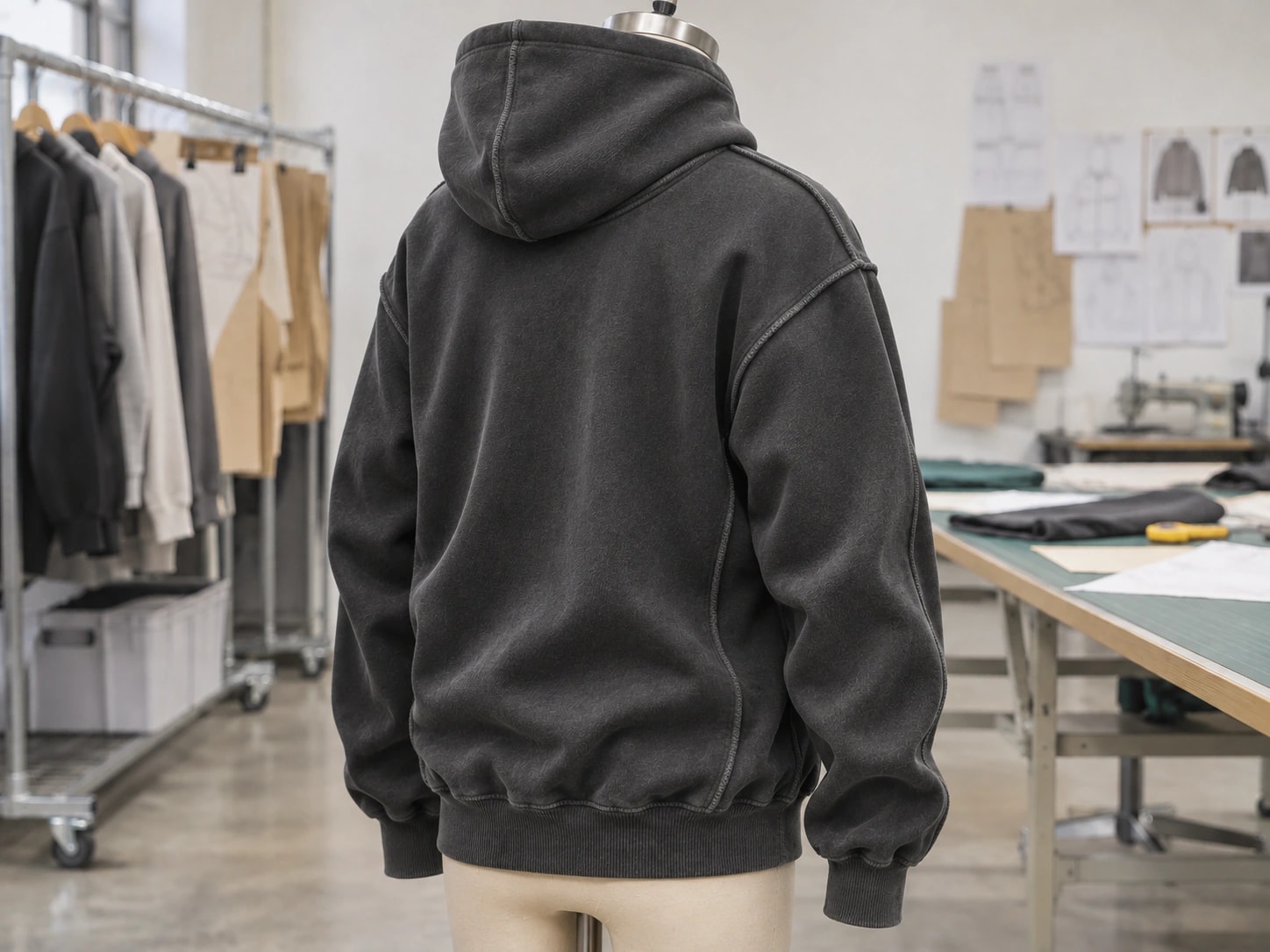
Fit should be considered alongside the visible construction. The boxy and oversized hoodie guide covers body and sleeve balance; this article's additional approval point is whether the seams remain correctly positioned and comfortable within that fit.
For quality control, KAOUYOU retains the approved garment, seam sample, patterns, measurement chart, material references, thread-color standards, production instructions and customer approval records. Intentional edge variation needs an agreed reference so that it is not confused with structural damage.
What affects cost, MOQ and sample revisions?
Panel count, total exposed-seam length, stitching method, contrast or special thread, material combinations, washing and processing difficulty all affect the quote. Curved panels and concentrated junctions may require additional handling and sample review. Timing is assessed against the actual construction and approval requirements.
KAOUYOU's usual garment MOQ is 100 pieces per style, per color. Custom panel fabrics, special rib colors, heavier decorative threads or subcontracted flat-seaming can have separate supplier or processor minimums. Review those conditions against the planned garment quantity.
Recurring revisions include reducing excessive bulk, staggering allowances, selecting a finer or softer thread, correcting a panel curve, changing edge securing or choosing fabrics with more compatible shrinkage and stretch. Reducing an allowance still needs to preserve the structural width required at that location.
The useful revision brief identifies the problem and when it appears: a line that is too prominent before washing, an uncomfortable underarm during wear, or an edge that opens too far after processing. KAOUYOU uses those findings to adjust the seam sample and complete garment, with strength and comfort established alongside the visual result.
Frequently asked questions
Does an exposed seam make the hoodie reversible?
No. An exposed-seam appearance does not establish that the interior, pocket, labels, hood and finishing are suitable for wear on both sides. A reversible garment requires a separate construction brief and complete sample approval.
Does a heavier thread automatically make the seam stronger?
No. KAOUYOU also reviews the needle, tension, fabric and layered thickness. Coarser thread can create unwanted needle holes or damage if the combination is unsuitable; approve the complete seam rather than thread size alone.
Is roughness acceptable because the design looks unfinished?
The intended exterior character still needs a defined reference. Hard edges, coarse thread and raised junctions that rub the wearer require review, particularly around the neck and underarms. A worn appearance does not by itself approve uncomfortable construction.
Can a problem seam be approved after it has been pressed flat?
Pressing alone does not establish that the cause has been corrected. Review fabric feeding, tension, panel compatibility and junction bulk as appropriate, then check the revised seam and complete garment under the intended wearing and washing conditions.
Prepare an exposed-seam hoodie brief
Send front and back references, a marked seam and panel map, intended inside and outside appearance, fabric directions, thread colors, edge finish, artwork, washing requirements, sizes and quantities by color.
Explore the hoodie and sweatshirt collection for design references, or work with KAOUYOU product development to establish the seam sample and complete garment requirements. Send your exposed-seam hoodie brief for a project-specific development review.