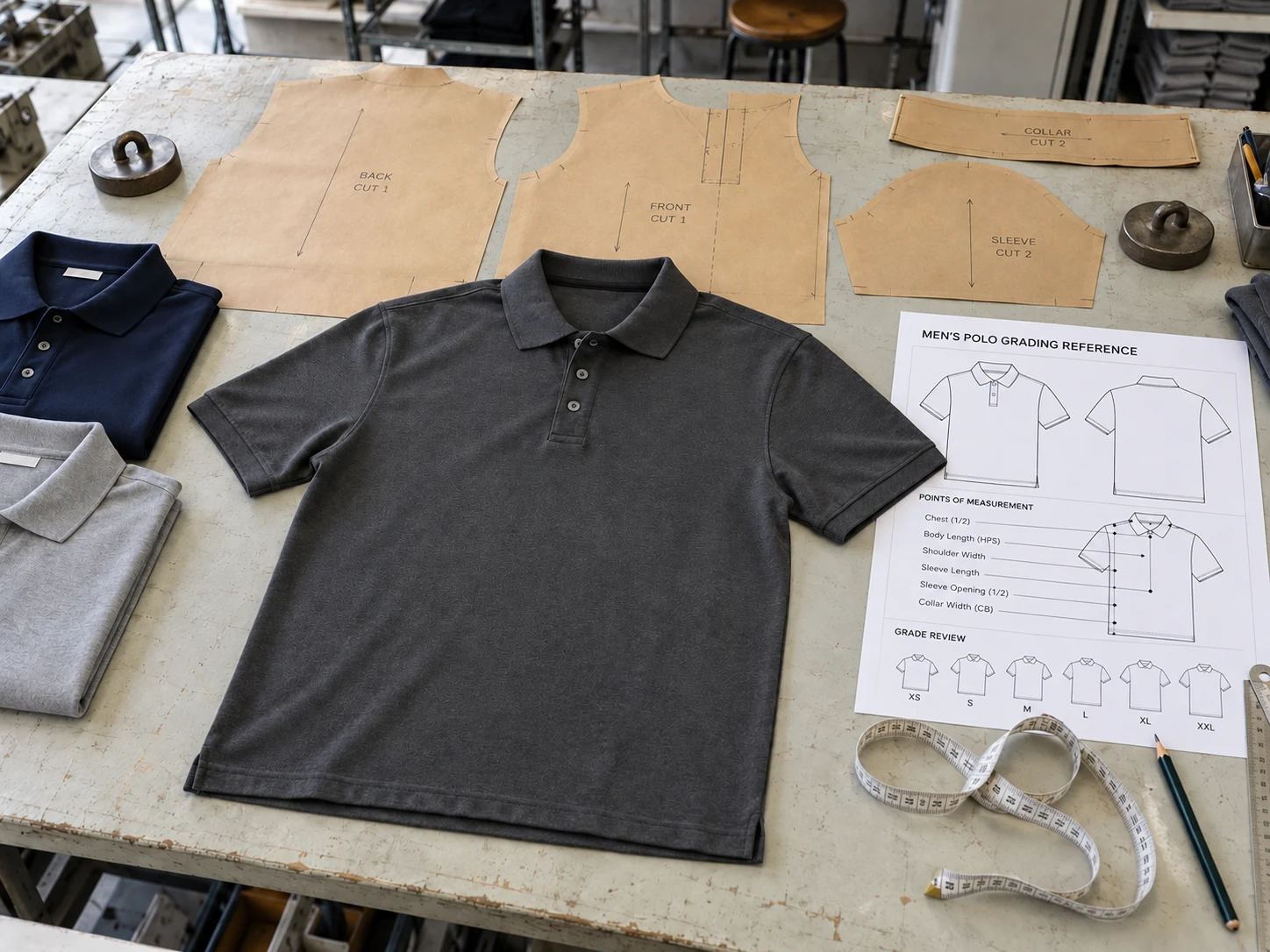
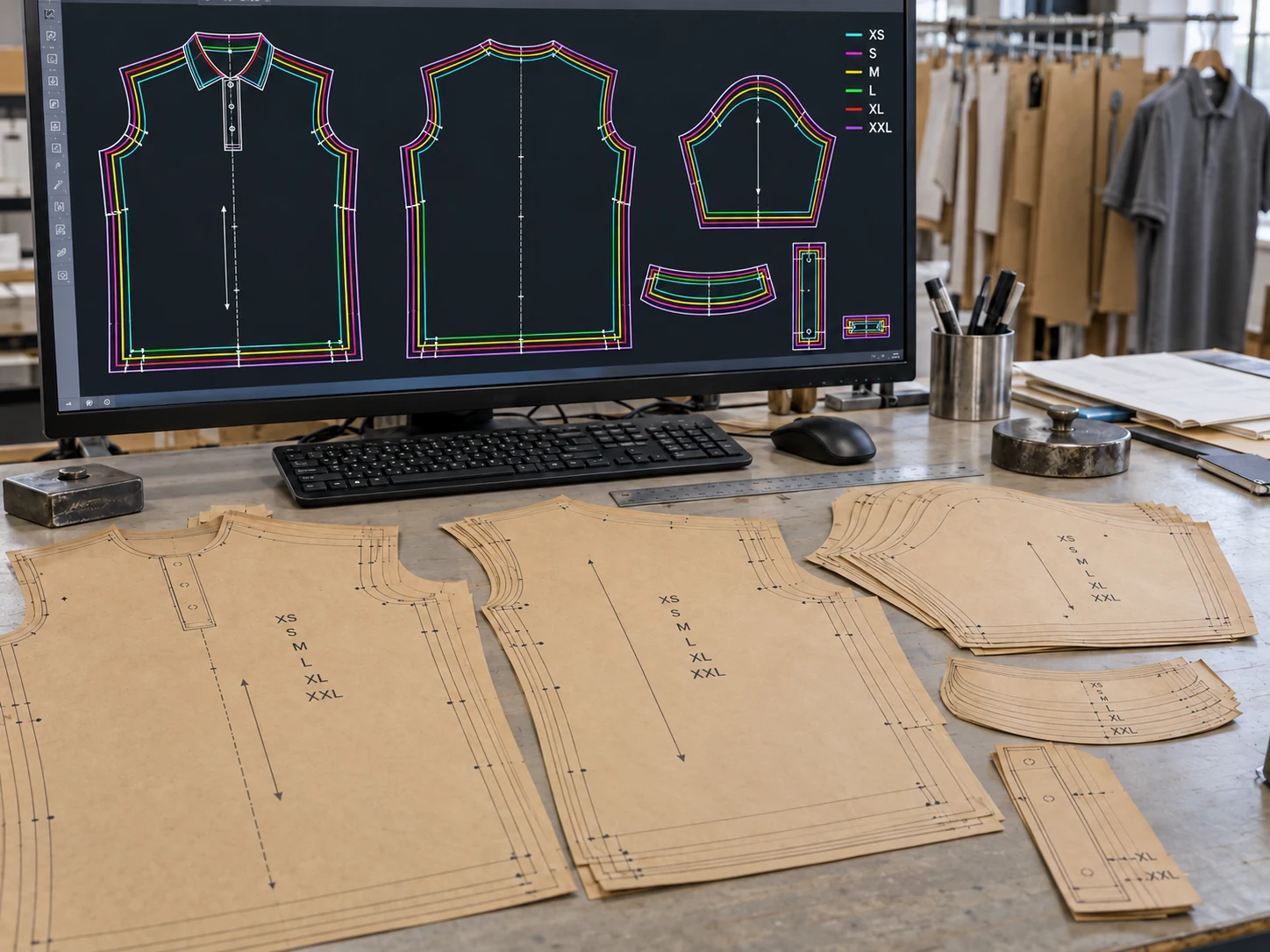
Clothing size grading develops an approved base pattern into the other sizes a brand intends to sell. Before bulk production, confirm the garment measurements for each size, the measurement methods, the changes between sizes and any size-dependent component specifications. An approved base-size sample is the starting reference; the graded chart records what the remaining sizes should become.
At KAOUYOU, customers commonly provide one size. After that base-size sample is approved, the pattern maker grades the style and submits the multi-size measurement chart for customer approval. Additional physical samples in other sizes are not routine for most projects; they may be requested by the customer or considered when a style has a particularly broad size range.
Answer in 30 Seconds
Before approving clothing size grading, check five things:
- The base-size pattern and sample reflect the agreed fit.
- The chart states finished-garment dimensions, units and repeatable measurement methods.
- Different measurement points use changes appropriate to the style, including smaller openings such as the neck and cuff.
- The fabric, wash condition and size-dependent trims match the development direction.
- The brand approves the graded chart, while later bulk inspections check the produced garments against it.
Grade rules define the intended difference between sizes. Tolerances define the permitted difference between a measured garment and its target. These are separate decisions. KAOUYOU commonly works with a 1 cm tolerance reference, but the applicable limit is confirmed with the customer for the relevant measurement points; it is not imposed on every dimension or order.
What Is Clothing Size Grading?
Grading changes a base pattern to produce the planned size range while preserving the intended design. It involves the relationship between widths, lengths, openings, curves and construction details—not simply adding the same amount to every measurement.
A wider chest does not tell the pattern maker how much to change the shoulder, sleeve, neckline or body length. Those decisions need to work together for the particular style. The resulting garment chart gives each size its own target dimensions.
If the base fit is still unresolved, settle that first. The oversized T-shirt fit guide explains the proportions to confirm on the initial garment. This guide addresses the next decision: extending that approved direction across the selling sizes.
What Should a Brand Provide Before the Factory Grades the Style?
Start with the approved base-size measurements and the intended selling range. An existing brand size chart or proven grading specification is useful when the new style must fit consistently with an established collection.
When a customer supplies only a design or reference garment, KAOUYOU asks for relevant body measurements, including chest, waist and hip, to clarify the intended wearer. The team also checks whether the supplied dimensions describe a person or a garment. Body measurements alone do not specify the finished garment; the intended fit and allowance around the body still need to be resolved through development.
If the customer has not selected a base size, KAOUYOU can recommend one for confirmation. Likewise, a request for European or American sizing needs a defined measurement reference. A market label by itself does not replace an approved chart for the actual style.
For a new project, send the reference, desired fit, base-size information, planned size range and material direction to the product development team. State whether the measurements are body dimensions or finished-garment dimensions.
What Needs to Be Clear in a Graded Measurement Chart?
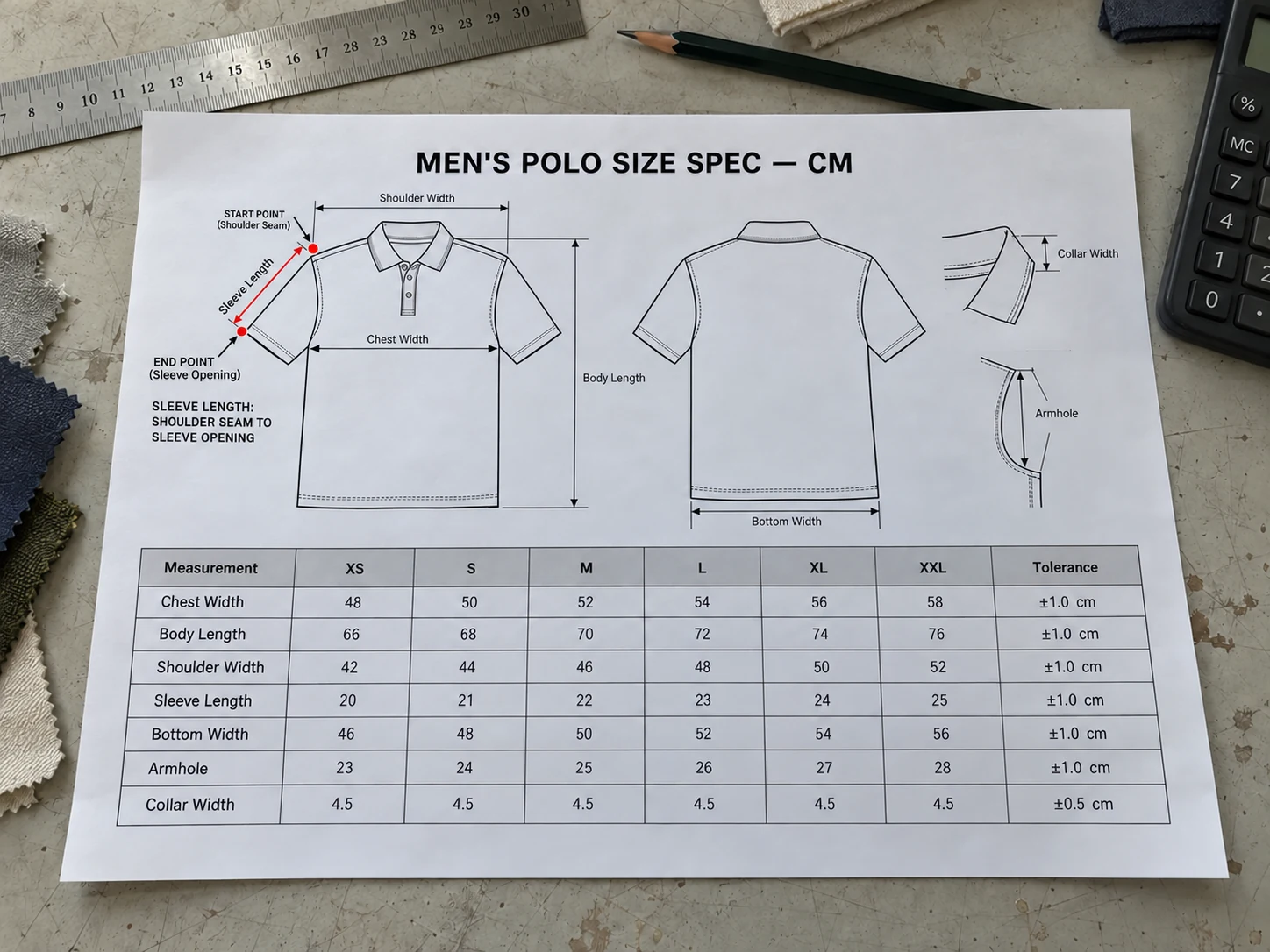
A useful chart lets the brand, pattern room and quality-control team identify the same measurement on the same garment condition. Define points of measure (POMs) clearly enough that a second person can repeat the check.
| Field | What to confirm | Why it matters |
|---|---|---|
| Size labels and range | The actual sizes included in the order | A label alone does not define dimensions |
| Base size | The approved development reference | Grading should follow the approved direction |
| POM and measurement method | Start point, end point and garment position | Different methods can produce different readings |
| Units | One clearly identified unit throughout | Prevents conversion and transcription mistakes |
| Measurement values | A target for each relevant POM in every size | Makes size-to-size changes reviewable |
| Garment condition | Before or after the specified finishing process | Wash and drying can change dimensions |
| Tolerance | The agreed permitted deviation for the relevant POM | Separates manufacturing acceptance from grading |
| Revision reference | The chart connected to the approved development record | Helps prevent use of an outdated specification |
For example, identify whether chest is a flat half-width or a full circumference. Body length also needs an agreed start point, and sleeve length needs to state where measurement begins. These examples are not a complete POM list; the construction determines what else must be recorded.
Should Every Measurement Increase by the Same Amount?
No. At KAOUYOU, the pattern maker uses grading appropriate to the style. Small dimensions, including neck and cuff openings, cannot automatically follow the same changes as the larger body measurements.
An oversized T-shirt, a boxy T-shirt, a cropped garment and a regular-fit style have different proportion goals. Increasing length too quickly can weaken a cropped direction; changing an opening without considering its function can make it unsuitable at another size. The chart should make these differences visible rather than assume one increment works everywhere.
The boxy-fit graphic T-shirt is a design reference for discussing width-to-length balance. Its pictured silhouette does not establish a grading rule for another order. The buyer's specification and approved sample remain the project references.
How Do Fabric and Garment Washing Affect Grading Approval?
The graded specification needs to correspond to the material and finishing direction. Fabric stretch, thickness and drape can change how a garment with the same nominal dimensions fits or hangs. At KAOUYOU, a fabric change requires renewed confirmation rather than assuming the existing approval covers the replacement.
For garment-dyed, enzyme-washed and vintage-washed styles, the customer's chart normally describes the garment after washing and drying. That is the condition intended for delivery. Before pattern development, KAOUYOU checks shrinkage of the body fabric, rib and other joined materials, then the pattern maker builds the necessary allowance into the pattern.
Do not enlarge the entire pattern by one blanket percentage. Lengthwise and widthwise shrinkage can differ, and body fabric and rib may respond differently. Pattern allowance must address those relationships.
Before bulk, a wash sample or small-batch trial can be used to compare dimensions before and after processing and adjust the pattern again where needed. The approved post-wash sample and chart form the production reference. This trial is separate from making a full range of physical size samples.
For a direction such as the washed crewneck sweatshirt, confirm the finished measurements together with the wash and rib behavior. The T-shirt shrinkage control guide explains the related material and finishing checks in more detail.
Must Pockets, Artwork and Zippers Change with Every Size?
Not necessarily. KAOUYOU considers function, appearance, production cost and component availability before choosing one specification, several size groups or a specification for each size.
| Component | KAOUYOU's described approach | Buyer decision |
|---|---|---|
| Pockets | May change with garment size, often less than the body; adjacent sizes may share a specification | Confirm proportion, position and usable opening |
| Printing | Most orders use one artwork size; a broad range can use smaller and larger groups | Approve how the graphic looks across the range |
| Embroidery | Usually shares a size where practical; clear proportion differences may justify grouping | Confirm the required artwork versions |
| Zippers | Length follows garment length and front construction; adjacent sizes may share when placement permits | Check top and bottom positions and finished appearance |
| Labels and small hardware | Usually share specifications, except information such as the size marking | Confirm size identification and the component list |
Grouping must be explicit in the technical package (Tech Pack) and component list. A group such as S–M or L–XL is a possible project arrangement, not a universal rule. KAOUYOU checks the planned range against the supplier's minimum order quantity (MOQ), cost and garment proportion before confirming the arrangement.
For a full-zip hoodie, a change in body length needs to be considered alongside zipper length and its connection to the hem. The pullover versus zip-up hoodie guide covers the construction questions that sit behind this decision.
Does Every Order Need Samples in All Sizes?
No. KAOUYOU normally develops and approves the base-size garment, then grades the style using the pattern maker's experience and submits the chart to the customer. Making other sizes is generally considered when the customer requires them or the style has many sizes.
A chart approval and a physical fit review provide different evidence. A chart confirms intended dimensions; a physical sample allows the named size to be measured and assessed as a garment. Record what was actually reviewed instead of describing unmade sizes as physically tested.
When extra samples are requested, agree which sizes and what the review needs to establish. The prototype and pre-production sample guide explains the broader sample approvals. Neither that guide nor this one makes a full size set a routine requirement for every order.
How Should Graded Measurements Be Approved and Recorded?
KAOUYOU sends the graded chart to the customer for approval and records production information in its internal pattern/development sheet. Before approving, the brand should check the base-size reference, selling range, POM definitions, size-to-size changes, finishing condition and component groups.
Keep the chart connected to the applicable pattern and development revision. If the customer changes the fit, fabric or requested measurements, identify which specification needs renewed confirmation. A garment measurement chart and an order's size quantity ratio also serve different purposes: one defines dimensions; the other allocates units between sizes.
A practical approval message can identify the chart revision, sizes covered and any remaining comments. This is a recommended communication format, not a claim that every KAOUYOU customer uses the same template.
How Are Dimensions Checked During Bulk Production?
KAOUYOU's quality-control (QC) team measures garments during early, middle and final production checks. The approved chart supplies the targets; the applicable tolerance supplies the acceptance boundary. Grading approval does not remove the need to measure the garments actually produced.
When dimensions differ, KAOUYOU may use pressing or rework according to the condition, then measure the garment again. Pressing is not a universal correction for an incorrect pattern or a substantial dimensional fault. If it cannot resolve the issue, further rework is needed. The recheck should establish the result rather than accept a temporarily improved appearance alone.
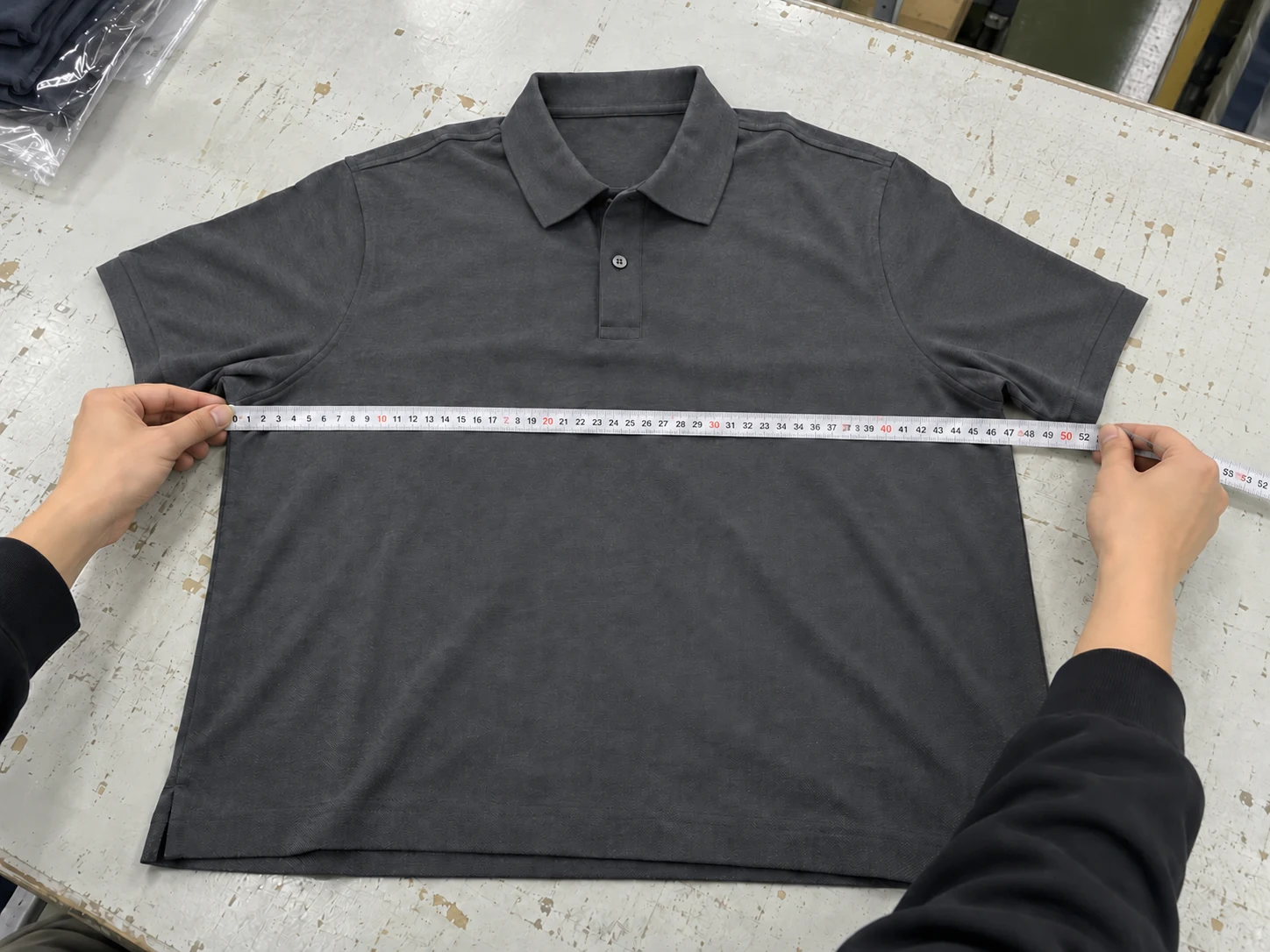
Agree the dimensional checks as part of the project's quality-control requirements. The clothing manufacturing QC checklist covers the wider inspection process; this article focuses on keeping the produced size range aligned with its approved measurements.
Frequently Asked Questions
Can a factory grade clothing when I only have one size chart?
Yes. KAOUYOU commonly receives one size, develops the base sample and grades after its approval. The customer still needs to approve the resulting multi-size chart. Provide an existing brand specification when the new product must align with an established range.
Can I ask for European or American sizes without exact measurements?
That can start the discussion, but it does not define the final garment. KAOUYOU clarifies the intended body dimensions and fit, then matches the garment direction for approval. State whether any supplied numbers describe the wearer or the clothing.
Is a grade increment the same as a measurement tolerance?
No. A grade increment is the intended change from one size to another. A tolerance is the agreed deviation allowed around one size's target measurement. A wider tolerance does not correct an unsuitable grade rule.
Do larger sizes automatically need larger graphics?
No. Many KAOUYOU orders use one print or embroidery size. A broad garment range may benefit from grouping when the visual difference matters. Confirm the grouping, placement and artwork versions before production.
If I add another size, must I remake every sample?
Not automatically. KAOUYOU can extend the chart using the relevant grading rules. Confirm the new target measurements and component requirements, then discuss whether the range or customer requirement calls for an additional physical sample.
Can I keep the same size approval after changing fabric?
At KAOUYOU, a change of fabric requires renewed confirmation. Review whether the replacement changes the intended fit, material behavior or finishing result, and identify the updated production reference.
Send the Base Size and Selling Range for Review
To discuss grading for a T-shirt or hoodie project, send the approved base-size chart or reference, planned sizes, measurement units, intended fit, fabric and wash direction, artwork and component requirements. Include any customer-specific tolerance or additional sample request.
Use the T-shirt collection or hoodie and sweatshirt collection to identify the closest design direction, then submit the project requirements. A clear base-size reference and approved graded chart help the development and QC teams work toward the same finished garment.