A pullover hoodie offers a continuous front without a full-length opening. A zip-up hoodie adds opening functionality, but also adds a zipper, installation work and alignment checks. With otherwise comparable specifications, those additions usually make the zip-up more expensive to manufacture.
For clothing brands, the choice affects more than the trim price. The front pattern, hood opening, pocket layout, rib hem, artwork and wash process must work together. KAOUYOU has developed pullover, full-zip and half-zip hoodies; pullovers are the most frequently requested of these styles.
Answer in 30 seconds
- Compare costs using the same fabric, weight, measurements, wash, decoration and quantity.
- A pullover pattern cannot normally become a zip-up simply by cutting the front open.
- Specify zipper type, size, length, color, puller and opening direction before sampling.
- Check the zipped garment for front waves, pocket alignment and matching rib-hem heights.
- Approve the complete washed sample when garment dyeing or washing is involved.
How Do Pullover and Zip-Up Hoodie Constructions Differ?
A conventional pullover can use a single front body panel. A full-zip construction splits that front into left and right sections and adds zipper attachment. Additional facings, guards or reinforcement depend on the design; they should be specified rather than assumed.
| Decision | Pullover | Full zip-up |
|---|---|---|
| Front body | Continuous front with no full-length opening | Left and right fronts developed around the zipper |
| Front pocket | A continuous kangaroo pocket is possible, but not mandatory | Split pockets or another layout that clears the opening |
| Hood and neckline | Confirm overlap, opening and ease of putting it on | Confirm top zipper position, hood connection and chin clearance |
| Front graphic | Continuous artwork placement is possible | Artwork may need separation and left/right alignment |
| Production focus | Fit, hood opening, pocket and rib balance | Those checks plus zipper function, front stability and symmetry |
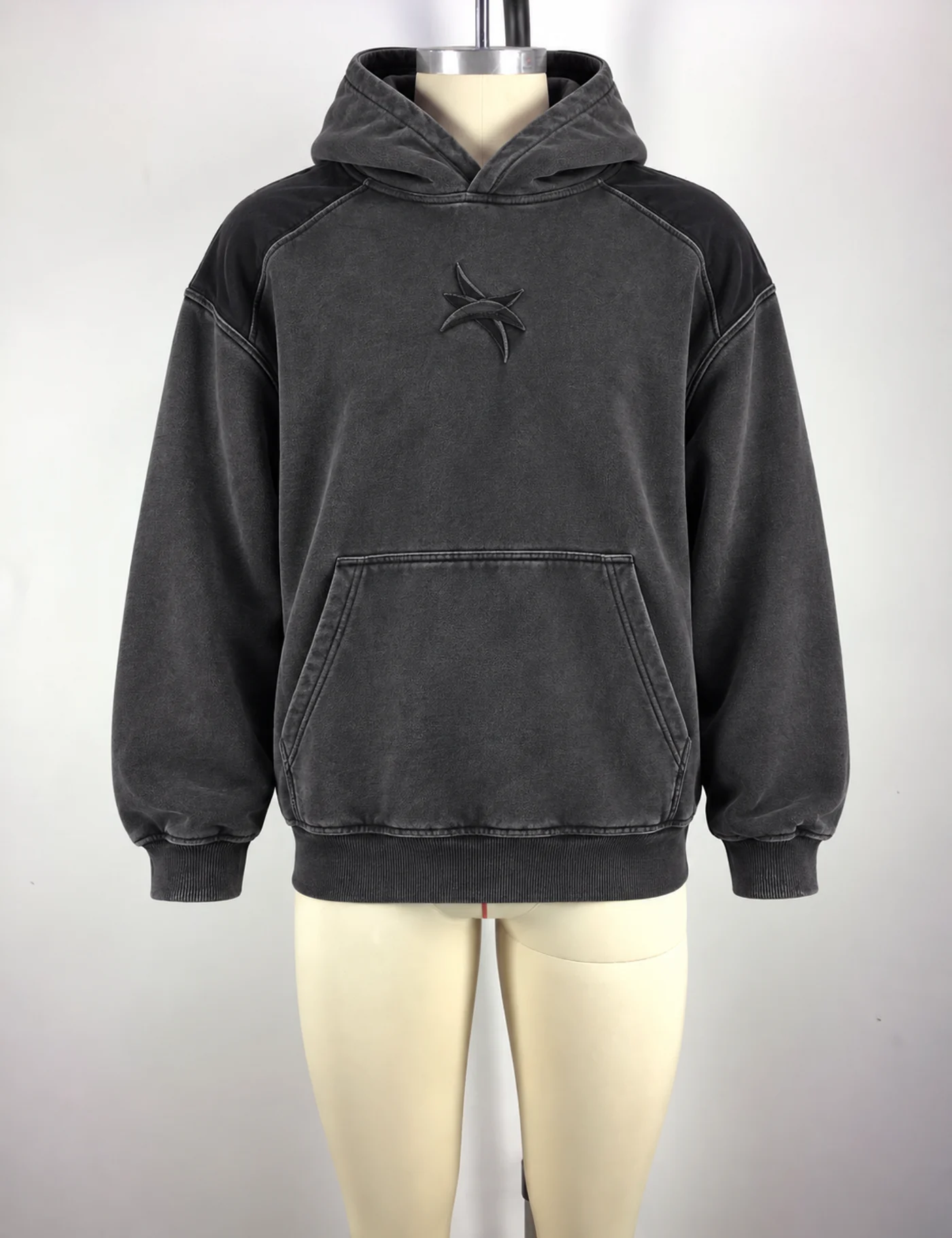
The washed tonal embroidered pullover hoodie illustrates one body direction. Its chest decoration, wash appearance and proportions are individual design choices, not requirements for all pullovers.
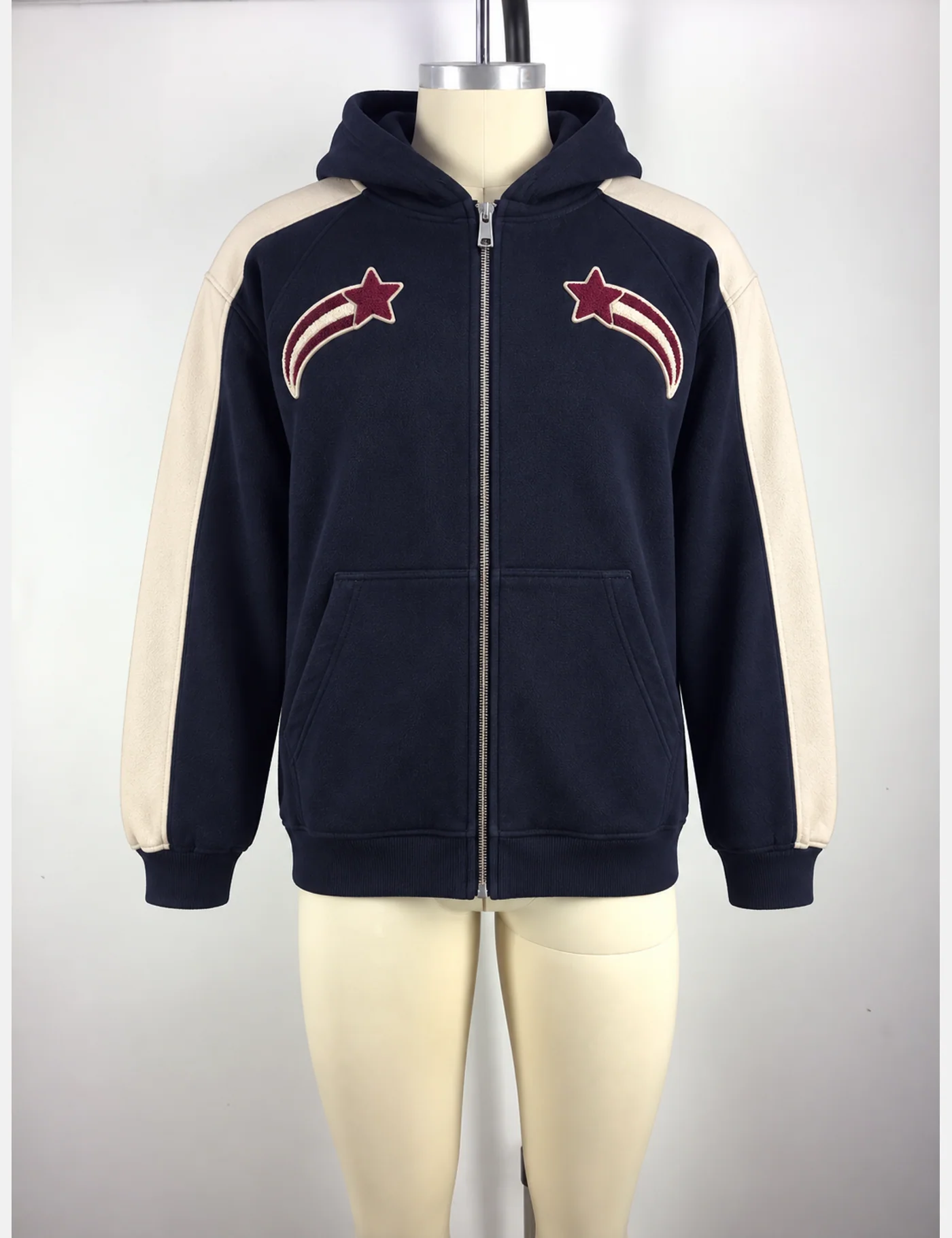
The chenille shooting-star zip hoodie provides a reference for the opening, pocket layout and decoration placement. Explore the hoodies and sweatshirts collection when choosing the body direction before adding branding.
Why Does a Zip-Up Usually Cost More, and What Can Change the Quote?
At KAOUYOU, the basic additional costs are the zipper itself and the work to install it. Splitting the front and managing zipper placement introduces sewing and alignment work that the comparable pullover does not require. Thick junctions, special guards, difficult artwork and washing can add further complexity.
Compare matched specifications. A simple zip-up made from a lighter fabric may cost less than a heavy pullover with elaborate embroidery and washing. The zipper difference alone cannot explain the price of two unrelated samples.
For a useful comparison, hold the fabric composition and grams per square meter (GSM), finished measurements, hood construction, decoration, wash, labels, packing and quantity as consistent as the designs permit. Then ask which construction and trim changes affect the quote. The hoodie manufacturing cost guide covers the wider garment breakdown.
Do custom zippers change sourcing time and cost?
KAOUYOU normally avoids unnecessary zipper customization. In its procurement experience, customized zipper orders commonly take around 15 days and cost more than suitable available options. That is an approximate sourcing experience, not a guaranteed delivery time; specifications, approval and supplier conditions must be confirmed for each order.
Custom puller shapes or other tooling-dependent changes can involve mold charges. Do not assume every color request requires a new mold, or that a logo puller and a custom-colored zipper have the same purchasing requirements. Request the relevant minimum quantity, development charge and procurement timing for the exact customization.
The usual garment minimum order quantity (MOQ) is the same for both constructions: 100 pieces per style, per color, with mixed sizes within that color. Special zippers or other custom trims may have separate supplier minimums.
Which Zipper Specifications Must Be Confirmed?
KAOUYOU commonly uses SBS zippers and asks the client which zipper size is required. A brand name alone is not a complete specification. Confirm the zipper construction and finished appearance, especially when the client requests a particular model or brand.
- Zipper material and type, such as metal, molded plastic or coil.
- Zipper size/model and any specified brand or product reference.
- Finished length and its relationship to the hood, front body and rib hem.
- Teeth, tape and puller colors, including any metal finish.
- One-way or two-way opening and the required separating construction.
- Puller shape, logo requirements, inside guard and top-end treatment.
KAOUYOU confirms zipper length with the client and commonly uses one length for a group of two or three adjacent garment sizes. This needs pattern approval: garment length, top clearance and the bottom junction must still work throughout the group. It is not a reason to force every size to use a single length.
Check how the zipper behaves on the actual hoodie, not only as a loose trim. The approved combination should open smoothly, close naturally and avoid catching the nearby fabric.
Can a Pullover Pattern Be Reused for a Zip-Up?
Not unchanged. KAOUYOU normally adjusts the pattern and makes a sample for the zip-up version. Cutting down the center of a finished pullover does not account for zipper width, attachment allowances, front treatment or the connections at the neckline and hem.
The review includes center-front seam allowances, zipper exposure, front width, chest measurement, hood opening, neckline position and rib connection. A continuous kangaroo pocket usually needs to become split pockets or be replaced by another layout. Check the overall proportion after these changes rather than approving each component in isolation.
What must be specified around the hood and pockets?
For the hood, confirm whether the front edges overlap, meet or remain separated. On a zip-up, review where the closed zipper ends, whether it approaches the chin and whether an inner guard is required. Inspect both the closed front and the open neckline.
For pockets, record width, height, opening length and angle, left/right spacing and distances from the zipper, hem and side seams. Keep enough room for construction and avoid unnecessary bulk where the pocket approaches the rib hem. On the sample, check whether hand entry is comfortable and whether the pockets align when zipped.
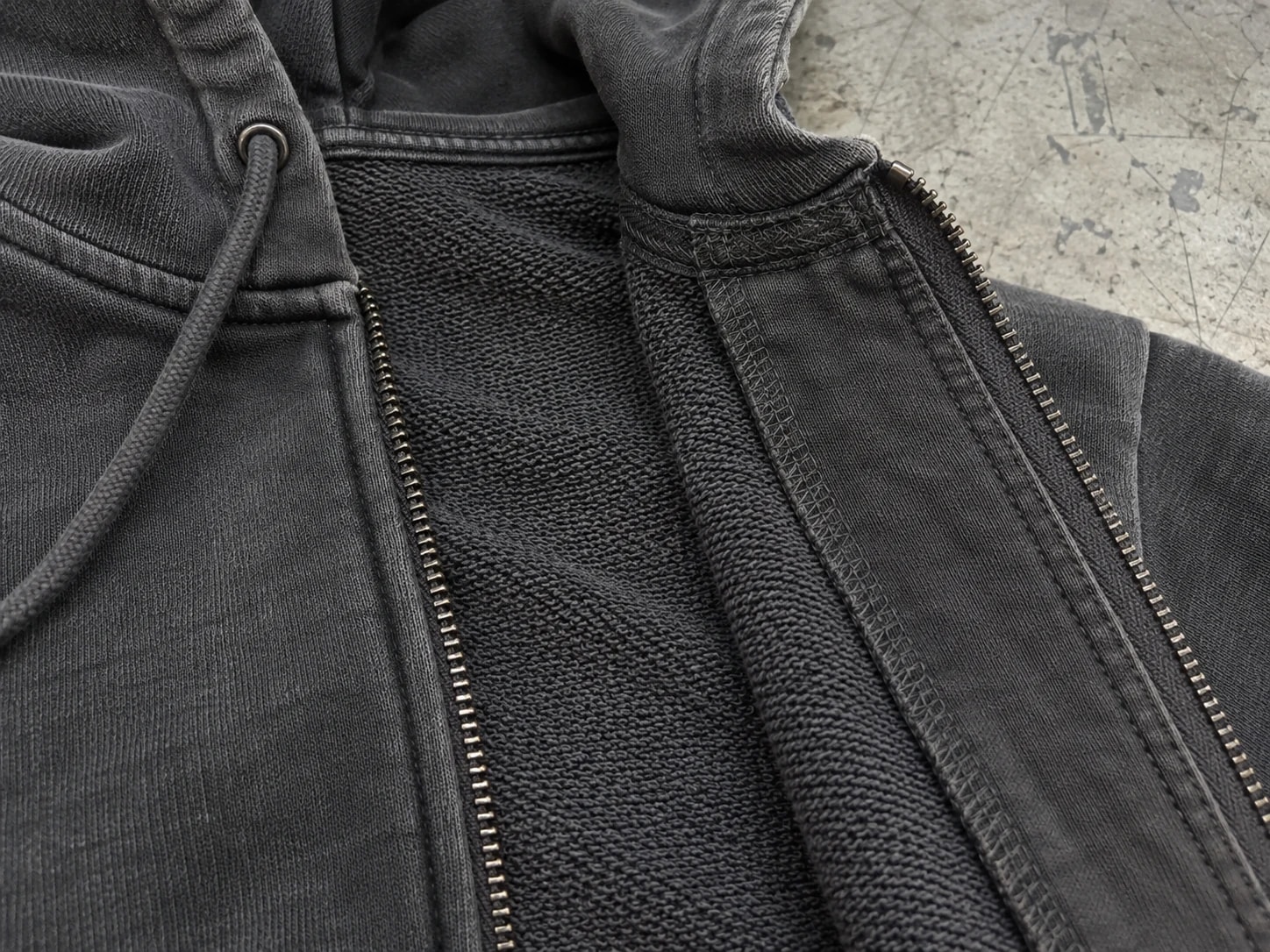
Why Do Zip-Up Hoodie Fronts Become Wavy or Uneven?
Common problems at KAOUYOU include wavy fronts, unequal left and right lengths, uneven hem heights, inconsistent zipper exposure and pockets or graphics that no longer line up when closed. Sweatshirt fabric can stretch during sewing, while the zipper tape generally has much less stretch. Different movement and recovery can distort the joined front.
The team also checks panel dimensions, zipper length, seam allowances and sewing handling. Before attachment, verify corresponding alignment points on both sides. Control fabric extension while sewing; where appropriate, a stabilizing strip or positioning template can help keep the front consistent.
Why is the zipper-to-rib junction difficult on heavyweight hoodies?
Main fabric, rib, zipper tape and seam allowances meet in a small area. Unnecessary stacked layers can create a bulky bottom corner or prevent the zipped hem from sitting naturally.
KAOUYOU adjusts or staggers allowances according to thickness, controls the zipper bottom position and reduces unnecessary layers without sacrificing seam security. Both sides need the same treatment. Check bottom-end flatness, matching rib heights and whether the hem aligns naturally after closing.
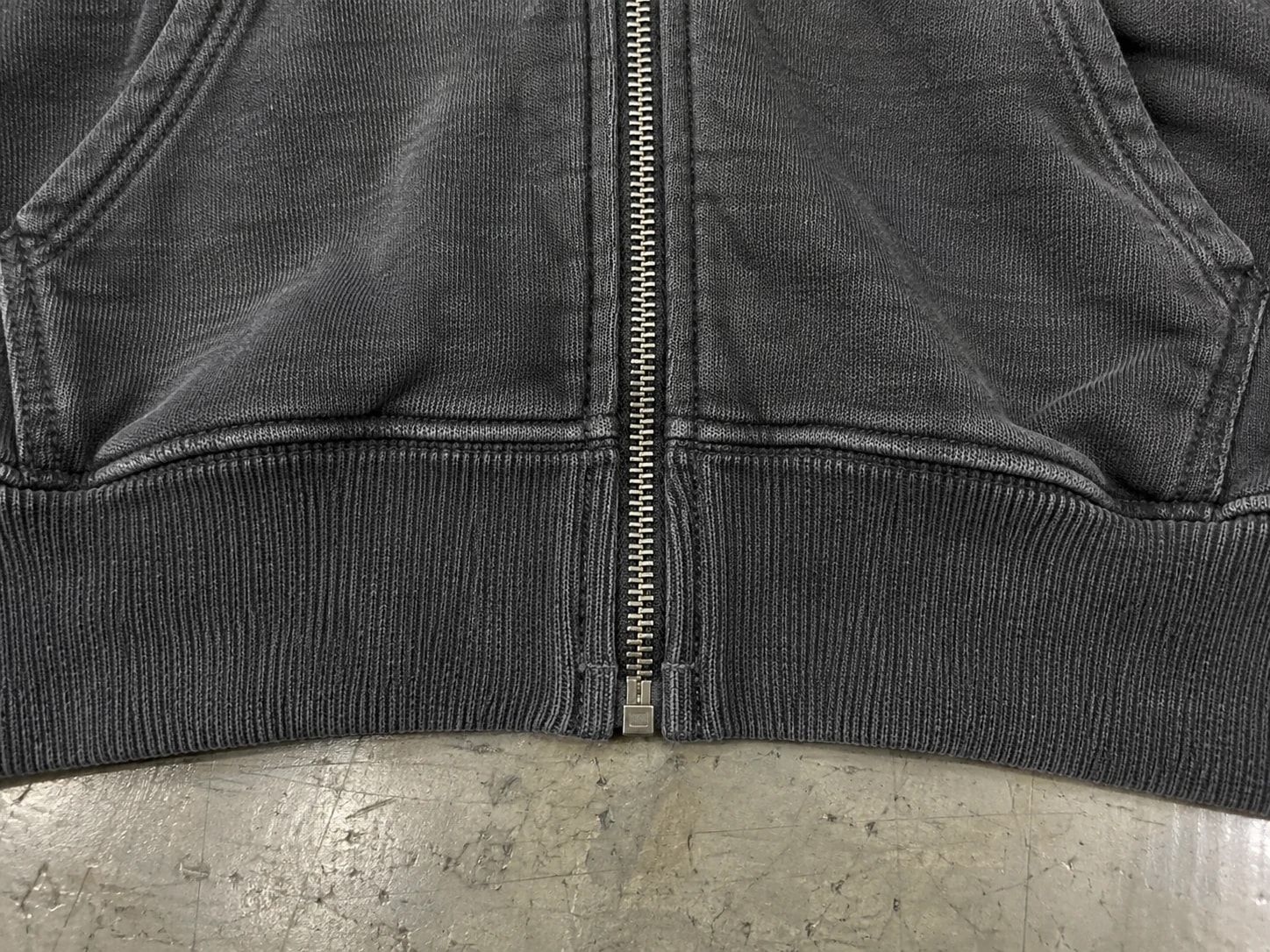
See the hoodie ribbing guide for the separate decisions around rib dimensions, recovery and compatibility with the body fabric.
Can Printing or Embroidery Cross the Front Zipper?
Yes, but the artwork determines the risk. Text, faces, regular geometry and strongly symmetrical designs make small mismatches especially visible. A digital mockup can show the intended composition without showing the effects of zipper width and front seam allowances.
KAOUYOU normally separates the artwork into left and right parts and positions them around the zipper exposure and construction allowances. Keep important details away from the teeth and leave practical access for the decoration process. Approve the closed garment to assess how the halves read together.
Embroidery has additional access and thickness constraints. The usual approach is to embroider the left and right panels separately before zipper installation, not to stitch directly across the zipper. Full-sample confirmation is more informative than approving an electronic placement alone.
The garment artwork preparation guide explains finished dimensions and positioning inputs. Confirm any permitted interruption or mismatch explicitly rather than promising an invisible join.
Should the Zipper Be Installed Before Garment Dyeing or Washing?
KAOUYOU usually completes sewing and zipper installation before garment dyeing or vintage washing so the garment develops its finish together. The zipper teeth, puller, tape and metal finish must first be assessed for the intended treatment and drying conditions.
Heavy washing can alter or scratch metal finishes. Differences between tape, body and rib shrinkage can produce front waves or distortion. Depending on the complete process sample, the team may change the zipper, adjust wash intensity or consider installing the zipper after washing. There is no single sequence suitable for every project.
Printing is normally completed after garment washing at KAOUYOU; embroidery timing depends on whether it should age together with the garment. Specify the complete route rather than treating the zipper, decoration and wash as independent approvals.
What is checked after washing?
- Smooth opening and closing, catching, distortion or color loss.
- Front waves, equal side lengths and matching bottom heights.
- Tape shrinkage, twisting and uneven coloration.
- Body-to-tape puckering and rib shrinkage or recovery loss.
- Bottom-junction bulk and natural closed-front alignment.
- Scratches, oxidation, finish loss, approved garment shade and hand.
If these components are incompatible, adjust the pattern, zipper length, rib dimensions or wash settings and confirm a new sample. Pressing a wavy front flat temporarily is not evidence that the underlying problem has been corrected.
What Must Be Approved on the Sample and Checked in Bulk?
Approve the complete hoodie, including its intended final wash condition. Besides fit and measurements, confirm zipper specification, opening function, exposure, hood connection, top-end comfort, inside finish, pocket symmetry and hem alignment. Check it open and closed.
For a decorated front, confirm the closed graphic relationship. Record outstanding changes rather than treating a general “approved” message as approval of every detail. Keep the zipper reference, pattern instructions, artwork files and final sample consistent.
Production checks include the zipper inputs before use, attachment and alignment on the first piece, checks during production, and finished-garment review. When washing applies, check function and symmetry again afterward. Look for caught fabric, insecure stitching, unequal exposure and top or bottom misalignment before packing.
The clothing quality-control checklist covers the wider inspection workflow. Customer-specific tolerances or test requirements should be agreed in advance; this comparison does not introduce a fixed inspection count or zipper-test standard.
What Should a Brand Send for a Comparable Quote?
Start with the effect drawing: the opening style is normally clear from the design. If both versions are being considered, identify the shared specifications and the differences so the comparison is meaningful.
- Pullover, full-zip or half-zip direction, with front, back and open-front references where relevant.
- Fabric composition, finished GSM, inside finish, colors and garment measurements.
- Hood, neckline, pocket and rib details, including any guards or reinforcement requirements.
- Zipper type, size, brand if specified, color, puller, length groups and opening direction.
- Artwork files, dimensions and placements; identify any design crossing the zipper.
- Garment dye or wash direction, final care requirements and sample approval condition.
- Quantity by style and color, size allocation, labels, packaging and budget direction.
Use the heavyweight hoodie tech-pack checklist to assemble the complete brief. A quotation comparison becomes more useful when the material and construction assumptions are visible.
Frequently Asked Questions
Does every zip-up hoodie need a custom zipper?
No. KAOUYOU normally uses suitable available zipper options and commonly sources SBS zippers. Custom colors, branded pullers or specified zipper brands are reviewed when the client needs them; their cost and procurement requirements must be confirmed separately.
Can several hoodie sizes share one zipper length?
Yes, when the pattern and client approval support it. KAOUYOU commonly groups two or three adjacent sizes around one zipper length. This is not a universal grading rule: finished front length and top and bottom placement still need checking.
Can a pullover sample approve the matching zip-up version?
Not by itself. Adding a zipper changes the front construction, seam allowances, hood opening, pockets and hem connections. The zip-up version needs its own pattern review and complete sample approval.
Is a zip-up hoodie always more expensive?
With comparable fabric, measurements, decoration and quantity, the zipper and its installation usually increase cost. Different fabrics, washes, artwork or trims can outweigh that difference, so compare matched specifications rather than unrelated product prices.
Do pullover and zip-up hoodies have different garment MOQs at KAOUYOU?
The usual garment MOQ is the same: 100 pieces per style, per color, with mixed sizes within that color. Special zippers and other custom trims may have separate supplier requirements.