A production-ready heavyweight hoodie tech pack must describe one complete product system: fabric, fit, hood, rib, pocket, construction, decoration, labels, packaging and the approval stage. “400 GSM, 100% cotton, oversized” is a direction—not a manufacturing specification.
This factory-side guide explains the minimum information needed for a useful quotation, a controlled Fit Sample and a bulk-ready PP Sample. It also shows which questions brands should ask when requesting a custom heavyweight hoodie.
Answer in 30 seconds
- State finished fabric GSM, fabric structure, full composition, color, hand and wash stage—not GSM alone.
- Fit names such as Boxy or Oversized never replace a POM chart and measurement diagrams.
- Specify the hood, rib, pocket and bulky seam junctions because these determine a heavyweight hoodie's silhouette.
- Release bulk only after the PP Sample and final tech pack are approved in writing.
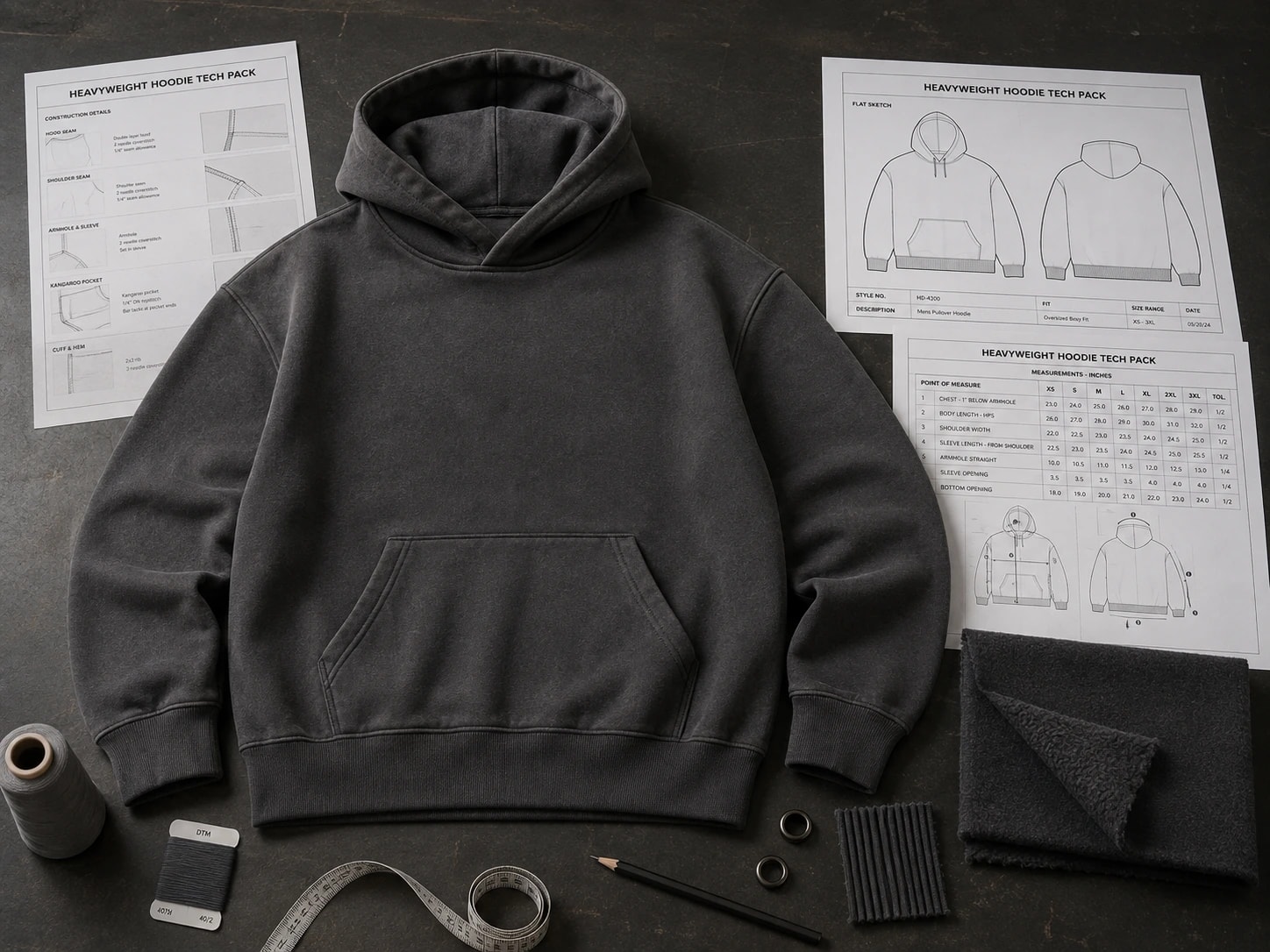
What GSM Is Considered Heavyweight for a Hoodie?
The apparel industry has no universal heavyweight threshold. For common sweatshirt fabrics, the following ranges are useful starting points—not quality grades or mandatory standards.
| Finished fabric weight | Practical product direction |
|---|---|
| 280–320 GSM | Regular medium-weight sweatshirt direction |
| 320–380 GSM | Medium-heavy to heavyweight |
| 380–450 GSM | Clearly heavyweight hoodie |
| Above 450 GSM | Ultra-heavy or highly structured product |
French Terry and Brushed Fleece should not be compared by GSM alone. At the same finished GSM, Brushed Fleece usually feels thicker and warmer because its raised reverse traps more air; French Terry normally feels tighter, drier and more structured. Read our French Terry versus Fleece guide before locking the fabric direction.
What Must a Heavyweight Hoodie Tech Pack Include?
The minimum useful pack for quotation and sampling covers the following information. A factory can estimate from reference photographs, but final pricing normally depends on confirmed materials, construction and techniques.
| Section | Minimum information |
|---|---|
| Style drawings | Front and back; add detail views wherever the structure is unclear |
| Measurements | Base-size POM chart, method diagrams, tolerances and units |
| Fabric | Type, full composition, finished GSM, color, hand and finish |
| BOM | Every garment and packaging material, with color, size, position and quantity |
| Construction | Seam, stitch, reinforcement and bulky-junction requirements |
| Decoration | Vector artwork, final size, position, colors and process |
| Branding and packing | Labels, hangtags, barcode, folding, polybag and carton |
| Commercial brief | Estimated quantity, colorways and size ratio |
Which drawing views should be provided?
Every hoodie needs clear front and back flats. Add side or internal views, hood enlargements, neckline, pocket and zipper details, cuff and hem construction, artwork and label placements, plus special panels or seam junctions when these cannot be understood from the main views. There is no value in drawing unnecessary angles, but every ambiguous structure needs a close-up.
How Should Heavyweight Hoodie Fabric and GSM Be Specified?
A useful fabric line states fiber composition, finished GSM and tolerance, French Terry or Brushed Fleece, two- or three-thread structure where required, color or Pantone reference, target hand, stretch, dye route, finishing, horizontal and vertical shrinkage, spirality and pilling expectations.
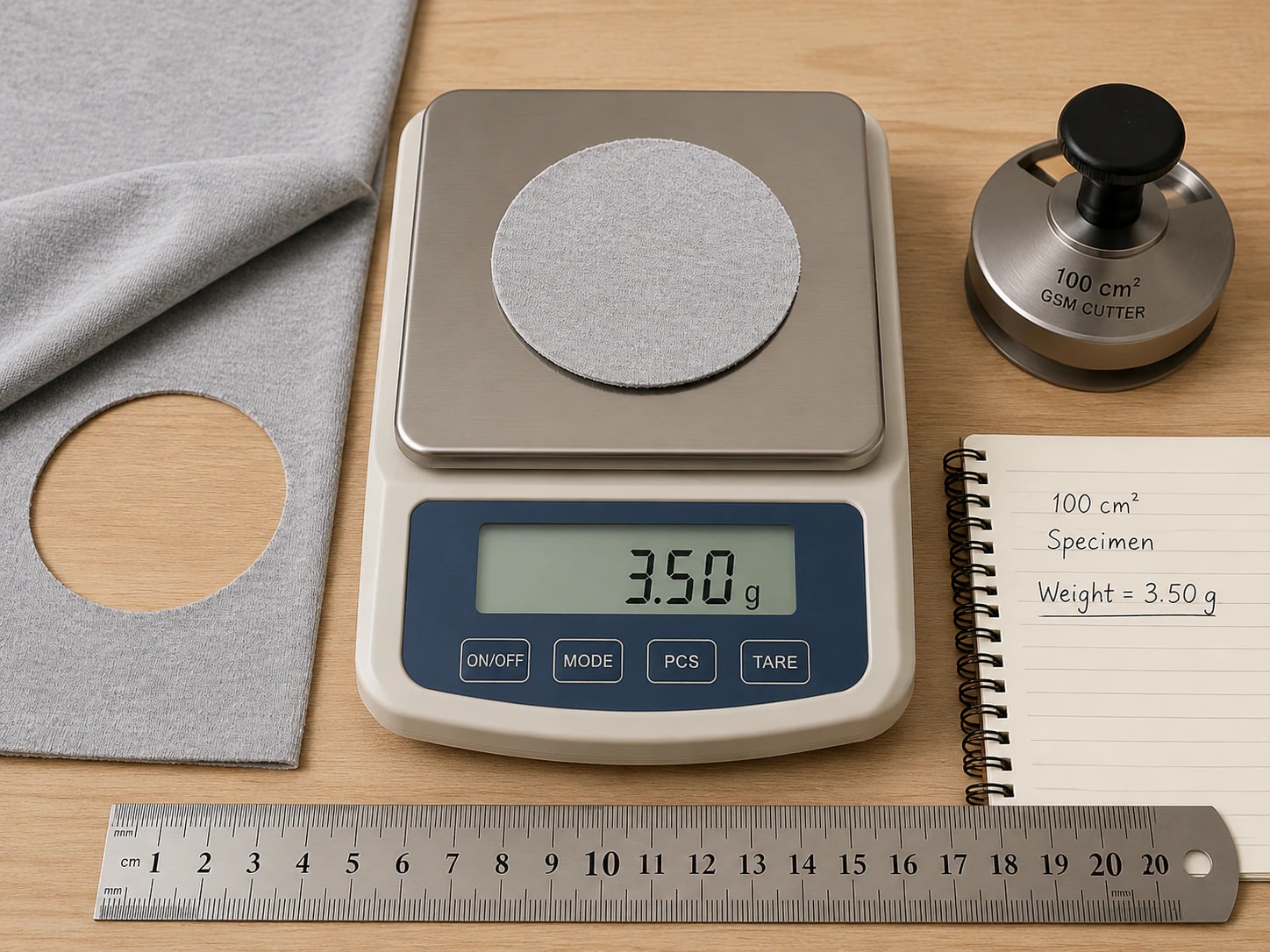
Is “400 GSM 100% Cotton Heavyweight Hoodie” enough?
No. Confirm whether 400 GSM is measured before or after finishing; whether the fabric is French Terry or Brushed Fleece; whether it is a three-thread construction; and whether 100% cotton applies to the face, tie and back yarns. Also state combed, carded or open-end yarn direction, target color and hand, piece dye or garment dye, wash process, shrinkage, spirality, pilling and the matching rib specification.
Many commercial fleece fabrics are cotton-polyester blends or use cotton only on the face. The complete construction must be verified with the fabric supplier. For sourcing support, review KAOUYOU's fabric, trims and packaging service.
How Should Fit and Hoodie POM Measurements Be Defined?
Regular, Relaxed, Boxy, Oversized and Cropped communicate a general silhouette, but the words do not control the garment. The most reliable brief combines an approved measurement chart, a model height and sample size, and an on-body reference.
| Fit term | General direction—not a measurement standard |
|---|---|
| Regular | Standard ease; shoulder seam close to the natural shoulder |
| Relaxed | More room than Regular without extreme enlargement |
| Boxy | Wide body with a comparatively shorter length |
| Oversized | Clearly enlarged chest, shoulder, sleeve and total volume |
| Cropped | Shortened body length; chest does not have to be narrow |
Essential POMs include back body length, half chest, shoulder width, sleeve length, bicep or half upper arm, cuff width, hood height and width, front neck drop and back neck width, kangaroo-pocket dimensions and opening, plus cuff and hem-rib height. A zip hoodie also needs center-front zipper length. Add hem width, armhole depth or center-back-neck-to-cuff length when the style requires them.
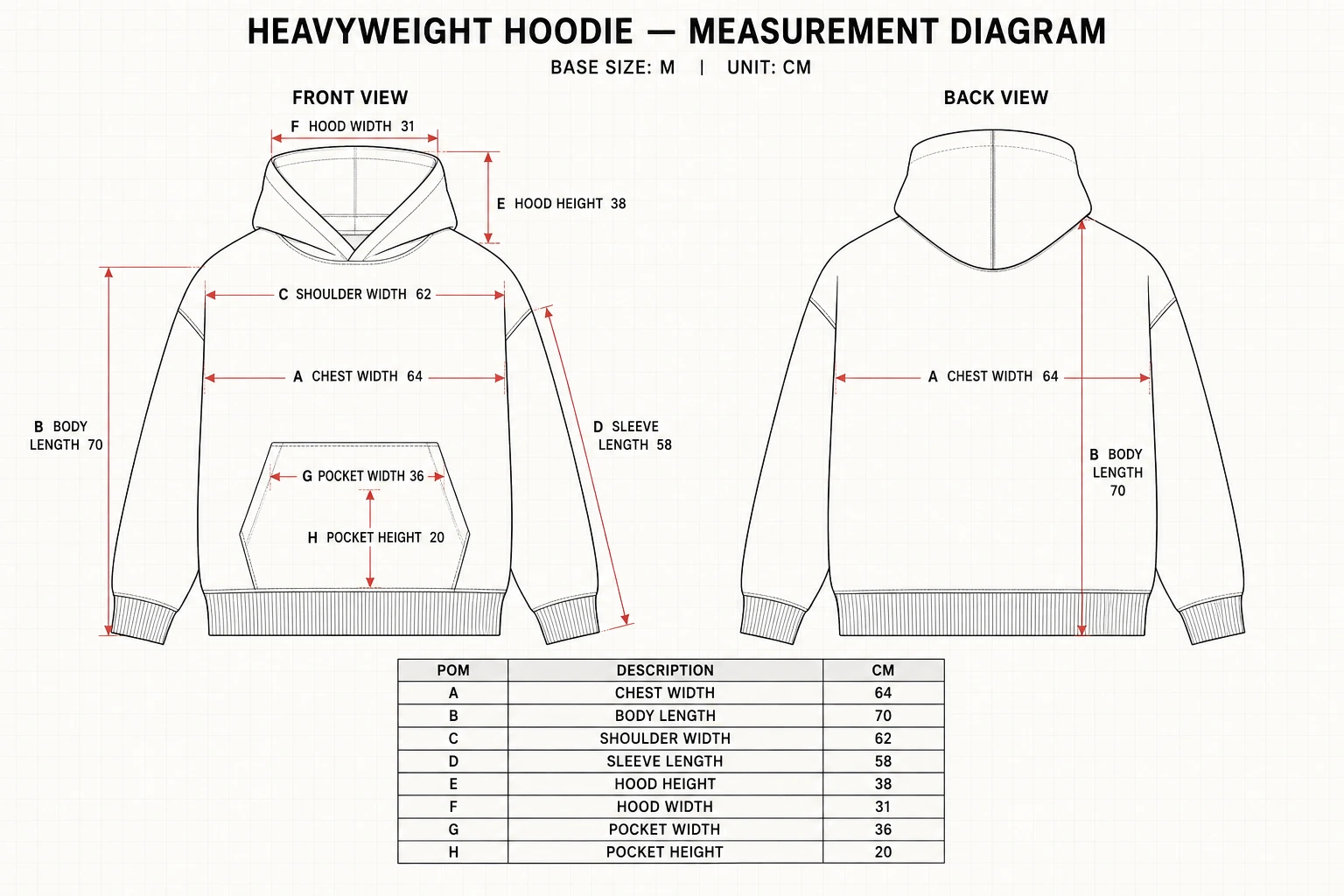
How should chest, body length, shoulder and sleeve be measured?
Pair every POM name with a diagram. For example: measure half chest horizontally at the stated underarm position; center-back body length from the back-neck seam to hem; shoulder point to shoulder point; and sleeve from the shoulder point to cuff edge. “Body length” from high shoulder point and from center back will produce different numbers, as will chest measured directly at the underarm versus 2.5 cm below it.
How do you measure a drop-shoulder hoodie sleeve?
Provide both shoulder-point-to-cuff sleeve length and center-back-neck-to-cuff total length. When shoulder width changes, the sleeve endpoint changes too. One measurement controls total reach; the other lets the factory check shoulder and sleeve independently.
What Hood, Rib and Kangaroo-Pocket Details Should Be Specified?
Hood construction
State single or double layer; hood height, width and opening; center-back seam; two- or three-panel structure; same-fabric or contrast lining; drawcord, eyelet and aglet details; cord gauge, length and material; topstitch or binding; and whether the hood should stand naturally or fully cover the head. “Standard hood” is not a reproducible specification.
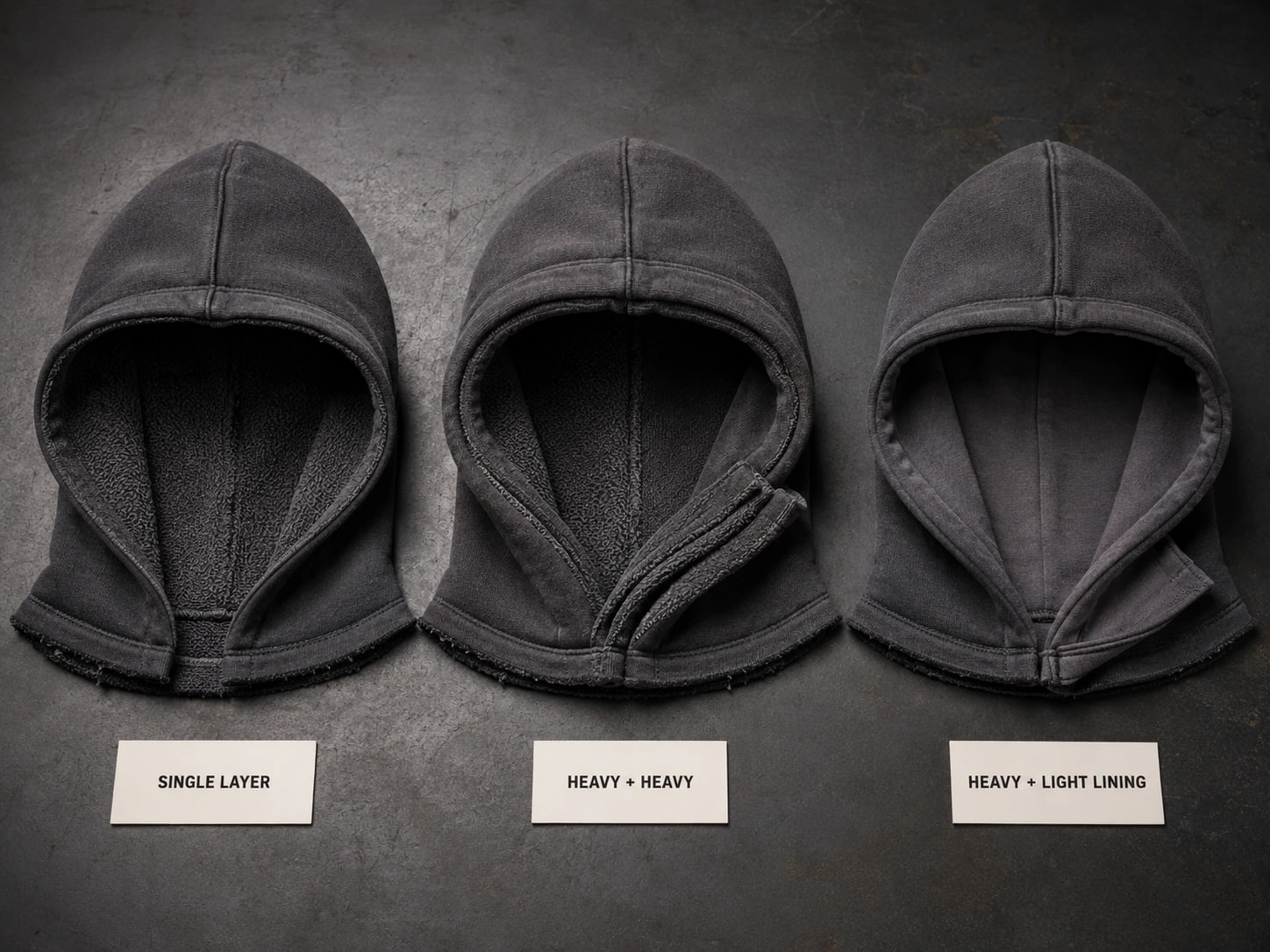
A double-layer hood looks fuller and cleaner inside, but adds material, sewing cost, garment weight and neck bulk. At 400–500 GSM, two layers of the same body fabric can pull the neckline backward, make the back neck too thick or feel rigid when worn. A refined hood pattern, fewer overlapping seams or a lighter lining can produce a better balance.
Rib specification
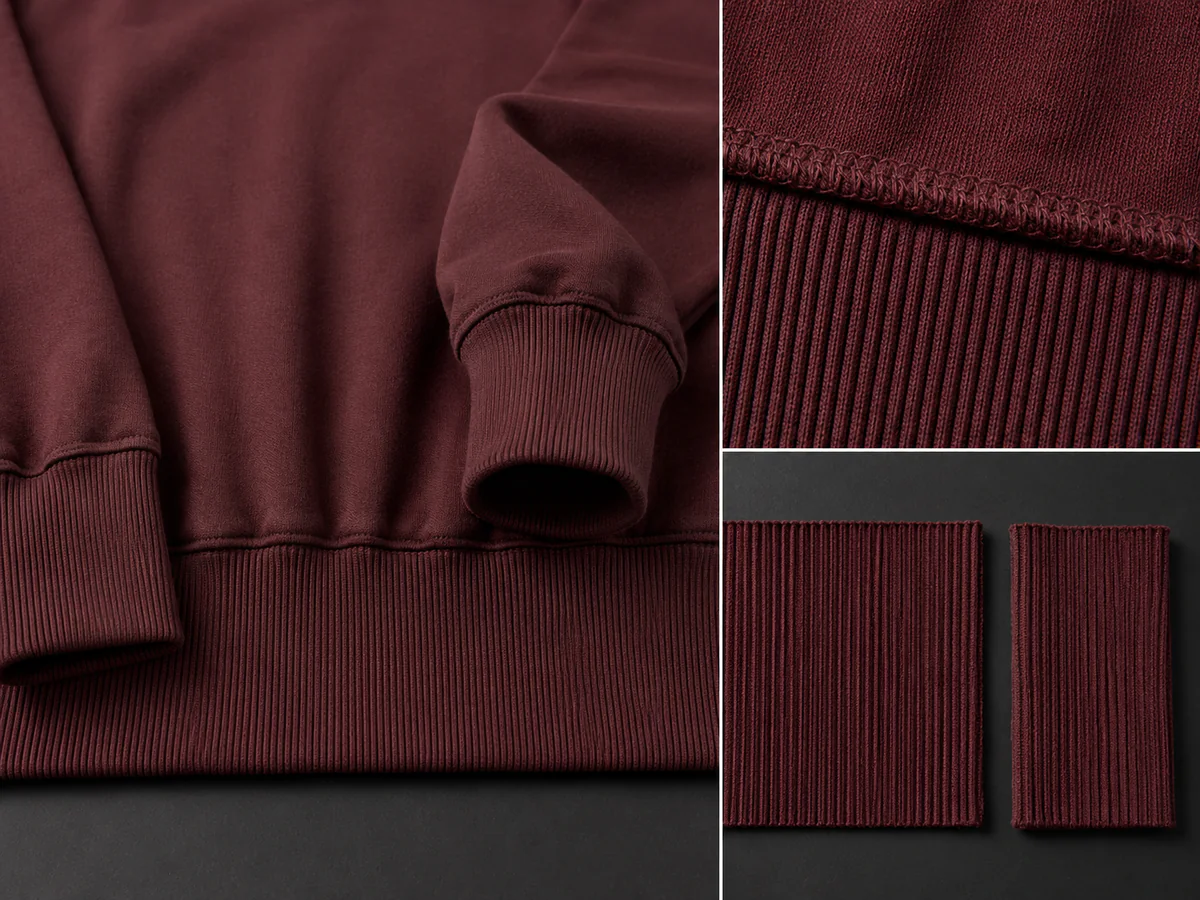
Define 1×1 or 2×2 structure, fiber composition, finished GSM or thickness, cuff and hem height, color, crosswise extension, elastic recovery, wash shrinkage and whether rib and body are dyed together. Do not copy one universal rib-cutting percentage: the correct ratio depends on actual elasticity, opening size, target appearance and wash test.
Kangaroo-pocket specification
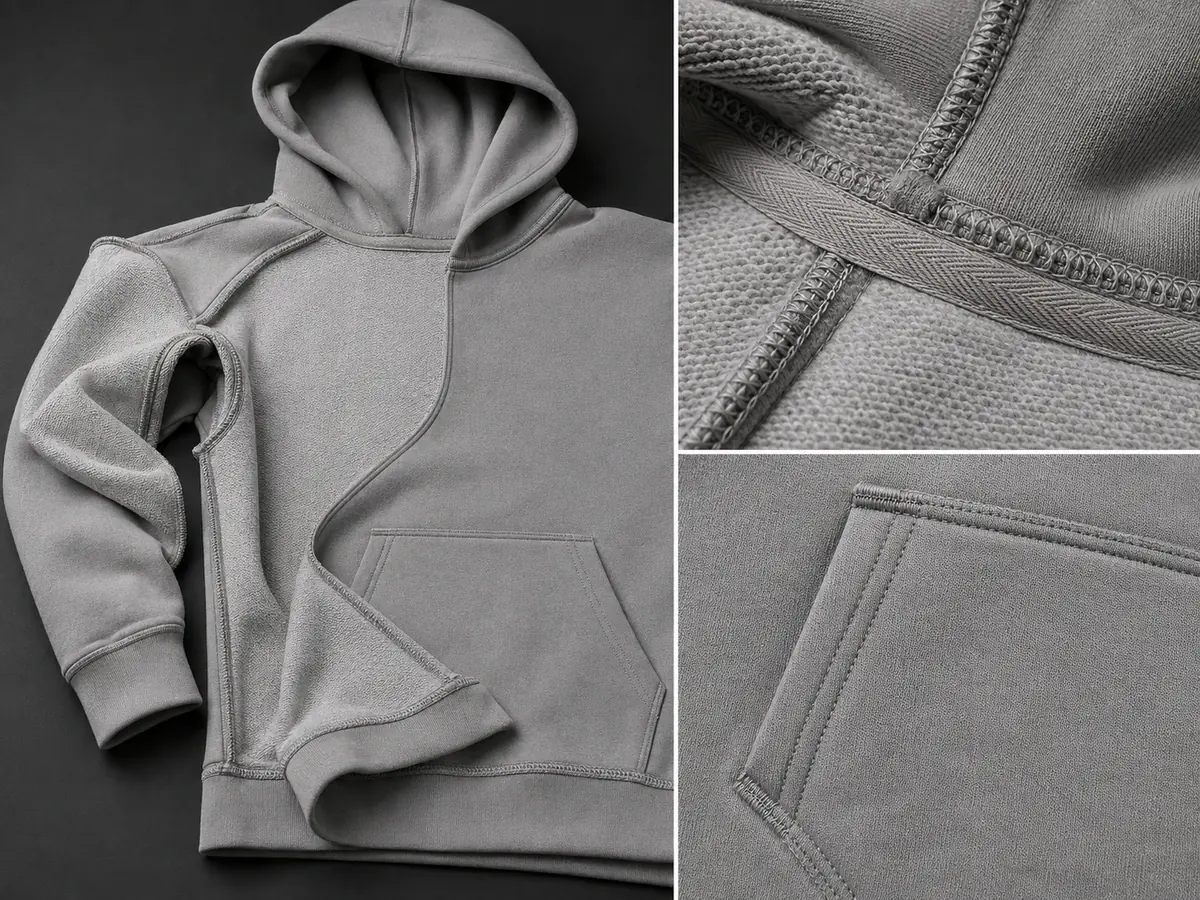
Record overall length and height, left and right opening length and width, placement from center front and hem, opening angle and shape, topstitch, bartacks, single- or double-layer construction and any hidden internal pocket. A normal pocket can use one layer of body fabric; double layers or local reinforcement suit stronger structure, a cleaner interior or added function.
What Sewing, Decoration and BOM Information Does the Factory Need?
Heavyweight sewing construction
State the overlock configuration, single-needle, twin-needle or coverstitch topstitching, stitch density and topstitch width, seam allowance and direction, shoulder or back-neck stabilizing tape, bartacks at stress points, and the handling of bulky hood-neck, underarm and rib intersections. Heavy fabric can skip stitches, break thread or create bulges when seam overlap is not planned.
Print, embroidery and appliqué
Supply vector artwork, final dimensions, exact garment position, Pantone or thread codes, technique, direction, color count and target hand or three-dimensional effect. Embroidery also needs stitch direction and density, thread, backing and reverse finish; appliqué needs material, edge treatment and fixing method. Test complex decoration on the intended production fabric.
BOM completeness
List every item entering the garment and its packaging: body fabric, hood lining, rib, drawcord, eyelets, aglets, zipper, thread, main label, size and care labels, hangtags, stickers, polybag, barcode and size stickers, carton and other packing materials. For each item, state material, dimensions, color, position, quantity and whether the client or factory supplies it.
Should Hoodie Measurements Be Before or After Wash?
For garment-dyed or garment-washed products, the final inspection standard should be the garment after all dyeing, washing and drying. The factory first tests actual horizontal and vertical shrinkage and spirality, then adds the necessary allowance to the pattern. Body fabric, rib, hood and sewing thread do not always change by the same percentage, so applying a universal 5% enlargement is unsafe.
| Measurement group | Practical starting tolerance |
|---|---|
| Back length, half chest, shoulder, sleeve | Approximately ±1 cm |
| Very large sizes or extreme oversized POMs | Some points may require ±1.5 cm |
| Cuff, rib height and small components | Approximately ±0.5 cm |
| Artwork, embroidery and label placement | Approximately ±0.5–1 cm |
These are working references, not universal acceptance limits. Different sizes, POMs and processes should not all share one tolerance. Align the final limits with the brand's inspection standard, measurement method and realistic production capability.
Can sample materials be substituted?
Initial and early Fit Samples can use close alternatives when custom fabric, labels or hardware are not ready, provided the factory identifies every substitution. A PP Sample should use the approved bulk body fabric and rib, functional lining, key zipper and hardware, and final print, embroidery, dye and wash. Temporary hangtags or packaging may be accepted only with written approval when MOQ makes production impractical at the sample stage.
Who completes size grading?
Either party can grade, but many OEM and ODM projects use the factory pattern room. The brand first approves a base size; the factory proposes the full size chart using the target customer and agreed grade rules; the brand approves the increments; and a Size Set is made when necessary. “S–XXL” without size relationships is not enough.
What Are the Most Common Heavyweight Hoodie Tech Pack Mistakes?
- Stating GSM without fabric structure or full composition
- Writing “Oversized” without measurable dimensions
- Allowing the drawing and measurement chart to conflict
- Omitting measurement methods and wash stage
- Ignoring hood volume, weight and neck bulk
- Leaving rib thickness, length and recovery unconfirmed
- Providing artwork mockups without size and placement
- Leaving thread, labels or packaging out of the BOM
- Changing critical details after PP Sample approval
These gaps cause samples that miss the design intent, incomplete quotations, delays and bulk rework. KAOUYOU can help organize drawings, measurements, BOM and construction notes from a reference garment, photographs and a clear brief through our product development service. The client still approves the final document, fit, fabric, color, techniques, labels and packaging.
What Is the Real Workflow from Tech Pack to Bulk Production?
- Review the tech pack and list missing decisions
- Confirm preliminary materials, techniques, quantity and colorways
- Calculate consumption and prepare the quotation
- Approve the quote and receive the sample fee
- Prepare materials and make the Initial or Fit Sample
- Client fits, measures and returns consolidated comments
- Make revised samples when necessary
- Complete color, print, embroidery and wash tests
- Make the PP Sample in production-intent materials
- Check measurements, shrinkage, spirality, colorfastness and washed appearance
- Approve the PP Sample and final tech pack in writing
- Confirm a Size Set when the project requires it
- Hold the pre-production meeting and issue the production worksheet
- Procure or produce bulk materials
- Release cutting, sewing, finishing and bulk production
Do not start bulk while the material, fit, measurements, color or key decoration remains unapproved. A purchase order plus written approval of the final correct sample creates a clear production release.
What Should a Brand Ask in a Heavyweight Hoodie RFQ?
- Is the proposed fabric French Terry or Brushed Fleece, and is it two- or three-thread?
- Is the stated GSM measured after dyeing, setting, brushing and the agreed wash?
- What is the full composition of every yarn in the construction?
- Can the proposed fabric, rib and hood achieve our target fit and hand?
- Which POMs, measuring methods and tolerances will control the sample?
- How will drop shoulder, sleeve reach, hood weight and seam bulk be checked?
- Which artwork, trim, label or packaging item is still missing?
- Which materials may be substituted in early samples, and which must be final for PP?
- Which shrinkage, spirality, pilling, colorfastness and wash tests will apply?
- What must be approved before the factory releases bulk production?
Send KAOUYOU your drawings or reference garment, base-size measurements, target market, fit, fabric direction, color, decoration, quantity and deadline through the project RFQ. We can identify the missing technical decisions before sampling begins.
Frequently Asked Questions
What should a heavyweight hoodie tech pack include?
At minimum, include front and back drawings, a base-size measurement chart with measurement methods, fabric type, composition, finished GSM and color, a BOM, decoration artwork, construction requirements, labels, packaging, estimated quantity, colorways and size ratio.
What GSM is considered heavyweight for a hoodie?
There is no universal standard. A practical factory-side guide is 320–380 GSM for medium-heavy to heavyweight, 380–450 GSM for clearly heavyweight, and above 450 GSM for ultra-heavy or highly structured hoodies. Fabric structure and finishing still change the result.
Is ‘400 GSM 100% cotton’ enough for a hoodie specification?
No. State whether the fabric is French Terry or Brushed Fleece, its yarn and sweatshirt construction, when GSM is measured, full fiber composition, color, hand, dye route, finishing, shrinkage, spirality, pilling and matching rib requirements.
Which POM measurements should a hoodie tech pack include?
Core POMs include half chest, back body length, shoulder width, sleeve length, bicep, cuff width, hood height and width, neck dimensions, kangaroo-pocket dimensions, and cuff and hem-rib height. Add zipper length and style-specific measurements where relevant.
How should a drop-shoulder hoodie sleeve be measured?
Provide both shoulder-point-to-cuff sleeve length and center-back-neck-to-cuff total length. Using both prevents a shoulder-width change from making the complete sleeve reach too long or too short.
Should garment-washed hoodie dimensions be specified before or after wash?
Final inspection measurements should apply after all garment dyeing, washing and drying. The factory should test actual shrinkage and spirality and add pattern allowances by component rather than increasing every measurement by one fixed percentage.
What measurement tolerance is typical for a heavyweight hoodie?
A practical starting reference is about ±1 cm for body length, half chest, shoulder and sleeve, ±0.5 cm for smaller components, and ±0.5–1 cm for artwork or label placement. Final tolerances must reflect the brand standard, measurement method, size and process.
Can a clothing factory help if a brand has no complete tech pack?
Usually yes. A factory can help organize drawings, measurements, BOM and construction notes from reference photos, a physical sample and a clear product brief. The brand must still approve the fit, materials, color, techniques, labels, packaging and final document version.
What must be approved before heavyweight hoodie bulk production?
Approve the production-intent fabric and rib, final fit and measurements, color, decoration, wash result, key trims, PP Sample, final tech pack and purchase order in writing. Do not release bulk while these decisions remain open.