A layered T-shirt can use two complete fabric layers or smaller inserts at the neckline, sleeves and hem. Two separate shirts worn together can create a similar appearance. Before sampling, confirm the construction, how much of each layer should show, and how the materials should behave after washing.
At KAOUYOU, common developments include double necklines, layered hems and short sleeves over longer inner sleeves. Complete double-layer T-shirts are also possible, particularly for heavier streetwear directions, but their extra coverage changes the garment's weight and construction requirements.
Answer in 30 seconds
Specify the layer coverage and attachment points first. Then approve the outer and inner fabrics together, record each layer's measurements and visible exposure, and check a complete sample after the intended washing and drying. Local mock layers may achieve the required appearance with less material; complete layers may suit a brief requiring fuller coverage or graphics on both layers. Neither route has a universal GSM or exposed length.
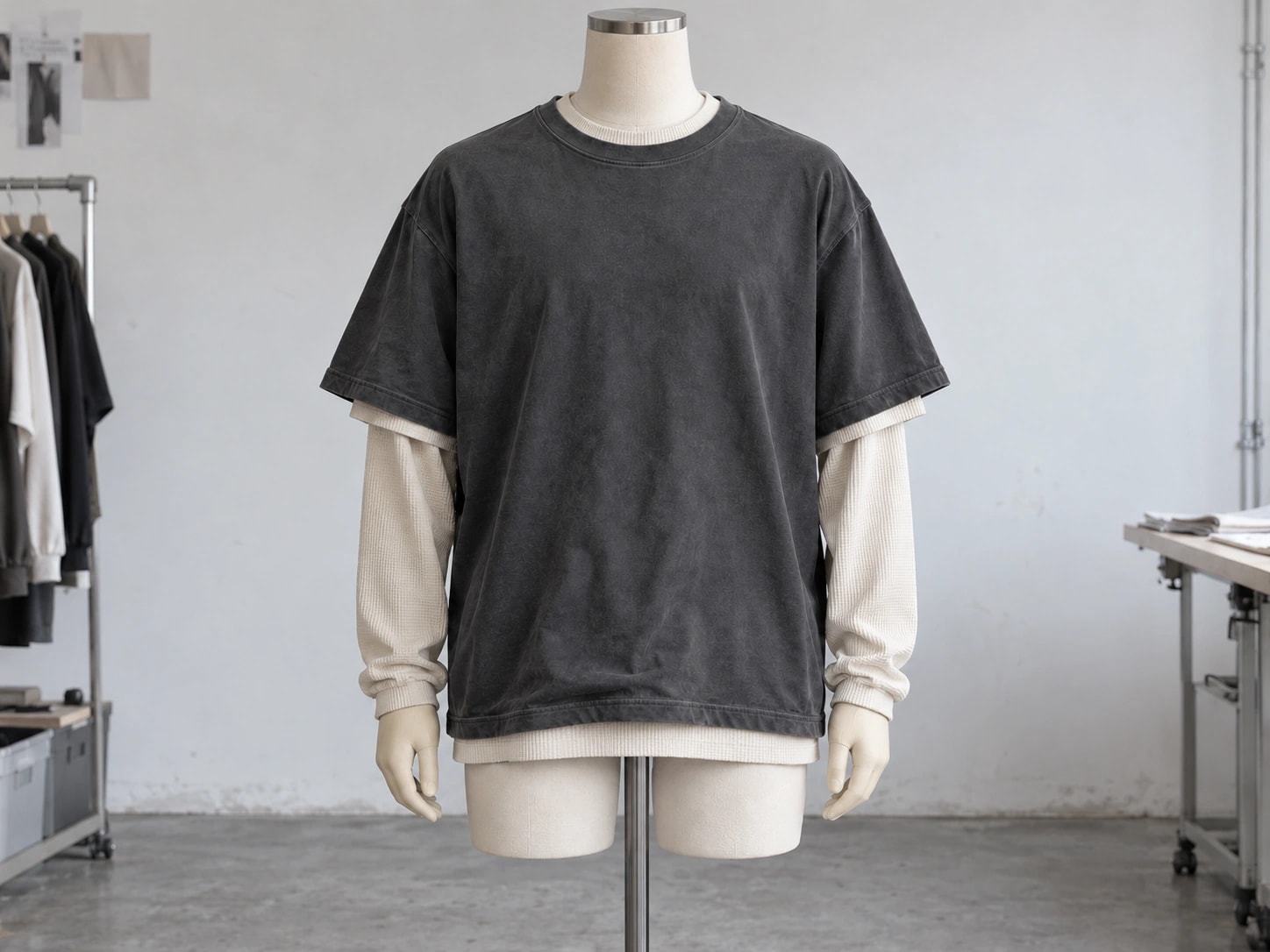
Which construction creates the layered effect?
“Double layer” and “two-in-one” describe an appearance without necessarily explaining its construction. When a customer sends a reference image, KAOUYOU asks whether it shows separate garments, complete layers joined into one garment, or local inserts. The team also confirms whether the layers should separate and what the finished effect should retain after washing.
| Construction direction | What it involves | What the brand should confirm |
|---|---|---|
| Two independent garments | Separate shirts styled together | Whether the brief requires two wearable pieces rather than a single product |
| Complete joined layers | Fuller inner and outer coverage within one garment | Coverage, ease, weight, graphics and connection locations |
| Local mock layers | Inserts at selected necklines, sleeve openings or hems | Insert depth, exposed length, fixing positions and the required appearance |
KAOUYOU may recommend a complete inner layer when the brief needs pronounced layering, graphics on both layers, different ease allowances or a heavier garment. If the main objective is a layered outline with controlled weight, cost and heat buildup, local inserts may be more suitable.
The distressed layered graphic T-shirt provides a product reference for visible sleeve and hem layers. Its appearance is a useful starting point; the new project's internal construction still needs to be specified.
What measurements define the neckline, sleeves and hem?
Record the outer and inner finished lengths alongside the intended visible difference. A photograph alone does not establish whether the inner fabric should show equally at the front, back and sides.
For the body and sleeves, define each layer's length, width and measurement reference points. For the neckline, include neck width, depth and the visible width of each band. KAOUYOU can suggest proportions from a reference when dimensions are missing, with the sample establishing the final result. The oversized T-shirt fit guide covers the underlying body proportions.
A double neckline needs separate decisions for the inner and outer bands: length, width, thickness and sewing stretch. Two identical rib bands do not automatically sit correctly. A tight inner opening can make dressing difficult; a loose outer band can turn outward. KAOUYOU checks rib recovery and seam bulk before approving how the neckline lies.
With short sleeves over a long inner sleeve, the outer opening must work with the inner sleeve cap, width and length. Excess inner width can bunch under the short sleeve; insufficient ease can pull at the underarm. Seam direction and material stretch also need to work together to limit twisting after washing.
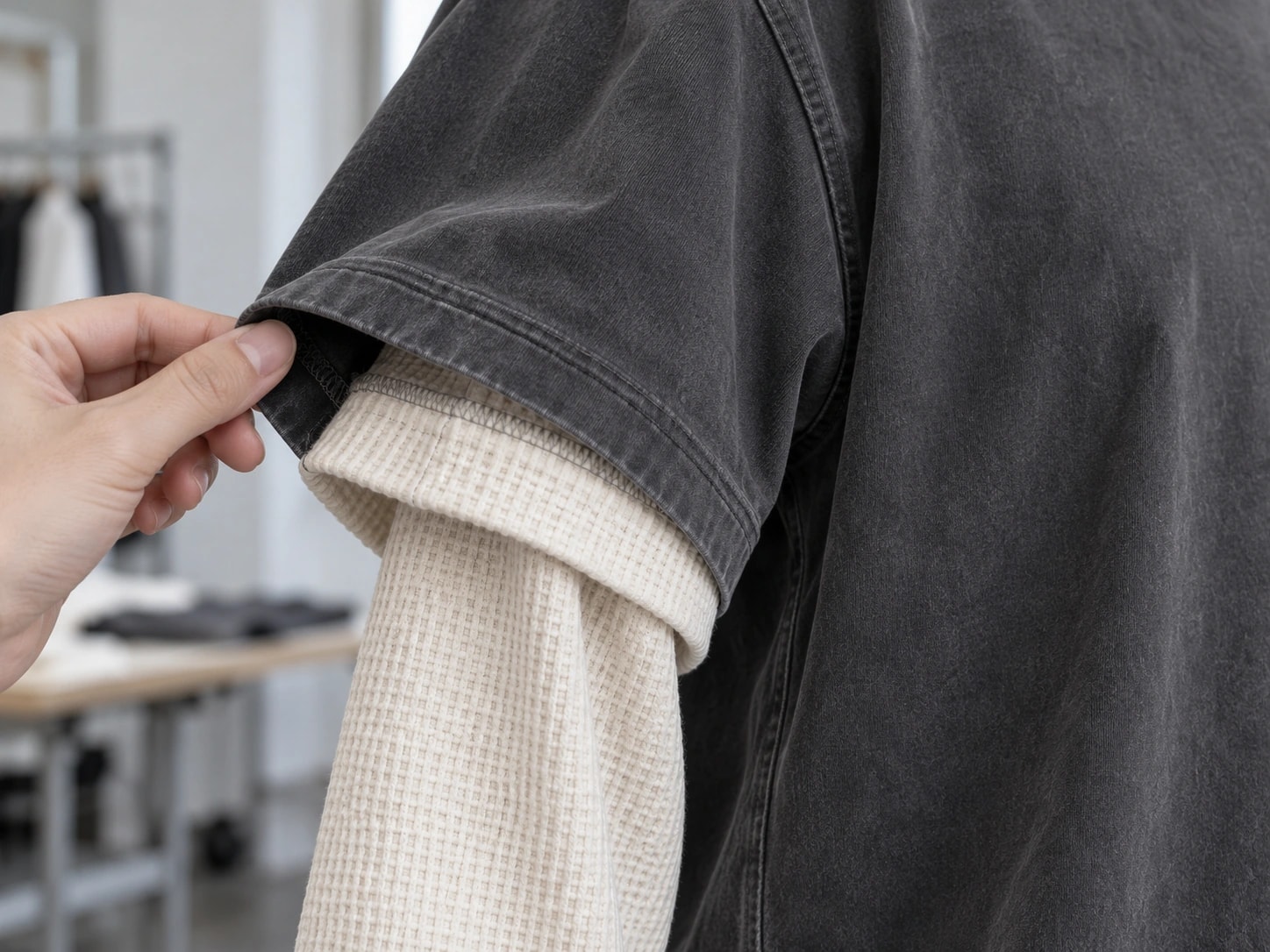
For a layered hem, confirm both body lengths, both opening widths and the side-seam connections. If the inner hem rides up, curls or shows unevenly, KAOUYOU reviews shrinkage, sewing tension and fixing positions before adjusting the pattern or connections. Pressing alone does not establish a lasting correction.
How should the outer and inner fabrics be paired?
The outer fabric usually establishes the silhouette; the inner material adds the visible layer and contributes to comfort. KAOUYOU commonly considers cotton jersey, heavier cotton or a stable knitted fabric outside, paired with a lighter, softer cotton jersey or cotton blend inside.
Both layers need to be assessed together. Two thick, stiff materials can add unwanted weight and bulk at the neckline, underarm and hem. A lighter inner fabric can help, but it still needs compatible stretch and washed behavior. KAOUYOU does not use one fixed GSM combination for every layered T-shirt.
| Material role | Options KAOUYOU considers | What needs approval |
|---|---|---|
| Outer body | Cotton jersey or another sufficiently stable knit | Support, density, silhouette and finished hand |
| Inner body or exposed insert | Softer, lighter cotton jersey or a cotton blend | Comfort, opacity where relevant, stretch and shrinkage compatibility |
| Neckline or cuff | Suitable rib qualities | Recovery, thickness, band dimensions and sewing stretch |
| Textured long inner sleeve or local section | Waffle fabric where the brief calls for it | Texture, shrinkage, distortion and the finished sleeve shape |
Rib is commonly used at necklines and cuffs rather than as a default large-area inner body. Waffle fabric can introduce a different texture, especially on a longer sleeve, but it needs specific shrinkage and shape checks.
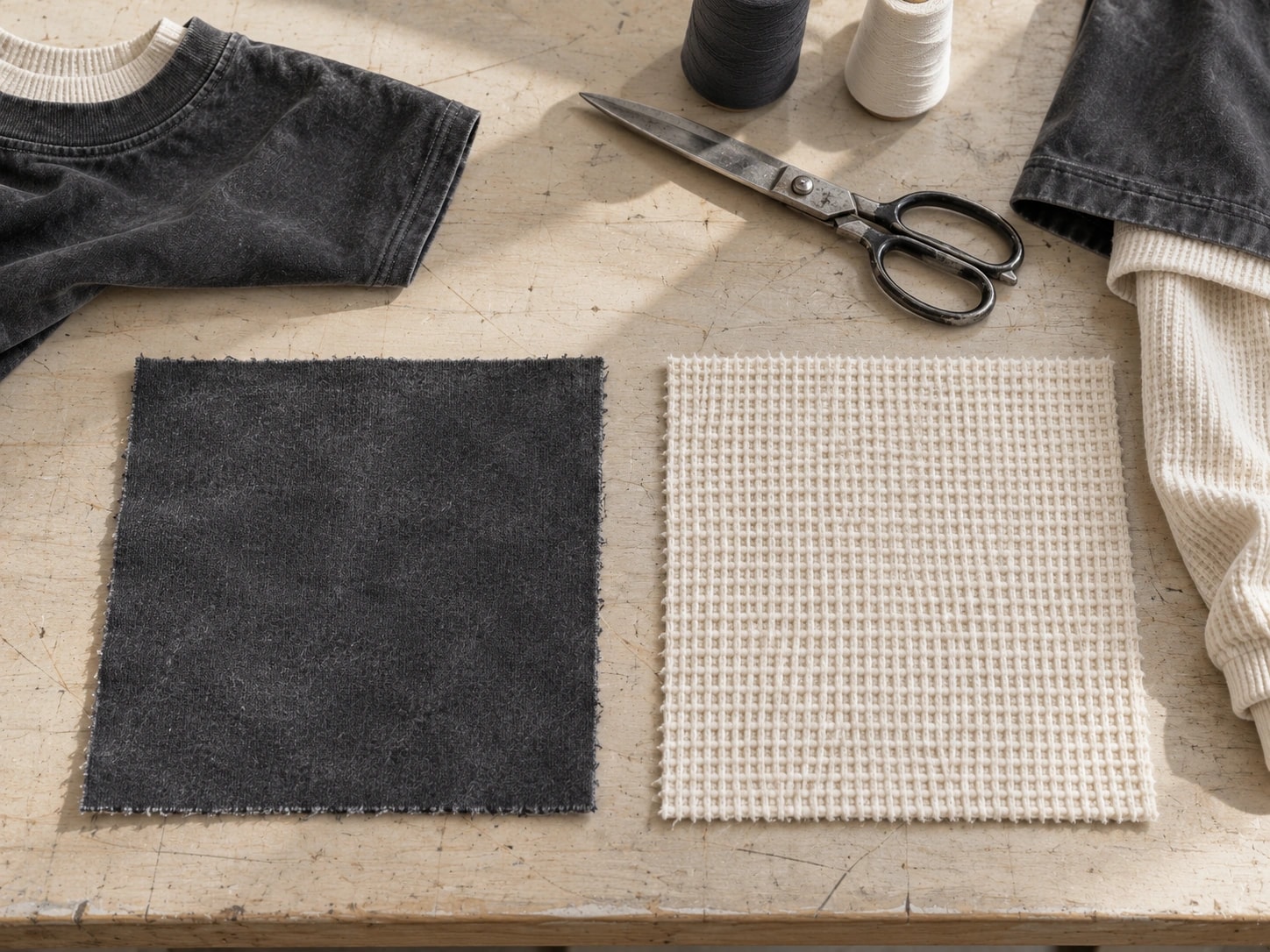
The fabric swatch evaluation guide supports the earlier material review. Final approval should also consider the complete garment's weight, season, fit and movement, rather than selecting the two fabrics by GSM alone.
Where should layers be joined without restricting movement?
Possible connection locations include the neckline, shoulder seams, armholes, underarms, upper side seams or selected hem positions. The correct combination depends on the structure and required movement. Fixing every location around the garment can restrict the layers and create pulling.
Complete double-layer constructions generally connect through principal structural seams. Local mock layers are attached at the relevant openings or seams. They use less coverage, but their visible length and position still need careful control.
KAOUYOU reviews seam-allowance width, how the layers overlap and the bulk of the stitching. Where a join becomes too thick, possible changes include trimming or staggering allowances, using a thinner support strip where needed, adjusting stitch length and presser-foot pressure, or moving overlapping stitching away from one concentrated point.
Check the inside as well as the exterior. Hard seam edges, loose threads and rubbing at a neckline or underarm can make an otherwise convincing layered garment uncomfortable. The sample should allow the arms and body to move without one layer pulling the other out of position.
How do washing, color and decoration affect the two layers?
KAOUYOU tests the outer fabric, inner fabric and rib separately through the intended washing and drying conditions. Lengthwise and widthwise shrinkage and twisting are recorded, then used to adjust the individual patterns. A complete garment wash follows to establish whether the visible layer relationships remain acceptable.
If the materials change very differently, selecting a closer match takes priority over trying to compensate entirely through pattern changes. The T-shirt shrinkage guide covers the broader process; for a layered design, the key additional question is how the two finished lengths relate to each other.
Deep and pale colors require review as a combination. KAOUYOU checks rubbing, washed color change and the risk of transfer onto the lighter layer. Rib and thread are included: different thread composition can leave conspicuous stitching after dyeing or washing. A color card alone is insufficient for a combination with a high transfer risk.
The production sequence follows the desired result. When both layers should develop a coordinated garment-dyed or washed appearance, assembly before processing may be appropriate if absorption and shrinkage are compatible. If the colors must remain distinct or one material cannot tolerate the process, fabrics or panels may be treated separately before assembly. Small-batch trials and a complete sample establish the route.
For graphics on both layers, approve their individual sizes, positions and visible relationship. An inner graphic that disappears beneath the outer body may defeat the design. Work close to a layered join may be processed on the cut panels before assembly, using matching points. Text, circles and regular shapes that must align across layers need a complete garment check.
Raw edges are another optional design choice. Specify their location, exposed width, permitted opening and fixing-line position. KAOUYOU may use one or more control lines inside the edge and avoids excessive cutting at load-bearing joins such as shoulders and underarms. “Naturally distressed” alone does not define an acceptable production range.
How should exposure change across the size range?
Grade the outer length, inner length and visible difference as related measurements. Adjacent sizes can share one exposed length when that matches the design. A wider size range, a large change in garment length or a brief requiring proportional exposure may need different values.
Decide whether the design calls for a consistent measured reveal or a consistent visual proportion. Those are different approval criteria. Copying one reveal across every size can make it look relatively small on a larger garment and relatively large on a smaller one.
The clothing size grading guide explains how the approved measurement chart supports production. For layered T-shirts, include both sets of dimensions and their intended relationship in that chart.
What should a complete sample establish before bulk production?
Review the finished garment flat, in wear and after the intended processing. Separate fabric tests and decoration samples help development, but they cannot establish the entire garment's balance, internal bulk or movement.
| Approval area | What to check on the complete sample | What to retain for production |
|---|---|---|
| Construction | Coverage, joining positions and intended freedom between layers | Construction instructions and approved sample |
| Materials and colors | Outer, inner, rib and thread as one combination | Approved fabric, rib and color references |
| Fit and exposure | Body and sleeve measurements, neckline and visible layer lengths | Measurement chart and placement details |
| Comfort and balance | Overall weight, arm movement, underarm thickness and inside seam feel | Approved finished garment and recorded revisions |
| Washing and decoration | Layer movement, twisting, color transfer and graphic visibility | Wash standard, artwork positions and finished references |
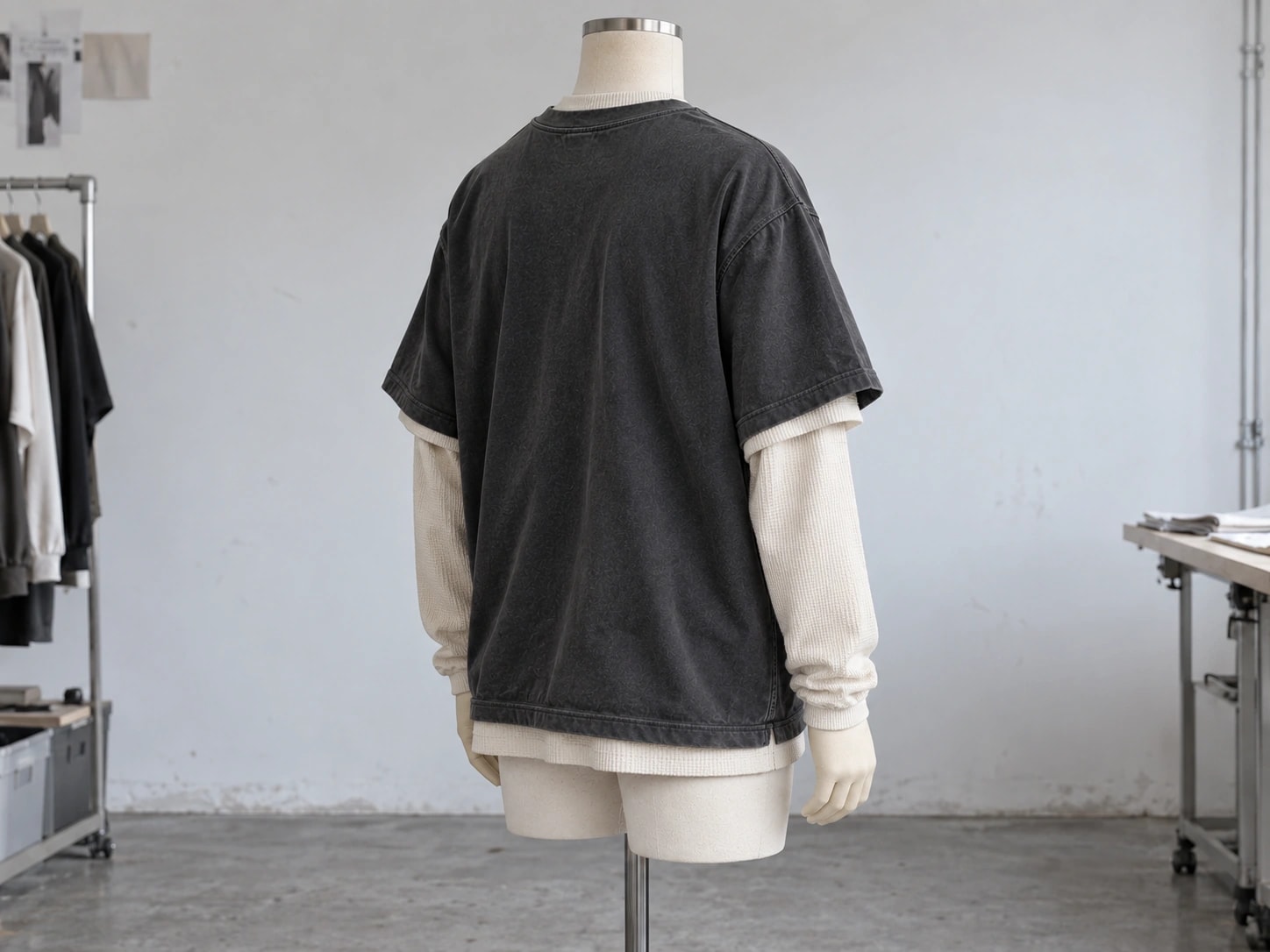
KAOUYOU retains the final garment, fabric and rib samples, measurement chart, production instructions, color references, artwork placement information and washing requirements as the approved production reference. Written revisions should agree with those materials.
During quality control, uneven exposure should be assessed against that reference. It can arise from dimensions, material change, sewing tension or connection positions; the cause determines the correction. A neat flat photograph alone cannot show whether the inner sleeve pulls during movement or the hem changes after washing.
What affects cost, MOQ and sample revisions?
Layer coverage, material types, sewing structure, custom rib, the number of graphics, washing and finishing requirements all affect cost. Complete double-layer coverage adds material, cut pieces and sewing time compared with local inserts. The finished specification is needed for a meaningful quote.
KAOUYOU's usual garment MOQ is 100 pieces per style, per color. Custom-produced or custom-dyed fabric, special rib, waffle colors and other custom trims may have separate supplier minimums. Their actual consumption needs to be reviewed alongside the garment quantity.
Recurring sample changes include reducing inner-layer weight, narrowing rib, adjusting inner and outer neckband lengths, changing the inner body length or width, revising fixing positions, or choosing materials with closer shrinkage behavior. Each adjustment addresses a specific finding; one change is not a universal solution to every layered-fit problem.
A useful revision request identifies what is wrong and when it occurs: too heavy when worn, too tight when dressing, uneven before washing, or changed after washing. That gives the development team a clearer basis for correcting materials, dimensions or assembly.
Frequently asked questions
Can two 100% cotton fabrics still need separate shrinkage tests?
Yes. A matching composition does not establish matching washed behavior. KAOUYOU checks the outer fabric, inner fabric and rib separately, then reviews the complete garment to confirm the finished layer relationship.
Can a long inner sleeve be used without a complete inner body?
It can be developed as a local sleeve construction if that fits the brief. Confirm its attachment, ease and arm movement on the sample; the visible layered appearance alone does not specify a complete inner body.
Does a layered T-shirt need raw or distressed edges?
No. A layered appearance can use clean finished openings. Raw edges are an additional design choice that needs its own placement, fixing and permitted-variation reference.
Can a full inner layer be replaced with inserts after the first sample?
That can be reviewed when the objective is mainly a visible reveal. It changes coverage, connection points, weight and potentially graphic placement, so the revised garment needs approval rather than being treated as an invisible production substitution.
Prepare a clear layered T-shirt brief
Send front and back references, the intended structure, which layers should be separable, fabric and color directions, outer and inner measurements, visible layer lengths, artwork, washing requirements, sizes and quantities by color.
Explore the T-shirt collection for product directions, or work with KAOUYOU product development to translate the layer concept into materials and sample requirements. Send your layered T-shirt brief to review the construction and approval steps for your project.