An oversized T-shirt fit is defined by the relationship between chest width, shoulder width, body length, sleeve length, sleeve volume and armhole depth—not by choosing a larger regular-fit size. Before sampling, a brand should confirm the intended silhouette, finished-garment measurements, measurement methods, fabric behavior and grading direction.
This factory-side guide explains how KAOUYOU translates an oversized T-shirt idea into a measurable sample and repeatable production standard. The client's approved size chart and fit requirements take priority. The methods below are practical working references, not universal dimensions, ease allowances or tolerances for every market and order.
Answer in 30 seconds
- Do not approve “oversized” as a name alone; approve a measurement chart and physical silhouette.
- Control chest, shoulder, length, sleeve and armhole as one proportion rather than enlarging every point equally.
- Use a production-intent fabric because GSM, stiffness, stretch and drape change how the same dimensions look.
- For washed or garment-dyed T-shirts, approve measurements after the complete finishing process.
- Check the graded smallest and largest sizes so the silhouette remains intentional across the range.
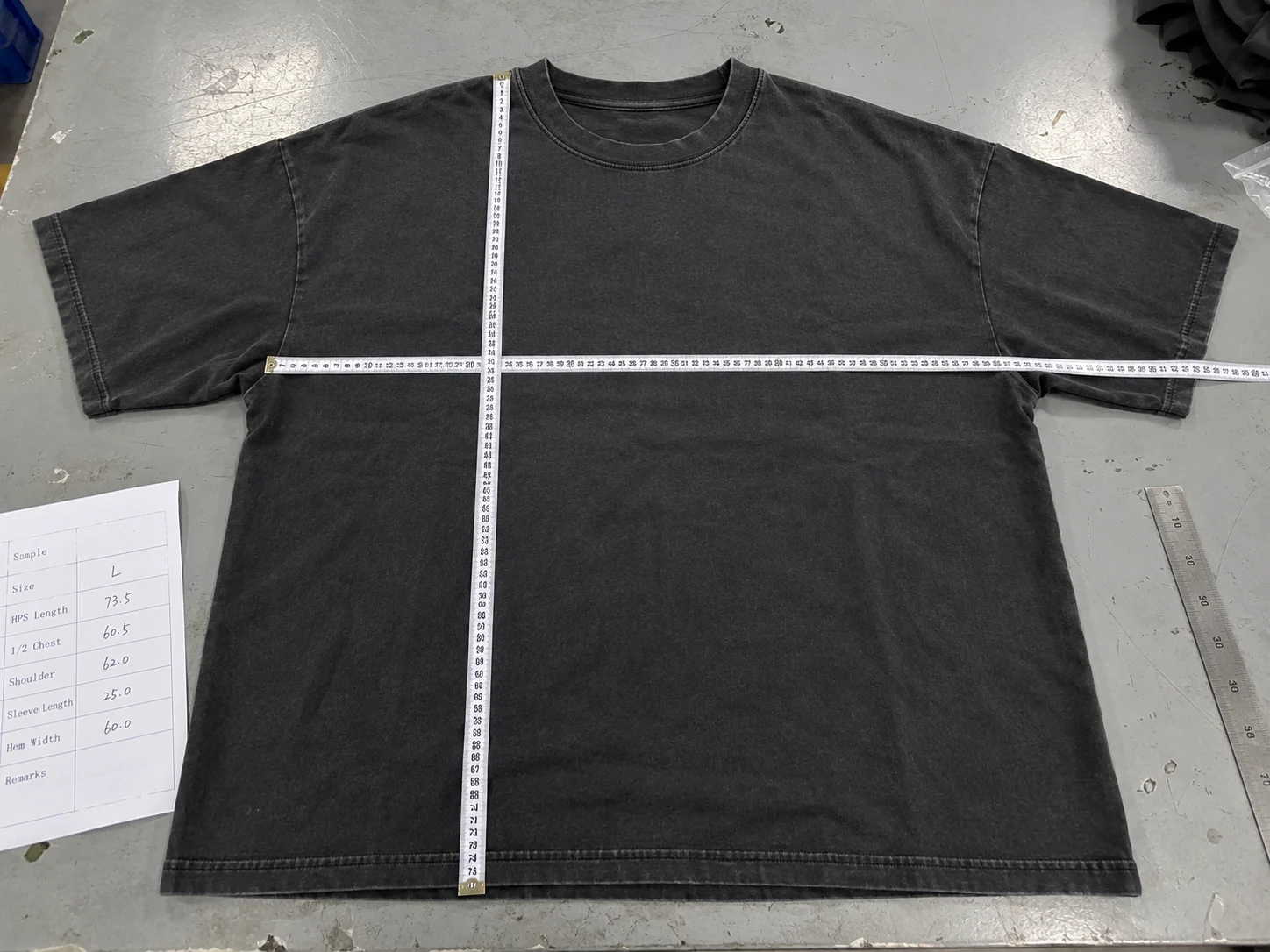
1. Define the Fit Before Discussing Measurements
Clothing teams often use “relaxed,” “oversized” and “boxy” interchangeably, but those terms lead to different patterns. KAOUYOU does not decide the block from the fit name alone. The factory reads the chest, shoulder, body length, sleeve length and amount of drop shoulder together, then compares that proportion with the client's visual direction.
| Fit direction | Practical meaning | Development note |
|---|---|---|
| Regular | Moderate chest and shoulder ease with a conventional body and sleeve proportion. | A standard fit reference, not an oversized block. |
| Relaxed | More room than regular fit while the overall length and proportions remain broadly familiar. | Often confused with oversized when only the chest is increased. |
| Oversized | A deliberately enlarged silhouette combining greater chest width, deeper drop shoulder and fuller sleeves. | The body length may be long or controlled; every point should not be enlarged by the same percentage. |
| Boxy | A wide body with a comparatively shorter length, creating a squarer chest-to-length proportion. | Boxy describes proportion more than overall scale. |
| Cropped boxy | A boxy body with a further reduced length. | Common in shorter T-shirts, sweatshirts and selected womenswear directions. |
The most common misunderstandings are relaxed versus oversized and oversized versus boxy. Relaxed fit usually adds room while preserving familiar proportions. Oversized fit deliberately enlarges the overall silhouette. Boxy fit emphasizes a wide chest relative to a shorter body. A design can also be both boxy and oversized, but the intended balance still needs measurable confirmation.
2. What Should a Brand Provide Before Pattern Development?
Useful starting information can include a finished-garment size chart, physical reference sample, front-side-back fit photographs, brand reference, drawing or written brief. The client or target market normally establishes the base size; KAOUYOU can also suggest a base size for the client to approve.
If the brief only says “make it oversized,” the first priority is size and overall silhouette. The team must clarify how wide, how long, how far the shoulder should drop, where the sleeve should end and whether the result should feel structured, draped, longline or boxy. A model's height, body shape and worn sample size make reference photographs more useful.
KAOUYOU generally does not rely directly on a client-supplied paper pattern. Once the size chart, physical sample or other approved reference is sufficient, the pattern team develops the production pattern internally. This reduces ambiguity if the finished sample does not match the intended fit and lets the pattern be adapted to the approved fabric and factory process.
A complete clothing tech pack remains the clearest place to record these decisions. When a brand begins with photographs or a sample instead, the missing points should be converted into a controlled size chart before bulk approval.
3. Oversized T-Shirt Measurements to Confirm
The measurements should describe the finished garment, unless the document explicitly says otherwise. KAOUYOU follows the client's stated method. If the client has not supplied one, the team proposes a method and records the start and end points before sampling. A dimension without a measurement method can produce two different “correct” results.
| Point of measure | Common factory method | Why it matters |
|---|---|---|
| Half chest | Garment laid flat and measured across the body, commonly about 2.5 cm / 1 in below the underarm when that method is agreed. | Controls body volume, but cannot define the fit by itself. |
| Shoulder width | Across the garment between the agreed shoulder seam points. | Establishes the amount of shoulder extension and drop. |
| HPS body length | From the high point shoulder along the front body to the hem. | Separates long oversized, balanced oversized and boxy directions. |
| Sleeve length | For a set-in or drop-shoulder style, from the shoulder seam to the sleeve opening unless the client specifies another method. | Must be balanced with the extended shoulder so total reach does not become excessive. |
| Bicep / sleeve width | Across the sleeve at the defined point of measure. | Keeps the sleeve volume consistent with the larger body. |
| Sleeve opening | Across the finished opening. | Influences whether the sleeve hangs cleanly, flares or bunches. |
| Armhole depth | Measured by the method shown in the brand size chart. | Affects mobility, underarm volume and how low the sleeve joins the body. |
| Neck width and drops | Neck width, front drop and back drop measured from defined seam points. | Controls coverage, balance and collar appearance. |
| Rib height and neck seam | Finished rib height plus the agreed neckline construction. | Supports recovery and visual weight, especially on heavyweight T-shirts. |
| Hem width | Across the finished bottom opening. | Shows whether the body remains straight, narrows or opens toward the hem. |
For a raglan or style without a clear shoulder seam, sleeve reach may be measured from the center-back neck to the cuff, or divided into center-back neck to shoulder point and shoulder point to cuff. Different brands use different conventions. The final chart should therefore show the diagram or written method instead of supplying only a number.
Body measurements and garment measurements are not interchangeable. KAOUYOU can help translate a target body and fit direction into garment ease, but sampling is still required because desired ease changes with market, fabric and silhouette.
4. Why Chest, Shoulder and Body Length Must Be Balanced
An intentional oversized T-shirt is loose but visually controlled. Chest width creates volume, shoulder width positions the sleeve seam, and body length determines whether that volume reads as long, balanced or boxy. Changing only one area usually weakens the silhouette.
- Increasing the chest without changing shoulder and sleeve shape can look like a loose regular T-shirt.
- Extending the shoulder without shortening or reshaping the sleeve can make the total sleeve reach excessive.
- Increasing chest and length by the same ratio can remove the intended boxy emphasis.
- An excessively deep armhole and wide sleeve can create underarm bulk and a collapsed shape.
- Grading a regular block up one or two sizes can also enlarge the neck, length and other areas that were not meant to change.
The product examples in KAOUYOU's custom T-shirt collection show several directions rather than one standard oversized block. A boxy-fit graphic T-shirt prioritizes width-to-length proportion, while a washed graphic oversized T-shirt combines a relaxed silhouette with a wash and decoration direction. These pages are capability references; every client order still needs its own measurements and sample approval.
5. Coordinate Drop Shoulder, Sleeve and Armhole
When the shoulder seam moves outward, the pattern has already added horizontal reach before the sleeve begins. Sleeve length therefore often needs to be shortened or otherwise rebalanced. There is no fixed amount that applies to every oversized T-shirt because the intended cuff position, sleeve angle and shoulder extension differ by design.
Sleeve width should normally grow enough to support the larger body, while the sleeve opening should preserve the intended hang. A narrow opening can make a full sleeve bunch; an uncontrolled wide opening can remove the shape. A deeper drop shoulder often requires a deeper armhole, but an excessive armhole can restrict comfortable lifting, create loose underarm fabric and distort the side view.
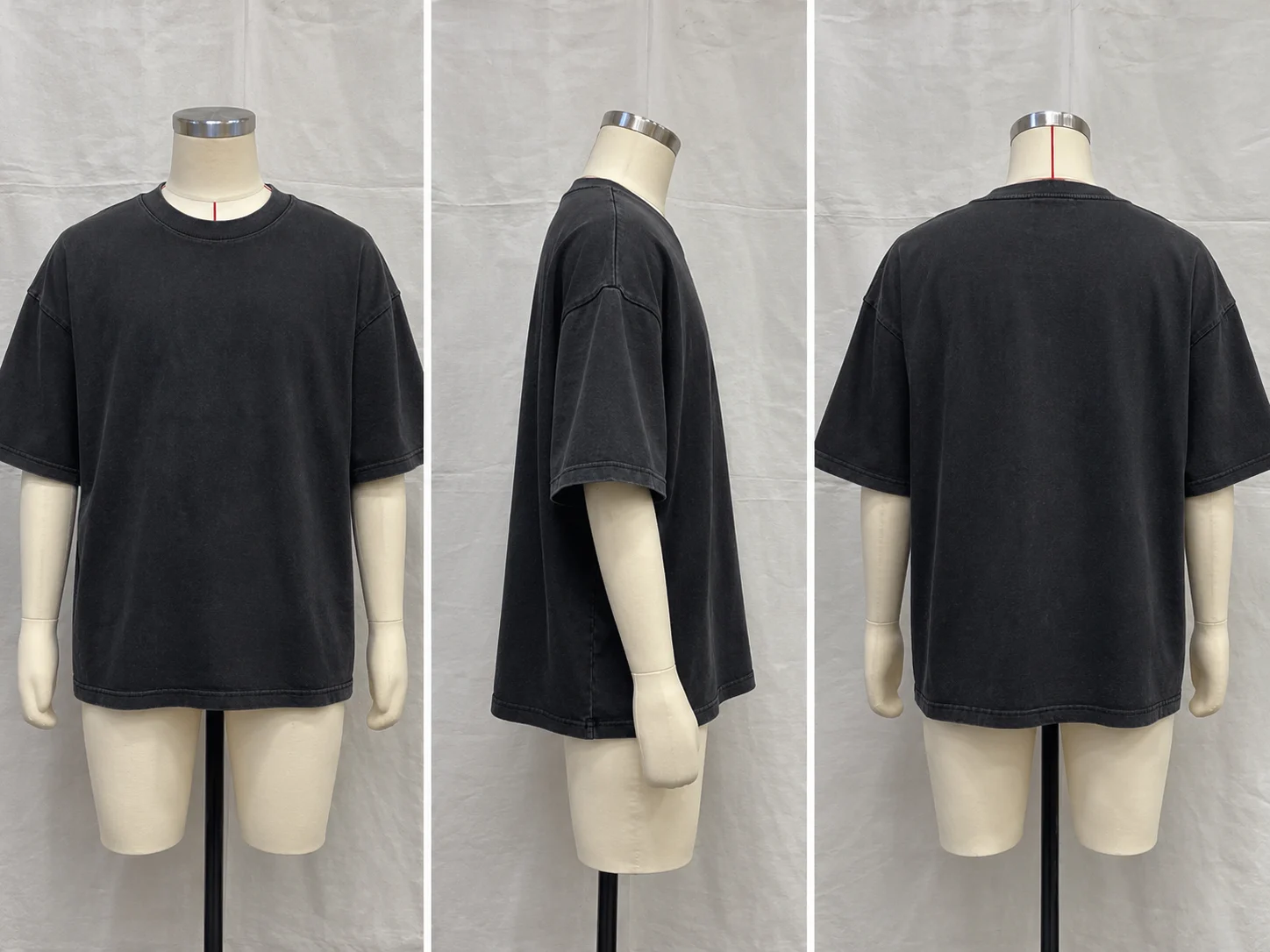
This is why KAOUYOU reviews the garment from the front, side and back rather than approving chest and shoulder numbers separately. The side view is especially useful for judging sleeve angle, armhole depth, body drape and front-to-back balance.
6. Keep the Neckline Stable While the Body Gets Wider
A larger body does not mean the neckline should increase by the same proportion. An over-enlarged neck can sit loose, expose the shoulder or lose shape after washing. The team reviews neck width, front and back drop, rib height, rib thickness, stretch and recovery, plus the rib-to-neck-seam relationship.
Heavyweight T-shirts generally need a rib that visually and functionally supports the body fabric. A thicker rib with suitable recovery may be used, and a back-neck tape can add stability when the construction requires it. The specific rib composition and dimensions should be sampled rather than treated as a fixed formula for every heavy or oversized garment.
7. Fabric and Washing Can Change the Same Pattern
Pattern measurements do not predict silhouette without fabric behavior. A high-GSM, firmer jersey holds a more structured outline and can make boxy width more visible. A light or soft jersey falls downward, so the same chest measurement may appear narrower and longer. High stretch changes how the garment opens on the body, while thick fabric adds bulk at the neck, sleeve and hem seams.
A small GSM change within a comparable fabric can sometimes be assessed through hand feel, shrinkage and sample evidence. If GSM, stretch, stiffness, shrinkage or knit structure changes materially, KAOUYOU recommends making another garment sample. Our T-shirt GSM guide explains why a weight number alone cannot predict drape or quality.
Approve garment-dyed and washed measurements after finishing
Garment dyeing, enzyme washing, vintage washing and other finishing routes can alter length, chest, sleeves, neckline, color and hand feel. KAOUYOU checks shrinkage or a wash trial first and uses the result when preparing the pattern. The final approved size should refer to the garment after all agreed dyeing, washing and pressing—not only the unwashed blank.
Production-intent wash samples or a PP sample are particularly important for heavy washes because material batches and processing can create variation. The size chart should include realistic, client-approved tolerances for the relevant points of measure; this article does not assign one fixed tolerance to every T-shirt.
8. Grade the Silhouette, Not Just the Numbers
Different points of measure need different grading logic. Applying the same increment to chest, shoulder, length, sleeve and neckline can distort the design. The pattern team considers how the intended ease and visual balance should change across the range, then records the finished measurements for each size.
A factory does not necessarily make a complete garment in every size. Depending on the range and risk, KAOUYOU may focus the size-set review on the base, smallest and largest sizes and add an intermediate size when useful. The smallest size can expose a tight neck or armhole and insufficient room for a pocket or print. The largest can develop excessive shoulder, sleeve or body length, a deep armhole or misplaced decoration.
The purpose is not to repeat approval of the base sample. It is to confirm that the grading preserves the intended oversized or boxy proportion at the edges of the size range.
9. How to Review an Oversized T-Shirt Sample
Begin with the final measurement chart, then assess the physical silhouette. KAOUYOU recommends consistent front, side and back images plus the model or mannequin information. A fit photograph without the worn size and model height can be misleading; a flat measurement without a worn view can miss drape, sleeve angle and balance.
- Confirm the sample uses the expected base size, fabric and finishing process.
- Measure each point using the method recorded in the size chart.
- Review chest-to-length proportion and the position of the shoulder seam.
- Check total sleeve reach, bicep volume, opening and underarm comfort.
- Assess neckline coverage, rib recovery and garment balance after washing.
- Photograph or fit the sample from front, side and back under consistent conditions.
- Return consolidated written comments with revised measurements and items that must remain unchanged.
A sample should not be approved with “make it a little more oversized” as the only comment. State which measurement changes, by how much, and what visual result the change is intended to create. The broader clothing product development process explains how those comments become a controlled approved sample.
10. How KAOUYOU Controls Oversized Fit in Bulk Production
KAOUYOU checks dimensions at several production stages instead of waiting until every garment is finished. Incoming fabric can be reviewed for GSM, shrinkage, stretch and usable width. Cut panels are sampled for dimensions and grain direction. QC checks the first sewn garment or first production group, monitors important dimensions during sewing, measures again after washing or dyeing, and completes measurement sampling and appearance inspection before packing.
Oversized styles receive particular attention at chest, shoulder, HPS length, sleeve length, drop-shoulder position, bicep and armhole depth. QC also considers the complete proportion rather than accepting a garment only because each isolated number appears within tolerance.
When consecutive deviations appear, the related process is paused and traced through panel identification, bundle records and sewing operations. If panels are already incorrect, the investigation covers pattern, marker, spreading tension, cutting or fabric shrinkage. If panels were correct but the sewn garment changes, QC checks seam allowance, operator handling and construction. A post-wash deviation leads to a review of material batch, wash time, temperature and drying; a pressing-related change leads to a review of heat, stretch and setting.
Affected work is isolated, repaired or reprocessed where possible, and the inspection scope is expanded before goods move forward. This is the same traceable approach described in KAOUYOU's clothing manufacturing quality control checklist.
11. Pre-Sampling Checklist for Clothing Brands
- Name the intended direction—regular, relaxed, oversized, boxy or cropped boxy—but also provide dimensions or a physical reference.
- Identify the base size, target market, intended wearer and whether the measurements are finished-garment measurements.
- Define every point of measure with a start point, end point and measurement method.
- Confirm half chest, shoulder, HPS length, sleeve length, bicep, sleeve opening, armhole, neckline, rib and hem width.
- State whether the approved measurements apply before or after garment dyeing, washing and pressing.
- Approve the production-intent fabric because GSM, stiffness, stretch and drape change the same pattern's silhouette.
- Review front, side and back views on a mannequin or model, not only a flat measurement chart.
- Provide the model's height, body information and worn sample size when fit photos are part of the approval.
- Confirm grading logic and check the smallest and largest planned sizes when the range is broad or the design is sensitive.
- Issue written sample comments and a final size chart before approving the production sample or PP sample.
Brands considering a wash-heavy or print-led style can also review the custom oversized cracked-print T-shirt as a product capability reference. It shows why silhouette, surface treatment and graphic placement should be discussed together, while the final order still requires its own approved sample and production files.
Frequently Asked Questions
What measurements define an oversized T-shirt fit?
The main measurements are half chest, shoulder width, HPS body length, sleeve length, bicep or sleeve width, sleeve opening, armhole depth, neck width and drops, rib height and hem width. Their proportion defines the silhouette; no single chest measurement can confirm an oversized fit.
Is an oversized T-shirt just a regular T-shirt in a larger size?
No. Simply enlarging a regular block can make the body, sleeve and neckline grow in the wrong relationship. A production pattern should rebalance chest, shoulder extension, sleeve length, sleeve volume, armhole, body length and neckline for the intended silhouette.
What is the difference between boxy and oversized T-shirt fit?
Boxy emphasizes a wide body with a relatively short length. Oversized describes a more broadly enlarged silhouette with greater chest, drop shoulder and sleeve volume; its body length may be short, standard or long. A T-shirt can be both boxy and oversized.
Should drop-shoulder T-shirt sleeve length be shortened?
Often it should be adjusted because the shoulder seam has already moved outward. The correct change depends on the intended total sleeve reach, shoulder extension and silhouette, so there is no universal amount to subtract.
Do heavier fabrics make an oversized T-shirt look bigger?
Not necessarily bigger, but a high-GSM or stiffer fabric usually holds a more structured outline. A lighter, softer fabric may drape downward and make the same measurements appear less wide. Fabric must therefore be approved together with fit.
Should an oversized T-shirt be measured before or after washing?
When garment dyeing or washing is part of the product, final approval should use the garment after all agreed dyeing, washing and pressing processes. Pre-wash measurements can support production control, but they are not the final consumer-facing size standard.
Does KAOUYOU use a client's paper pattern?
KAOUYOU normally works from the client's approved size chart, physical sample or other confirmed reference and develops the production pattern internally. This creates a clearer responsibility boundary and allows the pattern to be matched to the factory's production and fabric conditions.
Is a size-set sample required for every oversized T-shirt order?
Not automatically. The need depends on the size range, grading risk, client requirement, fabric and style. KAOUYOU commonly focuses on the base size, smallest size and largest size when checking whether the graded silhouette remains balanced.