T-shirt shrinkage is controlled before bulk cutting—not corrected only after finished garments become too small. A reliable process uses the actual bulk fabric, measures lengthwise and widthwise change separately, applies the result to the pattern, validates the finished sample, and rechecks dimensions after any garment dyeing or wash process.
This guide explains how KAOUYOU handles shrinkage risk in custom T-shirt production. The client's care method, tolerance and named test standard take priority. KAOUYOU's internal checks support development and production control; a formal AATCC, ISO or client-specific report is arranged through a third-party laboratory when required.
Answer in 30 seconds
- Test every relevant production fabric lot and color instead of relying only on a supplier's “pre-shrunk” statement.
- Record lengthwise and widthwise change separately because they affect different pattern dimensions.
- Use the customer's specified care or laboratory method; do not assume one wash cycle or tolerance fits every order.
- Validate garment-dyed, enzyme-washed and vintage-washed products after the complete finishing process.
- Control fit, torque, seam behavior and mixed-material distortion as well as the shrinkage percentage.
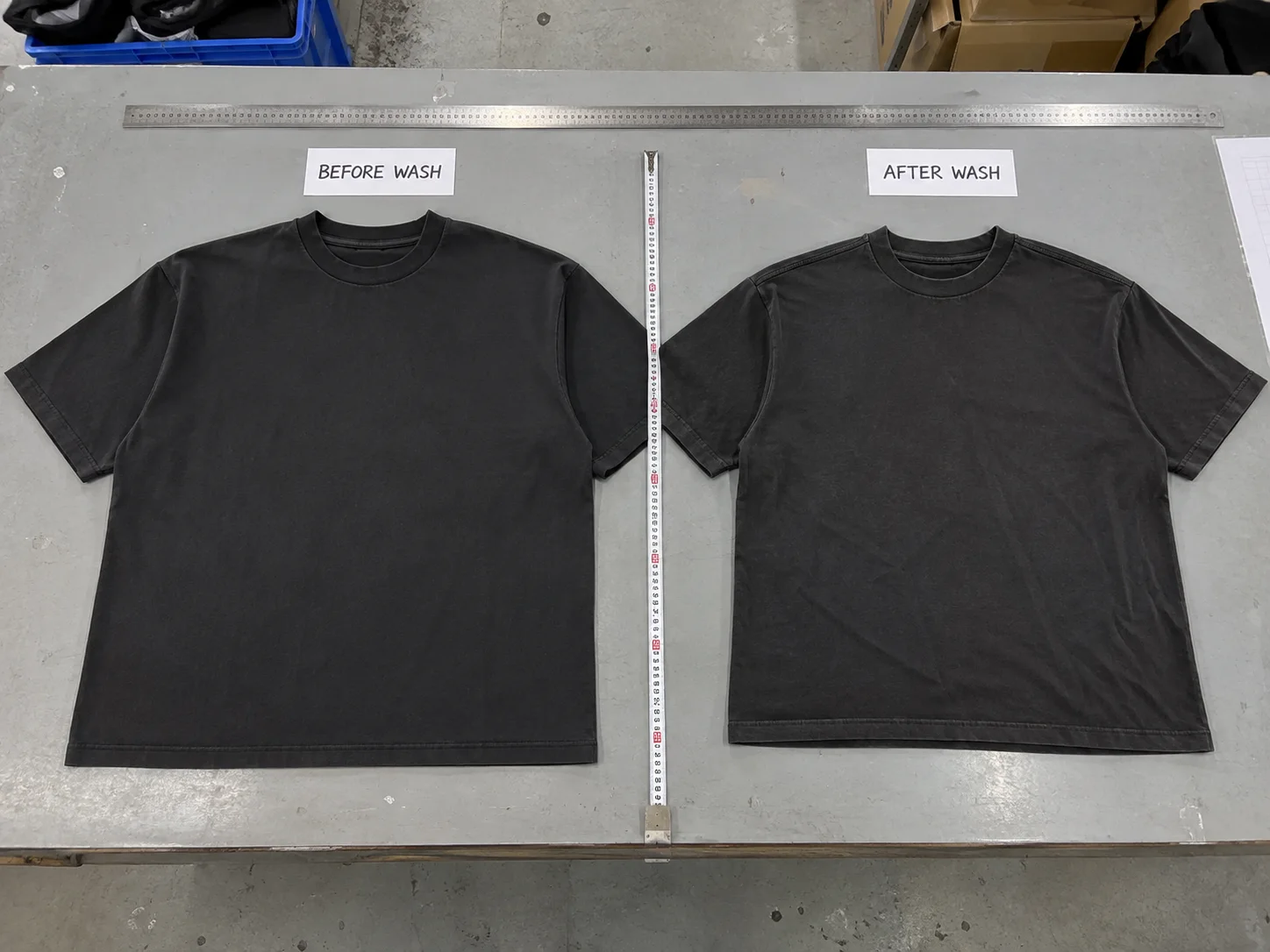
1. What Does T-Shirt Shrinkage Control Actually Mean?
A pass decision should not be based on one number alone. KAOUYOU reviews the dimensional change percentage, finished-garment measurements, skew or torque, side-seam position and the final silhouette. A T-shirt can remain within one measurement tolerance yet still look unacceptable if the body twists, the neckline waves or a panel pulls against the main fabric.
Shrinkage control also needs a defined product state. For a plain T-shirt, the approved state may be after the specified home-laundering test. For a garment-dyed or vintage-washed T-shirt, the production target normally refers to the garment after dyeing, washing, drying, pressing and recovery. The Tech Pack should say which state the finished size chart describes.
KAOUYOU internal process: factory washer-and-dryer checks guide fabric acceptance, pattern allowance and daily production. Client-specified requirement: the customer defines mandatory care conditions, tolerances or test methods. Formal external evidence: when a named AATCC, ISO or custom report is required, samples are sent to a third-party laboratory.
2. How Does KAOUYOU Test Bulk Fabric Shrinkage?
The internal test uses fabric from the same production-intent bulk lot, not fabric cut from a finished sample garment. Representative specimens are selected from appropriate parts of the roll or lot, including the beginning, middle and end where practical, while avoiding the selvage and obvious defects. This gives the pattern team information that is relevant to the material scheduled for cutting.
- 01
Select representative fabric
Use production-intent fabric from the same bulk lot. KAOUYOU samples representative areas from the beginning, middle and end while avoiding the selvage and obvious defects.
- 02
Mark the benchmarks
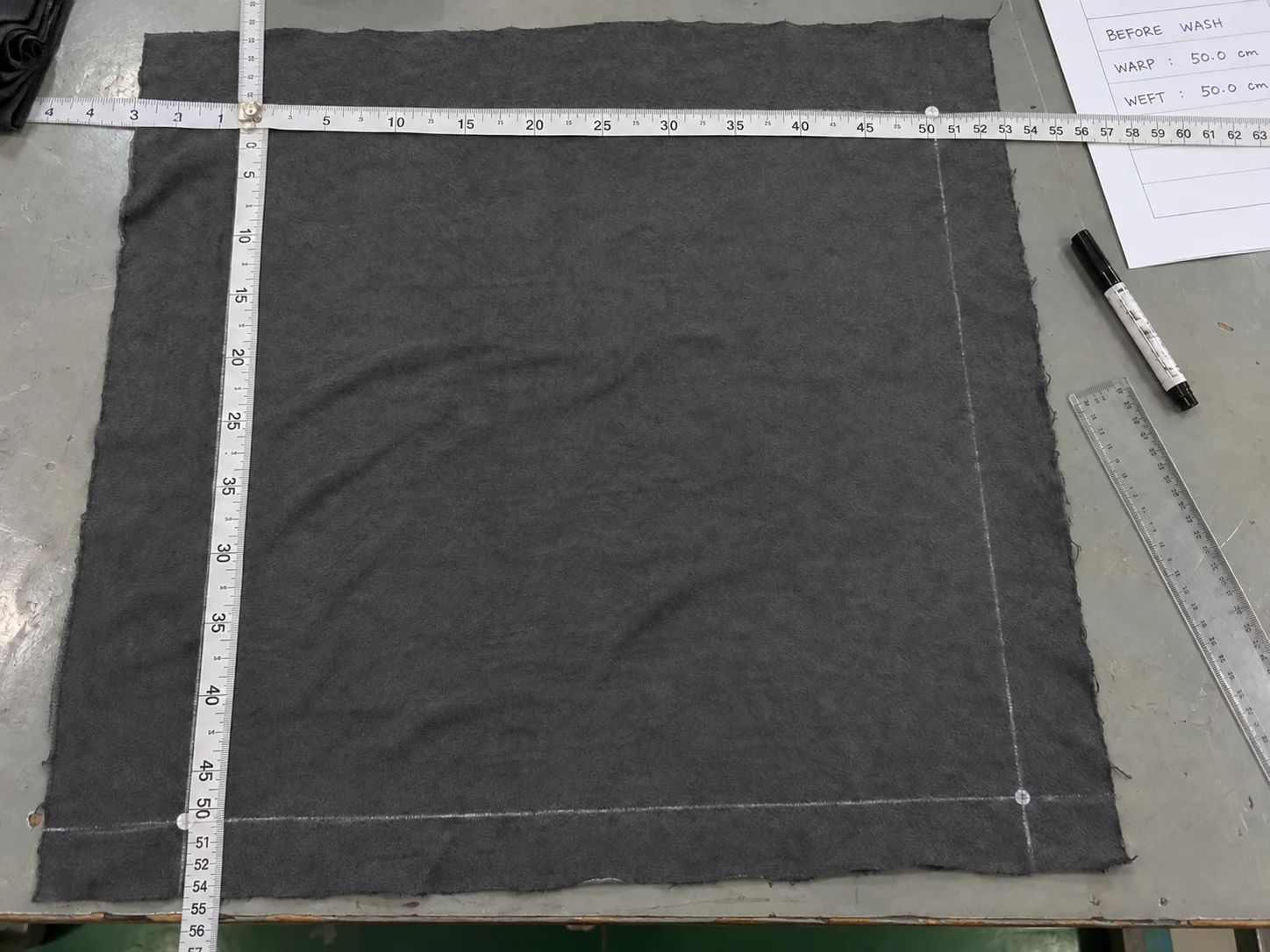
Cut the specimen to the working size, mark a fixed test frame or reference points, and record the original lengthwise and widthwise dimensions.
- 03
Apply the agreed care cycle
Wash and dry under the client's specified method. If no method is specified, KAOUYOU uses an internal condition selected for the fabric and product rather than one identical cycle for every material.
- 04
Allow recovery
After drying, let the specimen or garment recover before measurement so temporary heat, moisture and handling effects are not mistaken for the final result.
- 05
Measure both directions
Record the new lengthwise and widthwise dimensions separately, then calculate and document the dimensional change for each direction.
- 06
Inspect more than size
Also review skew or torque, curling, surface change, hand feel and color. For washed products, evaluate the complete garment result as well.
How is shrinkage percentage calculated?
When shrinkage is expressed as a positive percentage, a practical calculation is: (original dimension − final dimension) ÷ original dimension × 100. A specimen marked at 50 cm and measuring 48.5 cm after the agreed process has reduced by 3% in that direction. This is only an arithmetic example—it is not KAOUYOU's universal pass limit and does not define another customer's test method.
Some formal reports describe dimensional change with a signed value, where shrinkage and growth use opposite signs. The test report should therefore state its calculation convention. More importantly, the lengthwise and widthwise results must remain separate: body and sleeve length are influenced mainly by lengthwise change, while chest, shoulder and sleeve width are influenced more by widthwise change.
3. Which Washing Conditions and Standards Should Be Used?
The correct conditions come from the client's care label, quality manual or specified test method. The brand should define the wash temperature, wash program or agitation, detergent, number of cycles, drying method and allowable result when those details are mandatory. If they are not supplied, KAOUYOU selects an internal condition appropriate to the fabric and intended product; the factory does not apply one undisclosed universal cycle to cotton jersey, stretch fabric, heavyweight knit and garment-washed products alike.
For formal testing, AATCC lists TM135 for dimensional changes of fabrics and TM150 for dimensional changes of garments after home laundering. ISO 5077:2007 covers determination of dimensional change after specified washing and drying procedures; ISO states that this edition was reviewed and confirmed in 2022. Naming one of these standards is not enough by itself—the applicable preparation, laundering, drying, cycles and acceptance criteria still need to be defined for the order.
| Control route | Primary purpose | Who sets the conditions? |
|---|---|---|
| KAOUYOU internal test | Material evaluation, pattern development and production control | KAOUYOU selects an appropriate internal method when the client has not specified one. |
| Client-specified factory check | Verify the order against the client's care and quality requirement | The client supplies the complete conditions and allowable result. |
| Third-party laboratory report | Provide formal evidence under a named AATCC, ISO or custom method | The order specification names the method; the laboratory follows the applicable procedure. |
KAOUYOU does not have a dedicated temperature-and-humidity conditioning laboratory. Internally, washed specimens or garments are laid flat in the factory environment and typically allowed to recover for about half a day before measurement. When a formal method requires controlled conditioning, that work belongs with the third-party laboratory.
4. Which T-Shirt Materials Need Closer Shrinkage Control?
Fiber content is only one variable. Knit structure, density, stretch, dyeing, finishing and the interaction between materials can change the result. A supplier's “pre-shrunk” or “already heat-set” statement is useful background, but KAOUYOU still checks the actual production-intent lot because bulk color and finishing can change the behavior.
| Material or construction | Main risk | Production decision |
|---|---|---|
| 100% cotton or high-cotton jersey | Cotton fibers and knit construction can change in length and width after wet processing and drying. | Confirm the actual finished bulk lot, not only the supplier description. |
| Cotton-spandex or other stretch knits | Stretch, recovery and heat exposure can change both measurements and shape. | Check recovery, neckline stability and test conditions as well as shrinkage. |
| Heavyweight or loosely constructed knits | High mass, loop structure or lower structural stability can create different drying and relaxation behavior. | Evaluate drape, torque and the finished silhouette, not only one percentage. |
| Body fabric with rib trims | The body and rib may shrink or recover at different rates. | Test the materials separately and verify the sewn combination after washing. |
| Mixed fabrics or panel construction | Different compositions, structures or finishes can pull against each other. | Check seams, panels, appliqués and asymmetric details after the complete care cycle. |
| Garment-dyed or heavily washed products | Dyeing, enzymes, abrasion, heat and drying affect dimensions, color and hand together. | Approve a washed garment or pre-production sample using the intended process. |
Fabric weight can influence the silhouette and drying behavior, but GSM does not predict shrinkage by itself. Buyers choosing a material should review the broader T-shirt GSM and fabric specification guide, then validate the selected lot under the intended care process.
5. How Is the Test Result Applied to the Pattern?
The pattern maker reviews lengthwise and widthwise change separately rather than enlarging the entire pattern by one percentage. Body length and sleeve length mainly relate to the length direction. Chest width, shoulder width and sleeve width relate more to the width direction. Rib, body fabric and any secondary materials may each need their own allowance.
The calculated allowance is a development input, not final proof. The revised pattern still needs a sample or wash trial because sewing, seam structure, pressing, garment shape and material recovery can make a complete T-shirt behave differently from a flat fabric specimen.
When the first sample uses stock or substitute fabric, the formal bulk fabric is tested again even if the stated composition and GSM are similar. Differences in knit density, stretch, dyeing and finishing may require another pattern review and a new pre-production sample. This is also why oversized T-shirt measurements and proportions should be approved using production-intent material whenever possible.
6. How Are Garment-Dyed and Vintage-Washed T-Shirts Controlled?
Garment dyeing, enzyme washing, vintage washing and heavy drying affect size, color, hand and torque together. A flat fabric shrinkage test remains useful, but it cannot represent every mechanical and chemical effect applied to a sewn garment. KAOUYOU therefore first confirms the wash direction with a small trial, then checks a complete sample or pre-production sample after the intended finishing sequence.
Final measurements are taken after the agreed dyeing or washing, drying, pressing and recovery. The approved result becomes the production reference. Products such as a washed graphic oversized T-shirt illustrate the type of silhouette and finish that requires development as a complete garment; the product page is a design reference, not evidence that every washed order uses the same formula or test result.
Buyers can review additional silhouettes in KAOUYOU's custom T-shirt manufacturing collection. Each order still requires its own production fabric, wash recipe, measurement chart, tolerance and approved sample.
7. What Happens When the Body Fabric and Rib Shrink Differently?
Differential shrinkage occurs when two sewn materials change at different rates. A body fabric may become shorter while the neck rib changes less, or the rib may contract more strongly than the neckline seam. The result can be a wavy or puckered neck, an opening that is too tight, a loose collar, curled cuffs, distorted panel seams or an asymmetric garment.
Shrinkage is not the only risk. Widthwise skew, garment torque, bowing, curling and loss of recovery can make a T-shirt fail even when individual measurements appear close to tolerance. KAOUYOU therefore tests the main fabric, rib and relevant secondary materials, then reviews how the sewn combination behaves after washing.
The finished garment should meet the agreed measurement tolerance and preserve the approved shape. A percentage that looks acceptable on one fabric specimen does not override a twisted body, distorted seam, wavy collar or visibly changed fit.
8. What Happens If the Shrinkage Result Fails?
Before cutting
KAOUYOU first checks the test method and fabric lot to confirm that the result is representative. If a pattern or process adjustment can solve the issue, the team revises the allowance and repeats the test or sample validation. If the material itself cannot meet the agreed requirement, the fabric supplier is asked to replace it and compliant material is purchased. Even when the original material cannot be returned, replacing it before cutting can prevent a much larger finished-garment loss.
After cutting or sewing
The affected batch is paused and isolated while the team checks fabric lot, cutting, sewing, washing, drying and finishing records. Depending on the cause and scope, the response may include reprocessing, controlled finishing, repair, a revised wash operation or reproduction. Light measurement deviation may sometimes improve through proper finishing, but actual fiber shrinkage, serious torque or structural deformation usually cannot be fully reversed. KAOUYOU does not treat temporary stretching as a valid repair for shipment.
9. Where Is Shrinkage Checked During Bulk Production?
One pre-production test is not enough when a large order contains multiple colors, fabric lots or wash batches. KAOUYOU maintains records that connect the result to the relevant material and production stage, allowing an abnormal batch to be traced without mixing it with unaffected goods.
| Checkpoint | What KAOUYOU verifies |
|---|---|
| Bulk fabric arrival | Verify each relevant fabric lot and color before relying on the material for cutting. |
| Before cutting | Review shrinkage results, pattern allowance, relaxation needs and any unresolved material risk. |
| First piece or first batch | Measure the garment and compare the construction and proportions with the approved standard. |
| After garment dyeing or washing | Recheck finished measurements, torque, seam behavior, color, hand and silhouette. |
| Finishing and before packing | Sample finished-garment measurements and appearance before products enter final packing. |
The measurement review is part of a wider clothing manufacturing quality-control process. If repeated deviations appear, QC expands the inspection scope and traces the lot, cutting bundle, sewing operation or wash batch before allowing the next stage to continue.
10. What Should a Brand Put in Its Tech Pack or Purchase Order?
- State whether the target size chart applies before or after garment dyeing, washing, drying and pressing.
- Provide the intended care-label method or named test method, including wash temperature, number of cycles, detergent and drying method when these are mandatory.
- Set the allowable dimensional change by product, fabric and point of measure; do not rely on an undefined universal shrinkage limit.
- Confirm whether a formal third-party report is required and which AATCC, ISO or customer method should be used.
- Approve production-intent fabric, including composition, GSM, stretch, hand, color and finishing state.
- Identify all secondary materials—rib, panels, appliqués, bindings and trims—that could react differently from the main fabric.
- Approve the washed sample or pre-production sample when garment dyeing, enzyme washing or vintage finishing affects the final size.
- Record finished-garment measurement methods and tolerances in the Tech Pack, not only the nominal size name.
- Require written action when a result is outside the agreed requirement: hold, retest, adjust, replace or reproduce as appropriate.
These fields make quotations and sampling more reliable because the factory can evaluate the real care and dimensional-stability requirement before material purchase. If a brand adds a laboratory standard only after bulk garments are complete, the result may require new testing, rework or material replacement that was not included in the original plan.
Frequently Asked Questions
How do clothing manufacturers control T-shirt shrinkage in bulk production?
Control begins with production-intent fabric testing, separate lengthwise and widthwise results, pattern adjustment, sample validation and repeated checks during bulk production. For garment-dyed or washed T-shirts, the final garment must also be measured after the complete finishing process.
What is an acceptable shrinkage percentage for a T-shirt?
There is no single percentage that applies to every T-shirt. The acceptable result depends on the fiber, knit structure, finish, care method, style, customer quality standard and end market. KAOUYOU confirms the customer's requirement before sampling or bulk production; otherwise the result is evaluated for the specific material and product.
Does pre-shrunk cotton still need a shrinkage test?
Yes. A supplier's pre-shrunk or heat-set statement is useful background information, but the actual bulk lot can behave differently because of dyeing, finishing, color, washing and drying conditions. KAOUYOU tests the production-intent material again.
Should T-shirt shrinkage be tested on fabric or a finished garment?
Often both serve different purposes. Fabric testing supports material acceptance and pattern allowance. Finished-garment testing confirms the combined effect of construction, rib, sewing, garment dyeing, washing, drying and pressing. A customer's named method determines the formal requirement.
Why are length shrinkage and width shrinkage different?
Knitted fabric can respond differently along its length and width because yarn, loop structure, processing tension and finishing are directional. The pattern maker therefore should not apply one shrinkage percentage uniformly to every pattern dimension.
Can a factory fix shrinkage after garments are finished?
Some light measurement differences may improve through controlled finishing or pressing, but actual fiber shrinkage, severe torque or structural distortion may not be fully reversible. The affected batch should be isolated and assessed against the customer's tolerance rather than stretched temporarily and shipped.
What is the difference between an internal shrinkage test and a laboratory report?
KAOUYOU's internal washer-and-dryer checks support development, pattern decisions and daily production control. When a client requires a formal AATCC, ISO or custom-method report, representative fabric or garments are sent to a qualified third-party laboratory under the specified conditions.