An apparel packaging checklist should keep four things aligned: the approved garment, its product identity, the individual pack and the shipping carton. A clean polybag is not enough if the size sticker, barcode, pack ratio or packing list points to a different SKU.
KAOUYOU normally checks each finished garment before packing, folds it to the approved or practical method, packs one unit per bag, sorts units by style, color and size, reconciles carton quantities and then prepares the order for the agreed shipping and delivery handoff. Client instructions take priority where a different fold, bundle, label or carton configuration is required.
Apparel packaging checklist in 30 seconds
- Freeze garment, label, fold, bag, sticker, barcode, pack ratio and carton instructions before final packout.
- Match every physical unit to the correct style, color, size and SKU before sealing the bag.
- Reconcile carton contents with the order and packing list—not only with a shipment-level total.
- For Amazon or another platform, the client supplies current files and rules; KAOUYOU executes and checks the approved instructions.
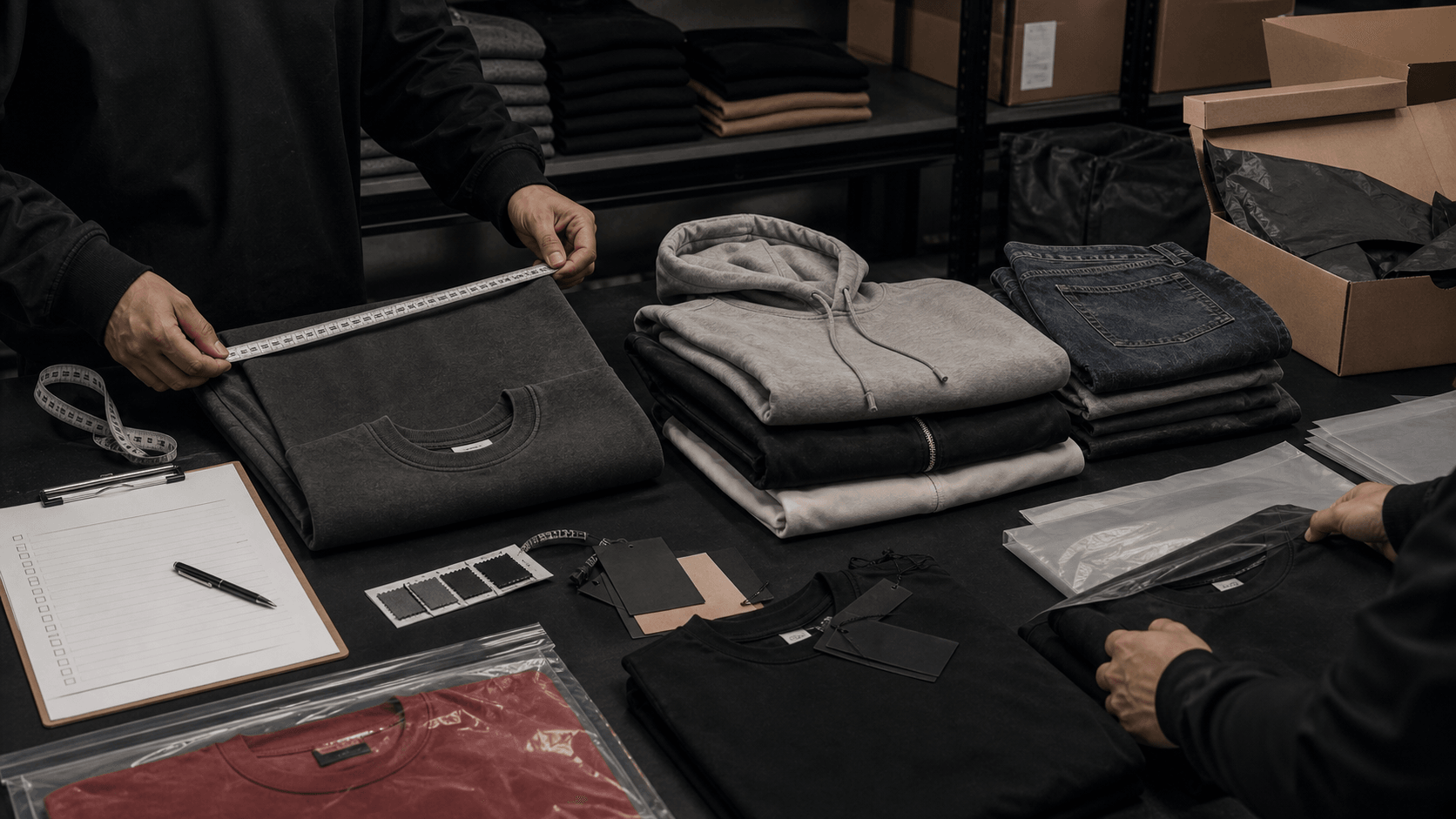
What Should a Clothing Brand Control Before Packing?
A useful clothing packaging checklist is more than a list of bags and boxes. It links four control layers so a warehouse can identify what arrived and the consumer receives the intended product.
| Control | What to specify | Evidence to approve |
|---|---|---|
| Product identity | Style, color, size, SKU and ordered quantity | Approved order breakdown and product data |
| Garment presentation | Fold direction, folded dimensions, visible front, hangtag position | Fold diagram, reference or approved photo |
| Individual pack | One per bag or multi-piece bundle; bag type, size, closure and printed content | Approved packaging sample and supplier specification |
| Unit identification | Size sticker, barcode, FNSKU or other customer-supplied identifier | Approved files, placement map and scan check |
| Carton configuration | Solid or mixed pack, size ratio, pieces per carton and carton sequence | Carton packing instruction |
| Outer identification | Carton mark, box label, destination and any warehouse identifier | Approved carton artwork or label file |
| Shipment record | Carton count, contents, dimensions, net and gross weight | Packing list and physical carton check |
What Is KAOUYOU's Garment Packing Sequence?
The standard sequence keeps quality release ahead of carton closure:
- Complete final appearance and workmanship inspection and address required corrections.
- Press or finish the garment and confirm that it is clean, dry and ready to pack.
- Fold the garment using the client-approved method or KAOUYOU's practical fold when no method is specified.
- Verify hangtags, labels, accessories, size sticker and customer-supplied identifier.
- Place the garment in the approved individual bag or multi-piece bundle.
- Sort packed units by style, color and size and follow the confirmed carton ratio.
- Count, record, seal and mark cartons, then reconcile physical totals with the packing list.
- Reconfirm shipment information with the logistics party during the handoff stage.
This is KAOUYOU's normal workflow, not a mandatory rule for every order. A retailer, marketplace, warehouse or client quality manual may require another sequence or an additional inspection gate.
How Should Garments Be Folded and Individually Packed?
One garment per bag is KAOUYOU's normal starting method. Several garments can be packed as one bundle when the buyer's approved requirement calls for it. T-shirts, hoodies, trousers and jackets follow the same control principle: present the front consistently, keep the hangtag and required identification visible, and use a bag sized for the folded thickness. The practical difference is mainly fold volume and bag size.
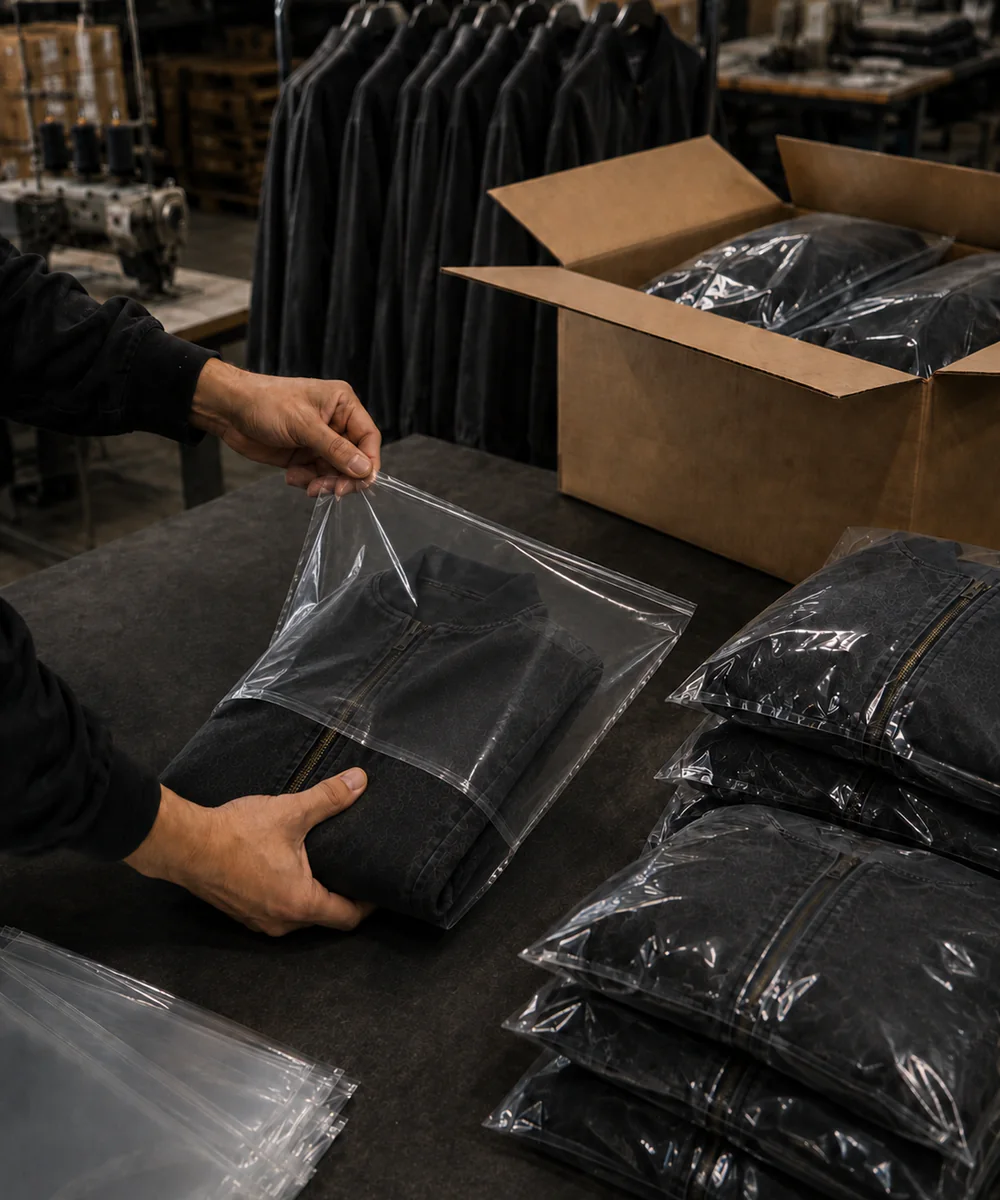
When a buyer supplies a folding diagram, tissue layout, folding board, visible-front instruction or finished reference, KAOUYOU follows the approved standard. Without a specific requirement, the team selects a stable practical fold suitable for the garment.
Standard and custom packaging bags
KAOUYOU can coordinate transparent self-seal bags, zipper bags, frosted bags, logo-printed bags and recyclable-material options. Standard packaging is normally included in the garment quotation. Custom packaging is quoted separately according to material, dimensions, printing and quantity.
KAOUYOU's current working MOQ is 1,000 pieces for a custom packaging bag and 3,000 pieces for a recyclable-material custom bag. These are KAOUYOU supplier conditions, not universal packaging-industry minimums, and the final specification and quotation must still be confirmed.
How Should Labels, SKU and Barcodes Be Controlled?
Main labels, size labels, care labels, hangtags, spare buttons or parts, external size stickers and customer channel labels should be checked against the approved accessory file. If supplied information conflicts, KAOUYOU stops and asks the client to correct or reconfirm it before packing continues.
KAOUYOU can print or apply customer-approved SKU, barcode, FNSKU, warehouse and carton-label files and perform a scan check before shipment. The scan proves that the applied symbol can be read; it does not prove that the client assigned the correct identifier to the product. Product mapping and current platform files remain the client's responsibility.
Can the code be scanned? Check contrast, quiet space, print quality, wrinkles and placement. Does it identify the correct SKU? Compare the decoded value and label text with the approved product-data file. Passing one check does not guarantee the other.
GS1 notes that barcode quality can be affected by insufficient quiet zones, weak contrast, incorrect sizing, packaging glare or obstruction, damage and poor positioning. The correct symbol and application specification must be selected for the intended scanning environment. See the GS1 barcode quality guidance.
How Should Garments Be Packed into Cartons?
KAOUYOU supports solid-size, mixed-size, mixed-color and pre-pack configurations. Solid color with an approved mixed-size ratio is most common; larger orders often use solid color and solid size. The buyer's warehouse receiving method should decide the final carton structure.
| Pack type | What is inside | Planning note |
|---|---|---|
| Solid color / solid size | One color and one size in a carton | Common for larger quantities and simple warehouse sorting |
| Solid color / mixed size | One color with an approved size ratio | KAOUYOU's most common apparel carton configuration |
| Mixed color / mixed size | Several colors and sizes under a defined matrix | Requires especially clear SKU and carton records |
| Pre-pack / assortment | A fixed retail or warehouse assortment repeated as one pack | Useful only when the receiving system expects that exact configuration |
When the client does not specify a carton, KAOUYOU normally uses a suitable standard carton. Carton dimensions, board construction, pieces per carton and final weight are adjusted when the garment is unusually thick, the pack ratio changes, or the customer, forwarder or receiving warehouse provides another requirement.
What belongs on an apparel carton mark?
- Customer name or approved identifier
- Purchase order number
- Style, color and size
- Quantity inside the carton
- Carton sequence, such as 1 of 20
- Net weight and gross weight
- Carton dimensions
- Destination
- Customer-required barcode or warehouse label where applicable
The responsible KAOUYOU merchandiser records each carton's style, color, size, quantity, dimensions and weights as required, then checks the packed total against the order and packing list. After dispatch, available shipment details are reconciled again with the logistics provider.
What Is a Shipment Sample?
KAOUYOU uses the term Shipment Sample for a garment selected from actual bulk that shows the final production quality, labels, hangtags, folding and individual packaging. It is different from an early prototype or fit sample because it represents what has actually been produced and packed.
KAOUYOU normally sends the Shipment Sample to the client for review. Smaller clients sometimes approve detailed photos instead when they do not want to add international courier cost. The chosen approval method and timing should be agreed before shipment release.
What Changes for Amazon FBA Apparel Packaging?
Amazon preparation must remain a separate, current requirement set—not a universal clothing packaging rule. Amazon's July 2026 FBA preparation guide states that apparel, fabrics and textiles require bagging and describes current barcode, bag closure, warning and shipping-box controls. Sellers should check the applicable Seller Central workflow and shipment plan because requirements can change by product, destination and program. See Amazon's official FBA packaging, prep and labeling guide.
KAOUYOU can coordinate FNSKU, barcode, individual packaging, carton preparation and warehouse labels, but does not operate the client's Amazon account or guarantee platform acceptance. The final current files and rules must be supplied or approved by the client.
What Does Final Apparel Packaging QC Check?
| Checkpoint | What the packing team verifies |
|---|---|
| Garment | Correct style, color and size; clean, dry, odor-free and approved for packing |
| Labels and attachments | Correct main, size and care labels, hangtags, spare parts and requested accessories |
| Fold and presentation | Approved fold, front orientation, hangtag position and suitable bag size |
| Bag | Correct material, print, warning content where specified, closure and external sticker |
| Identifier | SKU, size sticker, barcode or FNSKU matches the physical unit and approved file |
| Carton | Correct pack ratio and count; sound carton, sealing, mark and shipment label |
| Documents | Packed totals reconcile with the order, carton records and packing list |
Sea-freight orders may use desiccants, moisture-protection bags, boards or other protective materials. Air shipments may also use desiccants or another agreed protection. These additions depend on the garment, climate, transport route and customer instruction; they are not automatic for every order.
A late packaging change is simplest before packing begins. If garments are already bagged or cartons are sealed, changing a bag, sticker, carton mark or pack ratio can require new materials, full unpacking, re-sorting, re-packing and a revised schedule. KAOUYOU confirms any added cost when completed work must be repeated.
Case: An Incorrect Barcode Caught Before Shipment
A long-term KAOUYOU client once supplied an incorrect barcode-sticker file. If the order had shipped with those labels, the client's warehouse would not have been able to receive the inventory under the intended product records.
KAOUYOU identified the mismatch during the pre-shipment check and contacted the client. After the corrected file was confirmed, the team reopened every affected carton, replaced the barcode stickers across the bulk order, repeated the relevant checks and completed the rework in two days before shipment.
Because this was a long-term client relationship, KAOUYOU did not charge for that rework. This is a specific service decision from that project, not a general promise that customer-supplied data errors will always be corrected free of charge. The prevention lesson is broader: approve the product mapping, test a physical label and decode representative barcodes before the full order is sealed.
What Packaging Evidence Should a Clothing Brand Request?
- An approved packaging specification connecting every style, color and size to its SKU and packing method.
- A physical Shipment Sample or clear photos showing the final garment, fold, labels, hangtags, bag and stickers.
- Barcode scan confirmation plus a data check against the approved SKU or platform file.
- A carton plan showing solid or mixed pack, size ratio, pieces per carton and carton sequence.
- Carton-mark and shipment-label photos with confidential identifiers masked when used outside the project.
- A packing list that reconciles style, color, size and quantity totals with the physical cartons.
- Carton dimensions, net and gross weights and agreed protection or special receiving instructions.
Frequently Asked Questions
What should an apparel packaging specification include?
It should connect the physical garment to its style, color, size and SKU, then define the fold, individual bag, hangtag and sticker placement, barcode or channel label, pack ratio, pieces per carton, carton mark and packing-list fields. Include approved files and a visual reference rather than relying on names alone.
Does KAOUYOU normally pack one garment per polybag?
Yes. One garment per bag is the normal starting method, but several units can be bundled when the client's approved packing instruction requires it. Bag size and fold are adjusted to the garment thickness and packed configuration.
Can KAOUYOU coordinate custom or recyclable garment bags?
Yes. KAOUYOU can coordinate transparent self-seal bags, zipper bags, frosted bags, logo-printed bags and recyclable-material options. The current working MOQ is 1,000 pieces for a custom packaging bag and 3,000 pieces for a recyclable-material custom bag, subject to the final material, dimensions, printing and supplier quotation.
Can different sizes be mixed in one carton?
Yes. KAOUYOU supports solid-size, mixed-size, mixed-color and pre-pack arrangements. Solid color with an approved mixed-size ratio is most common; larger orders often use solid color and solid size. The customer's warehouse and order plan determine the final method.
Can KAOUYOU apply barcodes and Amazon FNSKU labels?
Yes. KAOUYOU can print or apply customer-approved barcode, FNSKU, warehouse and carton-label files and perform a scan check. The client or platform partner remains responsible for providing the correct current identifier, product mapping and platform requirement.
What is a Shipment Sample in apparel production?
A Shipment Sample is selected from actual bulk and shows the production garment with its final labels, hangtag, folding and packaging. KAOUYOU normally sends it to the client; smaller clients may approve detailed photos when they prefer not to pay additional courier cost.
What packaging evidence can a clothing brand request?
Depending on the order, KAOUYOU can provide packing photos, Shipment Sample evidence, barcode scan confirmation, packing-list data, carton dimensions and weights, carton-mark photos and final packing spot-check records.
Source and Evidence Notes
KAOUYOU's packing workflow, packaging-bag MOQs, common carton configurations, Shipment Sample practice, quality checks and barcode rework case were supplied and reviewed by the KAOUYOU team for this guide. They describe current KAOUYOU practice, not automatic rules for every manufacturer or order.
Platform and barcode references use current official Amazon and GS1 guidance. Clients remain responsible for supplying the requirements and files applicable to their destination, sales channel and shipment when the order is prepared.