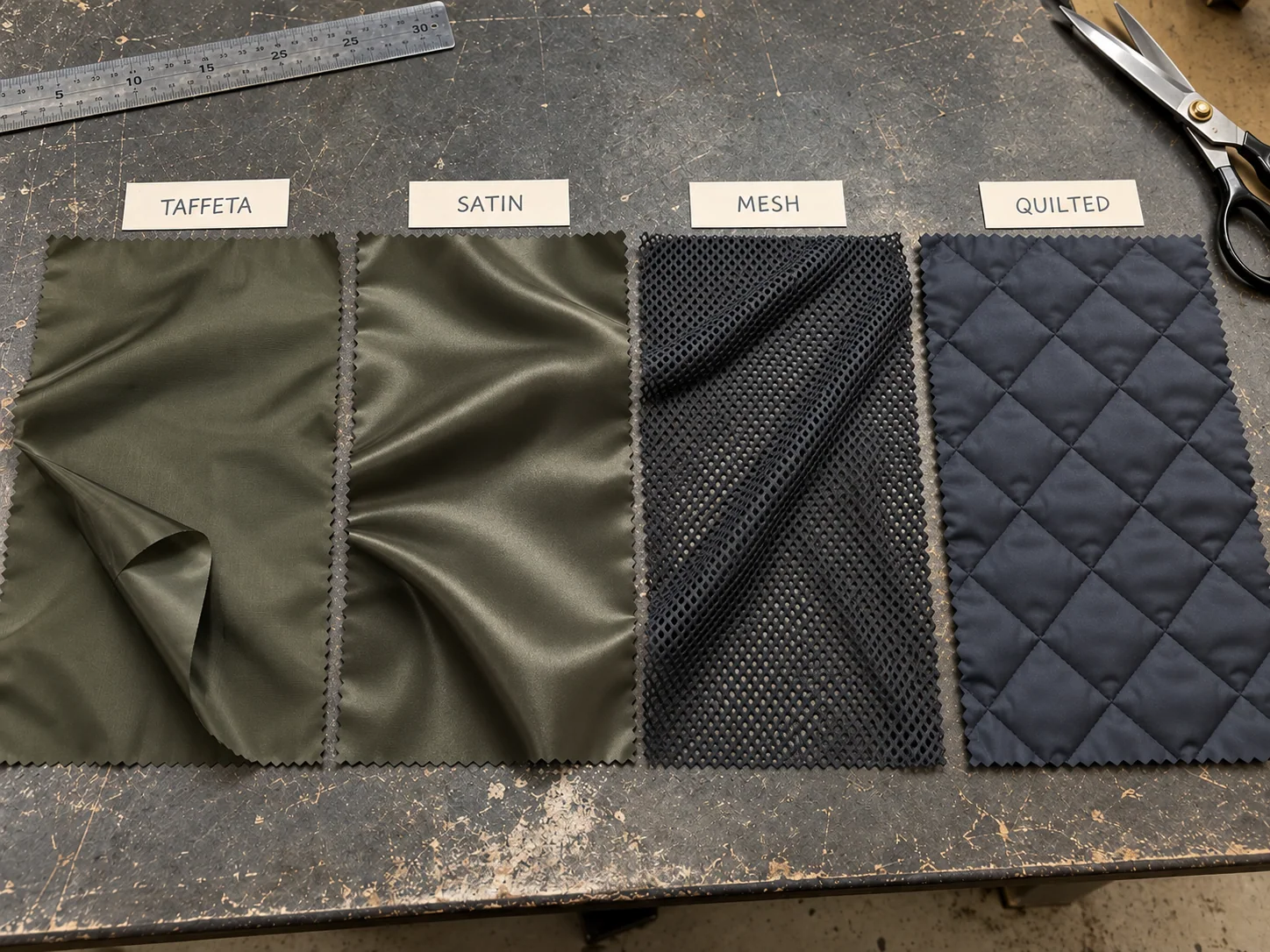
The right bomber jacket lining depends on the jacket's season, shell, target warmth, desired hand feel, wearing layer and price position. Polyester taffeta is a practical light and stable choice, satin gives a smoother and more elevated interior, mesh improves ventilation, and quilted lining adds insulation. A brand should approve the lining as part of the complete jacket—not as an isolated fabric name.
KAOUYOU has developed all four directions for custom outerwear. Most clients add a lining to a bomber; unlined construction is possible but comparatively uncommon. For a new custom jacket and outerwear program, the factory reviews the market, climate, shell, warmth target, layering needs and target cost before recommending a material system.
Answer in 30 seconds
- Choose taffeta for light weight, lower shine, structure and dependable bulk production.
- Choose satin for a softer, smoother and more fashion-led interior.
- Choose mesh when ventilation matters more than warmth or easy sleeve slip.
- Choose quilted lining when insulation and a padded internal structure are required.
- Confirm shell, lining, fill, rib and trims together in a finished sample before bulk production.
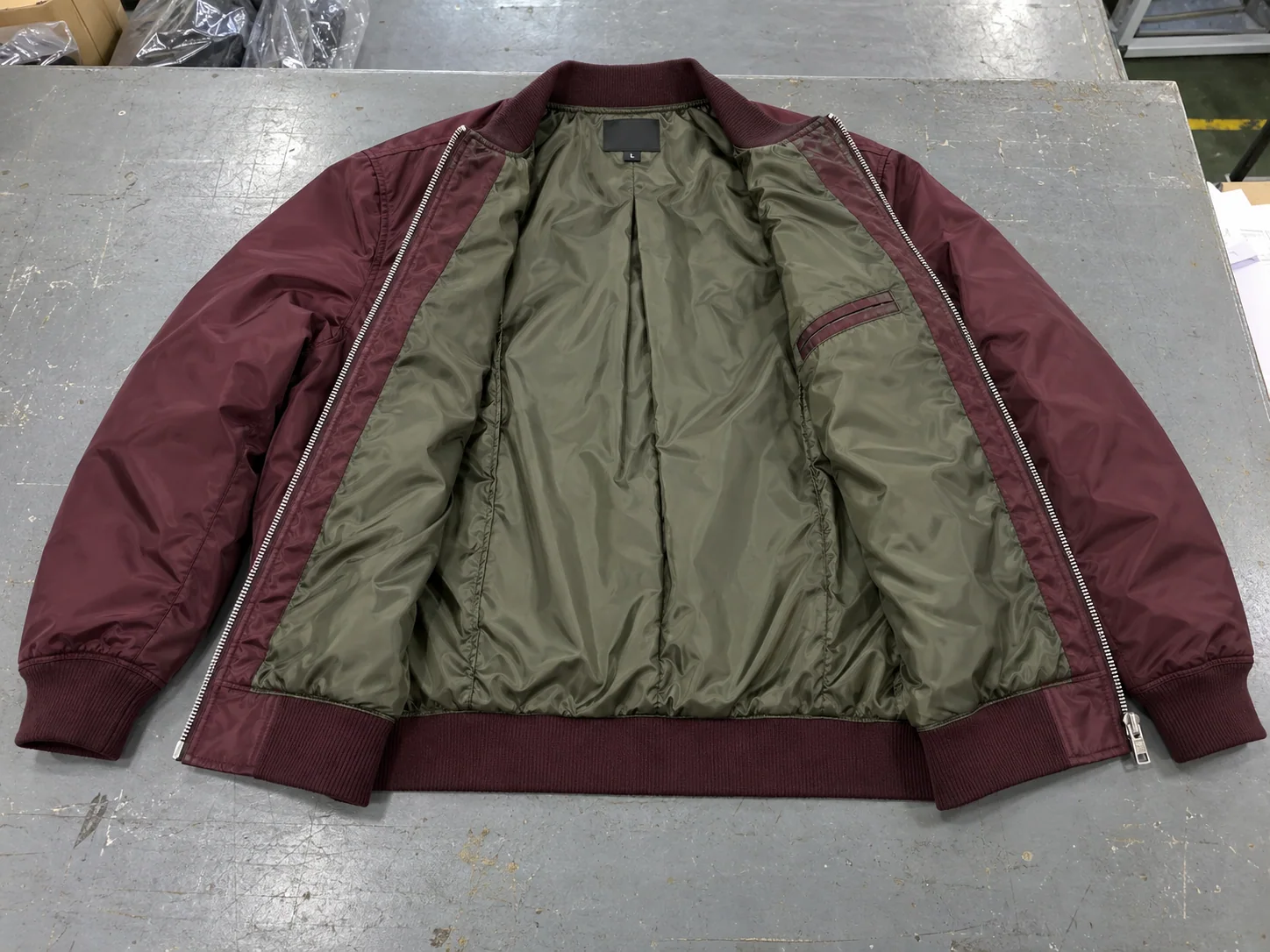
Which Bomber Jacket Lining Should a Brand Choose?
Start with the intended product rather than the material name. A lightweight nylon flight jacket, a polished fashion bomber and a padded winter jacket may share a similar silhouette while requiring very different linings.
| Option | Hand and appearance | Common direction | Main advantage | Main risk to check |
|---|---|---|---|---|
| Polyester taffeta | Light, crisp and comparatively matte | Regular flight jackets, lightweight outerwear, sport or functional bombers | Stable bulk production, durability and cost control | Very light grades may create noticeable friction noise |
| Polyester satin | Smooth, soft and more lustrous | Fashion-led, elevated or vintage-positioned bombers | Easy layering and a more refined interior presentation | Snagging, needle marks and excessive shine must be controlled |
| Polyester mesh | Open, breathable and lightweight | Spring/summer, sport, coach-jacket and lightweight nylon directions | Ventilation and less lining cling against the wearer | Limited warmth, wind protection and slip during dressing |
| Quilted lining | Padded, structured and warmer | Autumn/winter bombers and insulated outerwear | Warmth, volume and a controlled internal layer system | Bulk, pattern allowance, fill stability and wash behavior |
This comparison is a selection guide, not a fixed rule. Fiber quality, yarn, weave or knit structure, weight, finish and supplier consistency can change how two materials with the same general name perform.
Polyester Satin vs Taffeta: What Is the Difference?
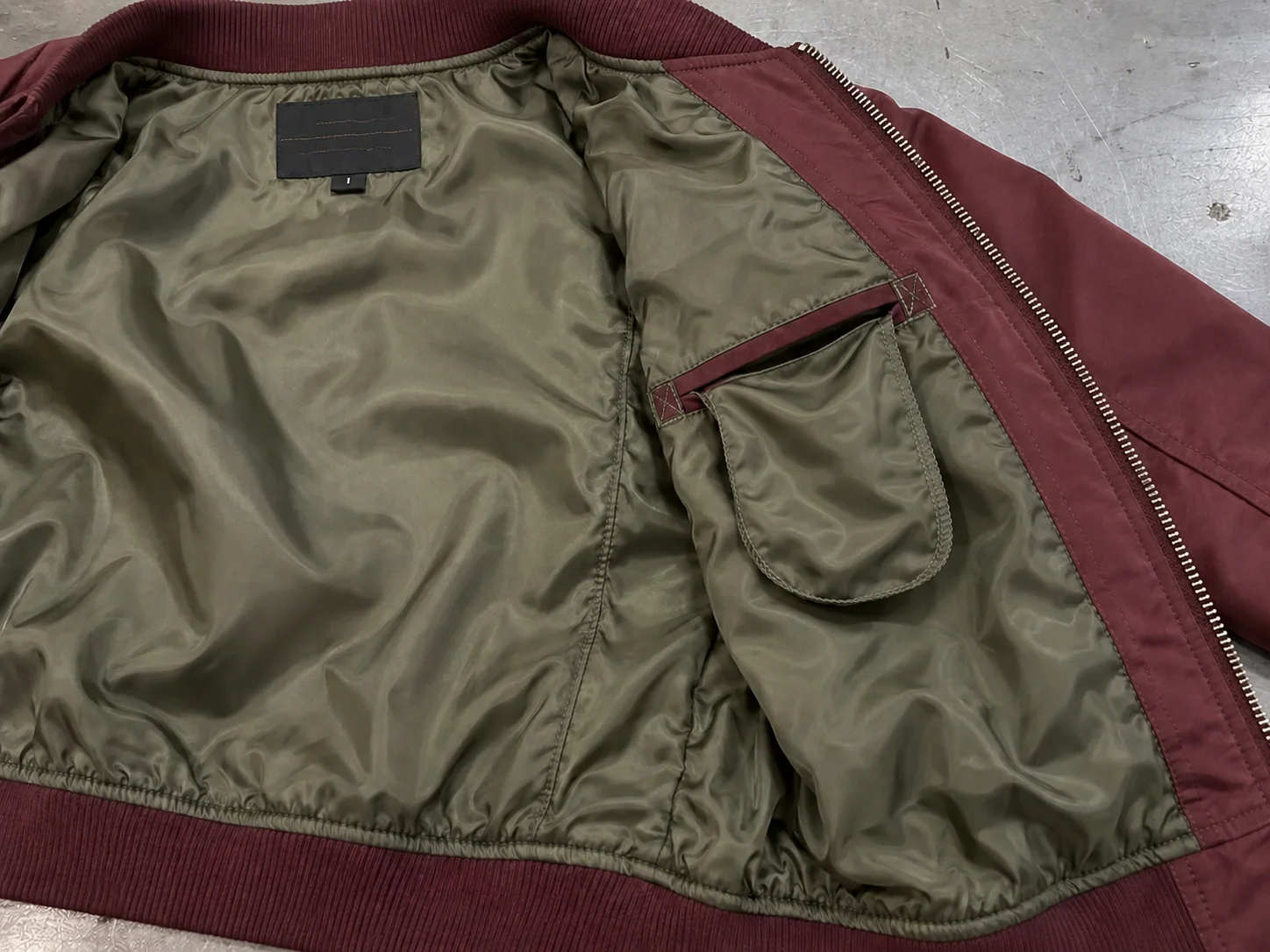
Both are suitable for bomber jackets, but they create different product impressions. Polyester satin has a smoother face, more luster and a softer hand. It slips easily over clothing and can support fashion, elevated or vintage styling. The factory must control excessive shine, snagging, visible needle holes and surface marks; a very bright or thin satin may not match the intended retail position.
Polyester taffeta usually has lower shine, a lighter and crisper hand and a more stable structure. It is a common direction for regular flight jackets, light outerwear and sport or functional bombers where durability, production control and cost balance matter. Very light taffeta can create friction noise, so the actual swatch and finished sample should be handled rather than selected from a specification name alone.
In simple terms, select satin when softness, slip and a more polished interior are priorities. Select taffeta when the project prioritizes low weight, stability, durability and cost control. The visible shell can already establish a strong design direction—as shown by this contrast-collar bomber reference—while the lining specification still needs separate approval.
When Does Mesh Lining Make Sense?
Mesh lining is mainly used when a bomber needs to stay light and breathable. It can suit coach-jacket directions, lightweight nylon flight jackets, spring/summer outerwear and functional or sport products. KAOUYOU may review ordinary polyester mesh, bird-eye fabric or a finer sports mesh according to the desired appearance and use.
Mesh reduces the enclosed feeling of a solid lining and is less likely to cling to the wearer in warm conditions. Its trade-offs are lower warmth and wind protection, less slip when worn over some garments and a less formal interior presentation. It is therefore not usually the first choice for a padded winter bomber or a jacket that needs a smooth, elevated drape.
How Is a Quilted Bomber Lining Constructed?
A common quilted lining contains three layers: a lining face, a middle insulation layer and a thin nonwoven, interlining or other stabilizing backing. The layers are quilted into a composite sheet, then cut into front, back and sleeve panels, sewn into the inner body and joined to the shell. The backing helps keep the fill stable during cutting, sewing, wear and washing.
Some lightweight constructions use only a face lining and fill, but a three-layer system is generally easier to stabilize for bulk production. KAOUYOU selects the exact construction with the client according to the intended warmth, fill weight, quilting pattern and finished thickness. The client can specify the quilt geometry and dimensions; otherwise the factory can discuss practical options for approval.
Quilting changes more than warmth. It adds volume at the chest, armhole, sleeve and seams, so the pattern must be adjusted rather than simply replacing a thin lining with a padded one. A brand may use quilted insulation in the body and a thinner, smoother sleeve lining to reduce arm bulk and make the jacket easier to put on. For a visible quilting direction, the diamond-quilted liner jacket shows how grid scale, fill, binding and finished silhouette must be developed as one layer system.
Can a Bomber Use Cotton Lining or No Lining?
Cotton poplin, cotton twill and cotton blends are possible when the design calls for a more natural internal hand. Poplin is lighter and flatter. Twill is heavier and more abrasion-resistant, adding structure as well as cost and garment weight. Cotton blends can balance a cotton-like touch with improved stability.
Compared with polyester, cotton linings tend to absorb moisture more readily and feel more natural, but they are less slippery during dressing and may wrinkle, shrink or collect fibers from the clothing underneath. Polyester generally offers lower weight, easier slip, better color stability and more predictable bulk handling. The decision should follow the final product brief rather than a broad assumption that one fiber is always more premium.
An unlined bomber is also possible, but relatively few KAOUYOU clients choose it. Without a lining, internal seams, pocket bags and construction are more exposed, so the shell, seam finish and intended lightweight character must justify that direction.
Why Must the Shell, Lining and Finish Be Tested Together?
A lining can work well on its own and still fail inside the finished bomber. The factory needs to review differences in stretch, shrinkage, surface friction, heat sensitivity and colorfastness between the shell, lining, rib, fill and trims. If one layer grows, shrinks or slides differently, the garment can twist, pull, bag or show uneven fullness.
Color transfer is another risk, especially when a dark shell or lining sits against a lighter material. KAOUYOU tests fabric colorfastness and does not use material that fails the required internal or customer-defined result. When the client requires formal performance testing, the method and acceptance requirement should be agreed before material approval.
When a bomber shell requires garment washing or another effect, most linings are not sent through the same process. KAOUYOU normally keeps the lining outside the shell treatment and plans the assembly sequence accordingly. A washed outerwear reference such as the two-tone raglan bomber still needs its shell, rib, zipper and project-defined lining to be checked as a complete system. If a buyer specifically wants the lining processed with the shell, that sequence must be sampled and approved.
Eight Questions to Answer Before Requesting a Lining Quote
- Which market, climate and selling season is the bomber designed for?
- Is the jacket a light layer, a smooth fashion piece or an insulated outer layer?
- What is the shell material, surface finish and expected garment-wash process?
- How much warmth, breathability and wind protection should the complete jacket provide?
- Should the lining feel crisp, soft, smooth, natural or padded?
- What retail positioning and target cost should the material system support?
- Will the customer wear the jacket over a T-shirt, sweatshirt or heavier knit layer?
- Does the lining need custom color, print, branding, pockets or special quilting?
Can a Brand Use Custom Color or Printed Lining?
Yes. KAOUYOU can coordinate market-available colors, custom colors, printed lining and specially developed branded lining. The practical route depends on the artwork, color, printing method, base fabric, finish and supplier.
KAOUYOU's regular garment MOQ is 100 finished pieces per style per color, with sizes mixed within that color. This is not a promise that a supplier will produce 100 metres of custom lining. Custom-dyed, printed, specially woven or specially finished lining may carry a separate supplier MOQ, which is confirmed for the specific material and artwork before quotation.
Market-stock taffeta, satin or mesh can often be purchased for the garment order without developing a new base material. Custom lining can add setup, sampling and material commitments. The buyer should approve a physical strike-off, color sample or fabric sample as appropriate before the material enters bulk jacket production.
What Lining Information Belongs in the Tech Pack?
A Tech Pack should make the lining reproducible. Writing only “polyester lining” leaves the factory without the hand, structure, color, weight, layer and construction information needed to quote or sample accurately. If the client starts with an incomplete brief, KAOUYOU guides the discussion until the required points are confirmed.
- Lining material, fiber composition, construction and target weight or approved reference
- Color, finish, sheen and hand-feel direction
- Whether the body and sleeves use the same lining or different materials
- Fill type, fill weight or warmth target when quilted insulation is required
- Quilting pattern, grid dimensions, spacing and stitch direction
- Shell-to-lining attachment, seam finish, facings, zipper guards and hem treatment
- Inside-pocket type, dimensions, position, closure and reinforcement
- Main label, size label, care label and any branding placement inside the jacket
- Shell washing or dyeing sequence and whether the lining stays outside that process
- Colorfastness, dimensional, wash or other client-specified test requirements
- Finished-garment measurements, tolerance and any allowance for padded bulk
- Custom lining artwork, repeat scale, print method and approval reference
Include the lining in the bill of materials and show its construction on the relevant technical pages. The clothing Tech Pack checklist explains how material, measurement and construction information should stay consistent across the file.
Why Is a Finished Bomber Sample Necessary?
A lining swatch can confirm color and hand, but it cannot show how the inner layer balances with the shell. After the full sample is completed, KAOUYOU sends it to the client so the complete jacket can be reviewed. The client gives final approval.
The sample review should cover:
- How easily the jacket goes on over the intended clothing layer
- Whether the lining pulls, twists, sags or shows excess fullness
- Whether a padded body or sleeve feels too bulky
- Inside-pocket access, capacity and reinforcement
- Label position, facing width, zipper guard and internal seam finish
- Shell and lining color compatibility under normal handling
- Finished measurements, silhouette, mobility and warmth direction
- Appearance after any agreed wash, heat or care test
If the lining type changes after sample approval—for example from taffeta to a thick quilted construction—the factory needs to reassess the pattern, bulk, sewing method, cost and sample requirement. It is not a simple material substitution.
How Does KAOUYOU Check Lining During Bulk Production?
KAOUYOU uses a fixed internal inspection flow instead of waiting until every jacket is complete. QC records and follows the relevant checks, while production staff and the client's confirmed documents provide the working standard.
If repeated pulling, puckering, twisting or another lining issue appears, the affected operation is corrected and the inspection scope is expanded. The goal is to stop one construction error from continuing through the remaining bulk quantity. Final quality expectations can also be aligned through a customer manual, internal report or third-party inspection requirement when specified before production.
Frequently Asked Questions
What is the best lining for a bomber jacket?
There is no universal best option. Polyester taffeta is often practical for light, stable and cost-controlled production; satin gives a smoother and more elevated interior; mesh supports breathability; and quilted lining adds warmth. The shell, season, target price, wearing layer and approval standard determine the right specification.
Is satin or taffeta better for a bomber jacket?
Choose satin when a softer hand, more slip and a more lustrous fashion presentation are priorities. Choose taffeta when the project needs a lighter, crisper, more stable and usually easier-to-control lining. Comparable fiber and construction specifications still matter, so the name alone does not determine quality.
Can a bomber jacket use mesh lining?
Yes. Mesh is useful for lightweight, spring/summer, sport and functional bomber directions where ventilation matters more than insulation. It is normally less suitable for a warm winter bomber or a style that needs a very smooth, formal interior.
What is inside a quilted bomber jacket lining?
A common construction uses a lining face, a middle insulation layer and a lightweight backing or stabilizing layer. The layers are quilted into a composite before the panels are cut and assembled. The final structure can change with the warmth target, fill, quilting pattern and customer requirement.
Can the body and sleeves use different linings?
Yes. A brand may use warmer quilted lining in the body and a thinner, smoother sleeve lining to reduce arm bulk and make dressing easier. The pattern and assembly method must be adjusted to the different layer thicknesses.
Can KAOUYOU make custom printed bomber jacket lining?
Yes. Custom color, printed lining and specially developed branded lining can be evaluated. KAOUYOU's regular garment MOQ is 100 pieces per style per color, with mixed sizes allowed within that color. A custom lining supplier may impose a separate MOQ based on color, artwork, printing method, weave, finish and fabric specification.
Should the lining go through the same garment wash as the bomber shell?
Not automatically. When the shell needs a wash or dye effect, KAOUYOU normally keeps most lining materials outside that process and selects an assembly sequence that protects the lining. If a customer wants both layers processed together, compatibility must be tested and approved before bulk production.
What should a brand approve before bulk bomber production?
Approve the complete sample: shell, lining, fill, rib, trims, pockets, labels, measurements, hand feel, warmth direction and internal construction. A loose lining swatch is useful for material selection, but it cannot confirm the balance and behavior of the finished jacket.