Puff print suits bold hoodie logos and clear graphic areas when a rounded, raised ink effect is intended. The production decision depends on artwork detail, fabric surface, stretch, print coverage and washing—not just the appearance of a digital mockup.
For a clothing brand, the important question is whether the raised effect can be reproduced on the intended hoodie without losing detail, comfort or wash performance. KAOUYOU coordinates puff printing through longstanding specialist partner factories and remains responsible for communication, checks and the quality of the delivered garment.
Answer in 30 seconds
- Bold text and open shapes are easier to evaluate than tiny letters, fine lines or complex gradients.
- Puff and high-density printing are different raised effects; approve their surface and hand on physical samples.
- Test on the intended fabric. Higher GSM alone does not guarantee clean edges or stable adhesion.
- For garment-dyed or washed hoodies, KAOUYOU normally sews and washes the garment before puff printing.
- Confirm the complete sample, production brief and any required care tests before bulk.
Puff Print vs High-Density Print: What Is the Difference?
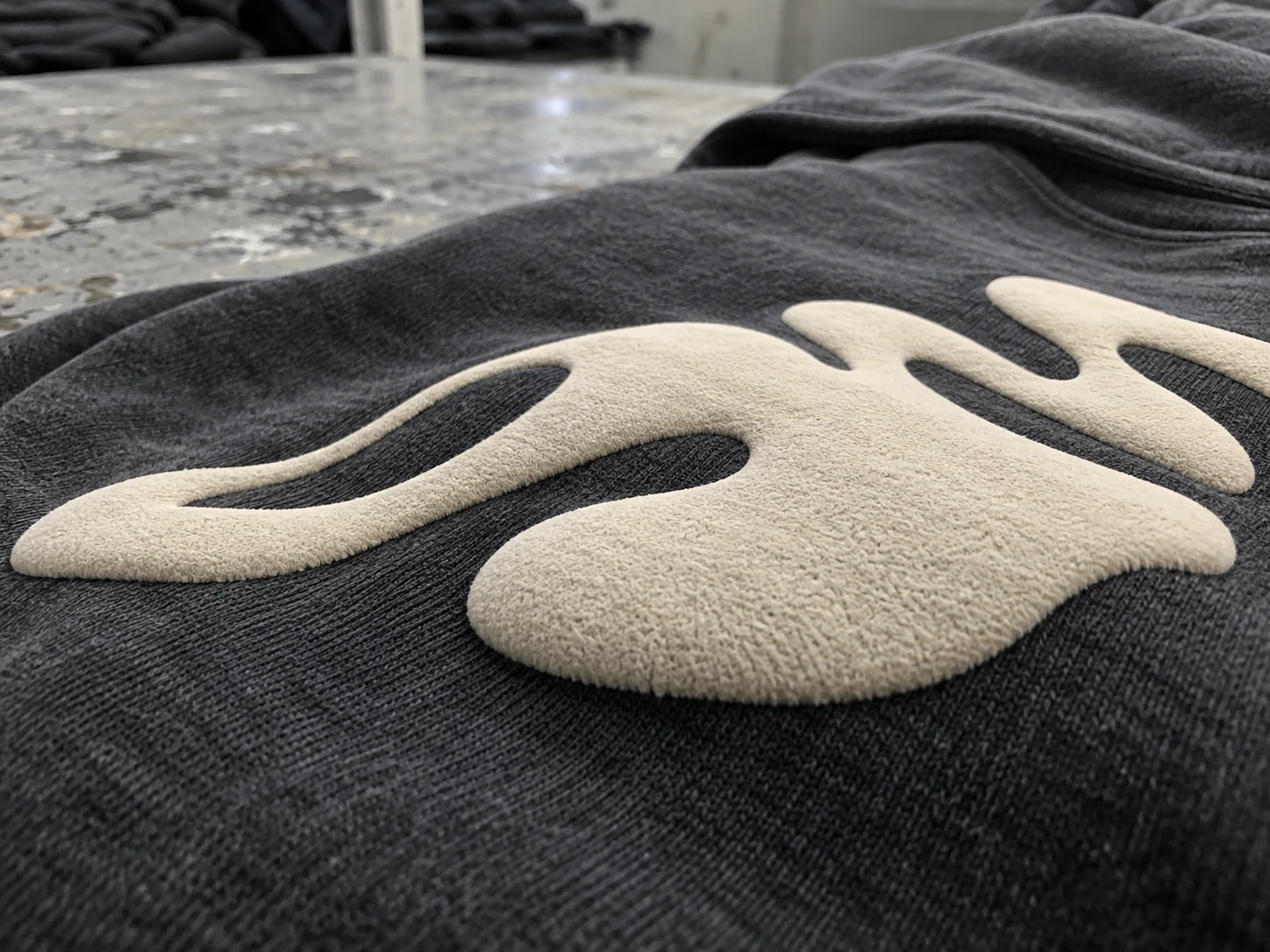
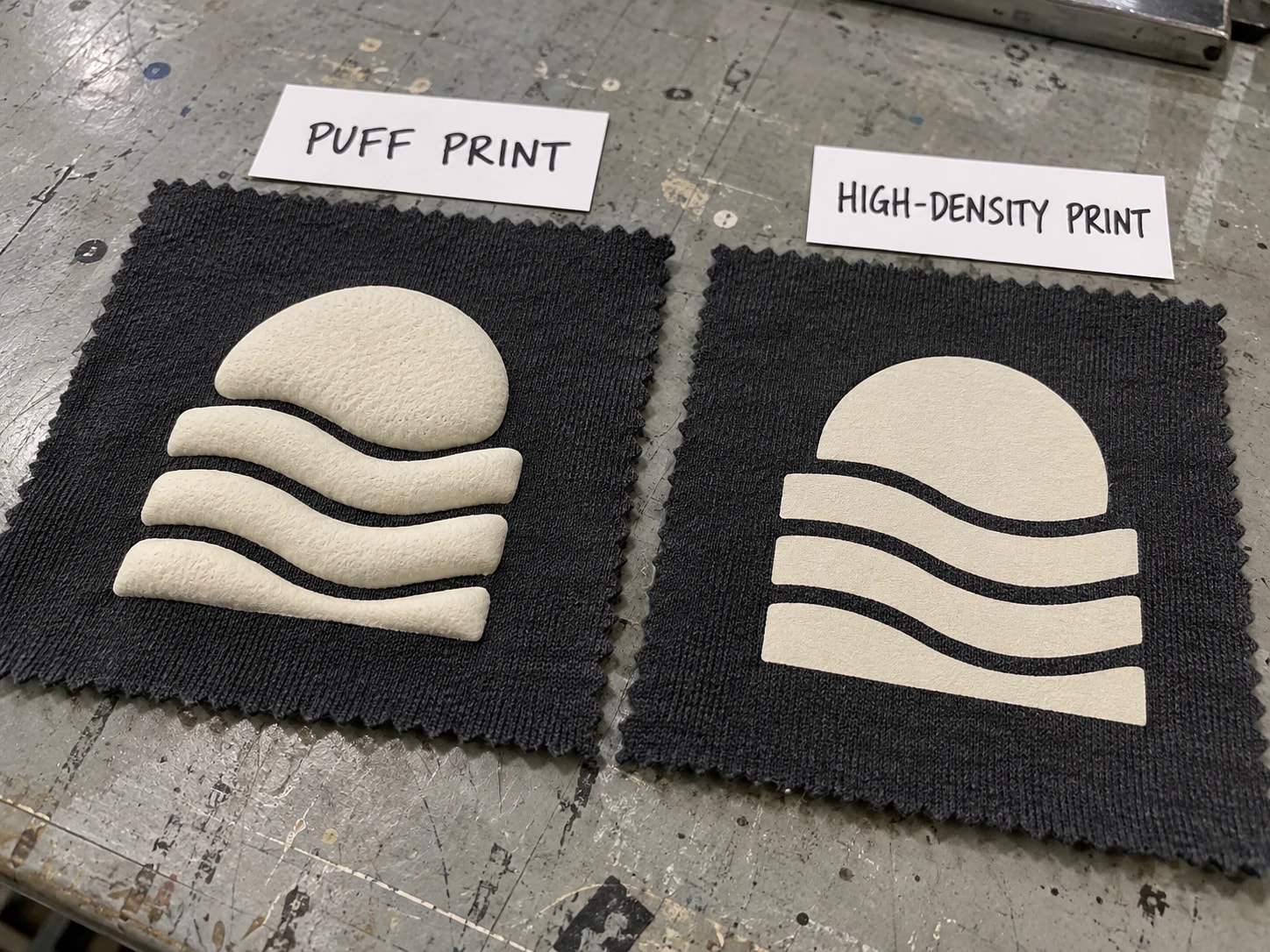
Puff printing uses an ink system containing an expanding component. Heating develops the raised effect, giving the graphic a rounded profile and a textured, foam-like surface. High-density printing builds up ink through a suitable stencil or repeated printing to form a more defined raised shape, usually with a flatter top and sharper edges.
Clients sometimes describe both as “3D printing.” That phrase does not tell a print factory whether the target is a soft-looking expansion or a more structured ink build-up. State the intended technique and provide an actual reference wherever possible.
| Decision | Puff print | High-density print |
|---|---|---|
| Raised structure | Developed by expansion during heating | Developed by controlled ink build-up |
| Surface and edge | Usually rounded, textured and less sharply defined | Usually flatter, more defined and firmer |
| Artwork concern | Expansion can close gaps or soften small details | Fine detail still depends on stencil, ink and fabric |
| Approval reference | Finished rise, color, texture and hand on actual fabric | Finished profile, edge definition and hand on actual fabric |
Which Hoodie Artwork Works Best for Puff Printing?
Start with bold lettering, clear logos and simple color blocks. Give the raised areas enough space to remain distinct after expansion. Photographs, complex gradients and highly detailed multicolor illustrations are generally poor starting points for an all-puff treatment.
Small lettering, hairline strokes, narrow negative spaces and tightly packed shapes can lose definition. Elements that look separate in a file may merge in the finished print. There is no single minimum line width that KAOUYOU promises across every fabric and ink setup; the actual-size process sample determines whether the design remains readable.
When the artwork is unsuitable, the team discusses changing the graphic or the method with the client. Possible directions include enlarging the logo, opening gaps, simplifying small elements, keeping detailed areas flat or choosing another decoration technique. Do not silently redraw a brand logo just to make it printable.
Can puff be combined with other decoration?
Yes. A flat screen-printed base can carry selected puff text, or a graphic can combine flat ink, high-density areas and local embroidery. The processing order depends on the design; base printing generally comes before the raised effect. Embroidery should normally avoid thick printed areas, and excessive overlap needs careful review.
A combined process sample must confirm alignment, color, surface and attachment. Separate approved swatches do not demonstrate that overlapping effects will work together. The screen printing and embroidery guide covers the broader comfort and cost trade-offs.
What Fabric and Color Conditions Need Checking?
Smooth, stable cotton or cotton-blend fabrics are generally easier to assess for puff printing. French terry and brushed-fleece hoodies are normally printed on their outer face, but thickness, surface fibers and response to heat still matter. Compare the intended materials using the French terry vs fleece hoodie guide.
Do not approve a fabric by GSM alone. A heavy fabric may still have a loose structure, considerable stretch or a fuzzy face. A thinner body can distort under a broad raised graphic; coarse texture can interrupt edges; stretch can put stress on an ink layer during wear. The partner factory needs to assess the actual fabric and proposed ink together.
- Cotton absorption can affect coverage and final color, making base-ink control important.
- Polyester-containing fabrics need attention to possible dye migration under heat.
- Dark ground colors often need an underbase, adding passes and thickness.
- Light fabric may allow fewer base layers, but this depends on the target color and coverage.
Why can the finished puff color differ from the mockup?
Expansion and surface texture can change the apparent shade, and the finished color may look lighter than expected. Fabric color, underbase thickness and the developed expansion all influence the result. An unheated ink reference or a screen image is not the final color standard.
When color matching is important, provide a Pantone reference or an agreed physical standard and approve the finished strike-off. Keep that approval tied to the fabric and process used; switching the ground color or wash finish may require another check.
How Much Height and Coverage Should a Brand Request?
More rise is not automatically better. A broad raised print changes local thickness, flexibility and breathability. Large or heavily built areas can feel stiff and affect how the front panel hangs, especially on a light, soft hoodie.
A heavyweight relaxed hoodie may accommodate a substantial graphic more easily, but the completed sample must still be assessed for drape and comfort. Consider reducing the raised area, leaving open spaces or using puff only on selected elements instead of covering the entire artwork.
KAOUYOU does not make a default fixed-height promise from a reference photograph. Unless the client specifies a measurable requirement and the parties agree how to check it, the approved physical sample is the effect reference. If height is commercially important, agree the target, acceptable variation and checking method before sampling.
Explore the hoodies and sweatshirts collection for garment directions. A washed crewneck sweatshirt is another body style to consider for a washed-and-decorated project; its product page is a garment reference, not confirmation that its existing decoration is puff print.
Does Puff Printing Happen on Cut Panels or Finished Hoodies?
KAOUYOU normally arranges printing at the cut-panel stage when the garment does not require subsequent garment dyeing or washing. Flat panels support positioning and access. Garment washing creates a different route: the body must first be sewn so that the wash can develop the complete garment effect.
For garment dyeing, enzyme washing, vintage washing or mineral washing, KAOUYOU normally checks the finished wash color, dimensions and appearance before adding the puff effect. This reduces exposure of the raised layer to wash chemicals, mechanical action and drying that could change its color, height or attachment.
Printing after garment washing requires the specialist partner to evaluate access and positioning on the complete hoodie. Pockets, zippers, seams and thick areas can affect printing support. The factory must plan this route from the outset rather than assuming that a panel-print setup can simply be used unchanged.
If the client wants the graphic itself to fade, crack or age with the garment, print-before-wash can be explored. It is a higher-risk route and requires a complete process sample and wash checks before bulk. Intentional distressing must be distinguished from unacceptable cracking or detachment.
The print stage, wash stage and approval condition should be written into the production brief. “Washed fabric” and “garment washed” are not interchangeable instructions.
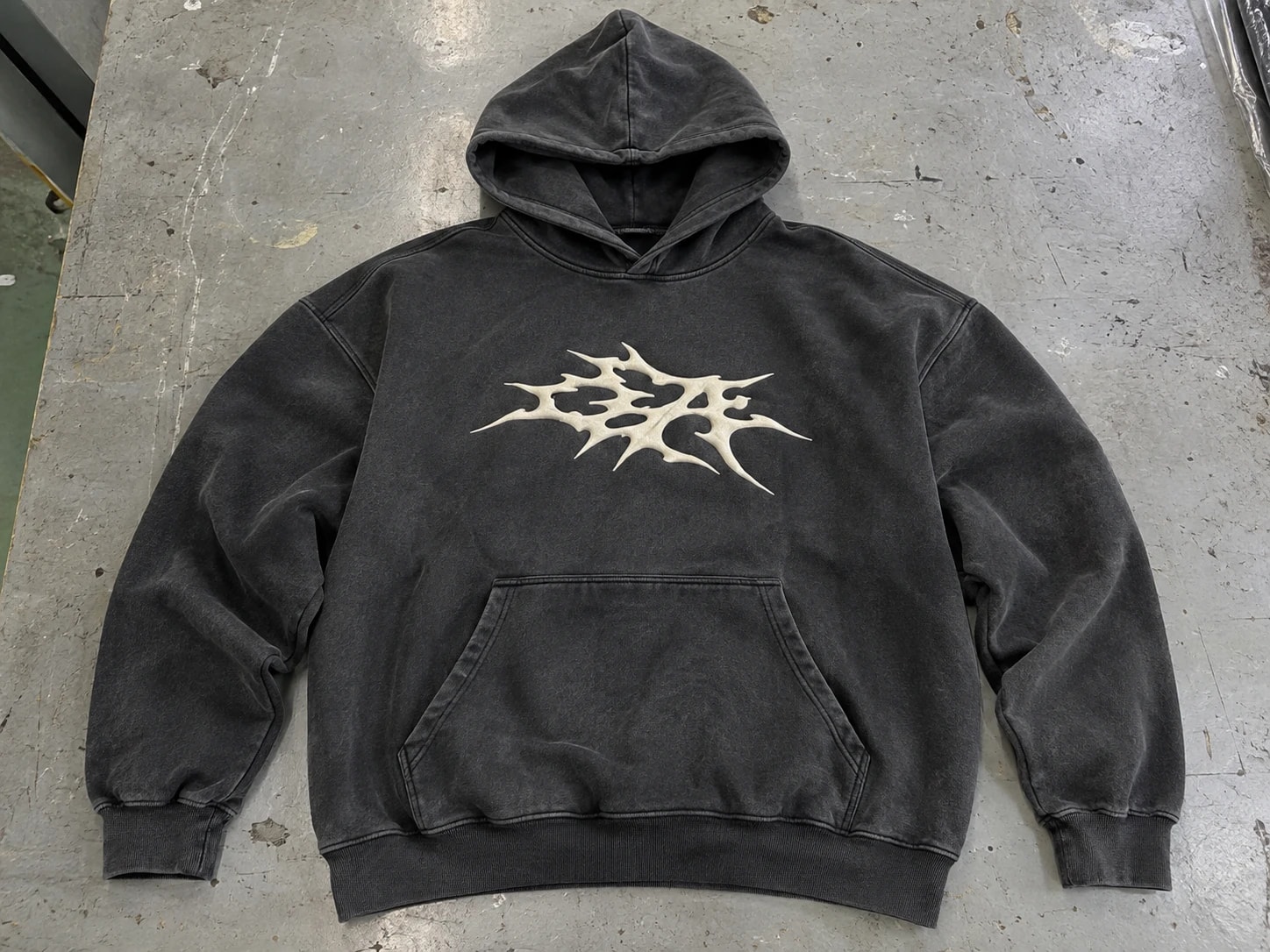
A black acid-wash pullover hoodie provides a reference for the washed garment direction. Adding puff printing is a separate development decision: the existing product reference does not replace approval of the proposed print and complete production sequence.
What Affects Puff-Print Cost and MOQ?
Puff usually adds development and processing work compared with an ordinary flat screen print. The quote depends on finished dimensions, coverage, colors, raised areas, requested effect, underbase, screens, printing passes, placement and order quantity. Special color development, combination decoration and wash validation can add further work.
There is no universal price based only on logo width, nor a fixed quantity at which a complex raised print becomes inexpensive. Request a quote for the actual artwork and hoodie specification. If the cost is too high, review whether selective puff, fewer colors or reduced coverage can retain the design intention.
KAOUYOU’s usual garment MOQ is 100 pieces per style, per color, with mixed sizes within that color. This is not a blanket MOQ for every special ink or printing setup. Partner-factory requirements must be checked for the particular effect and production conditions.
The custom hoodie manufacturing cost guide places printing alongside fabric, sewing, washes, trims and packaging so the brand can assess the complete product price.
What Should Brands Provide for Artwork Review?
Send the garment brief and print artwork together. KAOUYOU first reviews the requested effect with the client, then coordinates the technical approach with the specialist print partner. Identify undecided fields so they can be resolved before sampling.
- Editable original artwork, such as AI or PDF, plus a clear reference for the desired raised surface.
- Finished print width and height; mark exactly which areas should be flat, puff or another effect.
- Color references, hoodie ground colors and any specified underbase or color-matching requirement.
- Position measurements from defined garment points; note pocket, zipper and seam restrictions.
- Whether one graphic size serves all garment sizes or different size groups need review.
- Fabric composition, GSM, surface, stretch and the intended hoodie fit or a physical fabric reference.
- Fabric pretreatment, garment dye or wash direction, final care instructions and any required tests.
- Quantity by style and color, size breakdown, budget direction, labels and packaging requirements.
For file preparation and positioning details, see the garment printing artwork guide. For the complete garment specification, use the heavyweight hoodie tech-pack checklist.
What Must the Client Approve Before Bulk?
KAOUYOU normally starts with a print strike-off and confirms the complete sample before bulk. The strike-off establishes the raised surface on fabric; the garment sample establishes its scale, position and effect on the hoodie. Neither stage should be reduced to approving a computer image.
Record approval of artwork, finished dimensions, placement, colors, expansion, edge definition, hand and the intended final wash condition. If a measurable height, wash result or other performance requirement applies, record it separately with the agreed checking conditions. Keep the latest approved file and physical reference aligned.
Changes to fabric, ink effect, coverage, color or washing can make an earlier approval insufficient. Confirm the changed result before using it as the production reference. Do not treat a clean strike-off on substitute fabric as proof that the same effect will work on the washed bulk hoodie.
What Testing and Bulk QC Should Be Agreed?
KAOUYOU checks the delivered print against the approved effect, including color, dimensions, placement, height consistency, edges, missing areas and unwanted joining of details. Unapproved cracking, lifting, fabric marks and changes after required washing also need attention.
The partner factory controls the technical ink and heating setup for the intended fabric. This guide does not specify one curing temperature, wash-cycle count or test method for all puff prints. The buyer should provide any required care conditions, test method and acceptance criteria before development; the applicable procedure must be confirmed for the project.
Useful questions for a test brief
- What laundering and drying conditions will the care label allow?
- Is a specified test method or formal laboratory report required?
- What change in color, raised profile or cracking is acceptable after the agreed treatment?
- Does the fabric stretch during intended wear, and should the sample be assessed under that condition?
These are planning questions, not a claim that KAOUYOU uses a fixed laboratory protocol for every order. Photographs can support visual review but cannot replace the agreed physical or laboratory checks.
When repeated defects appear, the affected pieces should be separated and the cause reviewed with the print partner before processing continues. Reheating or covering a failed print is not a universally safe repair: it can alter expansion or damage the fabric. Any proposed correction needs verification against the approved result.
See the clothing quality-control checklist for the wider production checkpoints surrounding print inspection.
Frequently Asked Questions
Is puff print the same as high-density print?
No. Puff ink expands during heating, producing a rounded raised surface. High-density printing builds up ink to produce a more defined, usually flatter raised effect. Compare physical samples for height, firmness and edge definition.
Can every hoodie logo be puff printed?
No. Tiny lettering, thin lines, narrow gaps and dense detail can lose definition as the ink expands. Simplify the artwork, enlarge selected elements, use puff only in bold areas or choose another technique after sample review.
What GSM is best for a puff-print hoodie?
There is no universal GSM threshold. Assess surface smoothness, fabric stability, stretch, heat response and artwork area together. A heavyweight but fuzzy or stretchy fabric can still be difficult to print consistently.
Should puff printing come before or after garment washing?
KAOUYOU normally completes garment dyeing or washing before puff printing to help protect the raised layer. Fabric-level pretreatment is different: the fabric can be treated first, then cut, printed and sewn. Print-before-garment-wash requires a full process sample when an aged graphic is intended.
Does KAOUYOU guarantee a fixed puff-print height?
Not by default. Unless a measurable height requirement is specified and agreed, the approved physical sample is the effect reference. A mockup or reference photograph alone is not a height specification.
What is the MOQ for a custom puff-print hoodie?
KAOUYOU’s usual garment MOQ is 100 pieces per style, per color, with mixed sizes within that color. A special print may have separate partner-factory production requirements, which must be reviewed for the actual design.